Assam family recently discovered that their act of kindness towards an orphaned civet cat had become part of an NCERT textbook used by students across India. According to a TOI report, Dharani Saikia and his wife Anjali were surprised to learn that the story of Bhakat, a civet cub they rescued and raised in 2009, had been included in an NCERT Class X English workbook.
The unexpected discovery came through their younger son, Gibbon Saikia, who returned home after completing his board examinations at Jawahar Navodaya Vidyalaya in Dhing, Assam.
How an orphaned civet cub entered the Saikia family's life
The story began nearly 17 years ago in Tetelisara village in Assam's Nagaon district.
Bhakat, a palm civet cub believed to be around 15 days old, had fallen from a coconut tree and was found by villagers. Too young to survive on his own, the helpless animal was brought to Dharani Saikia, who was known locally for caring for animals.
A wildlife rescue centre reportedly advised the family that the cub's best chance of survival would be receiving mother's milk. That advice led to an extraordinary act of compassion.
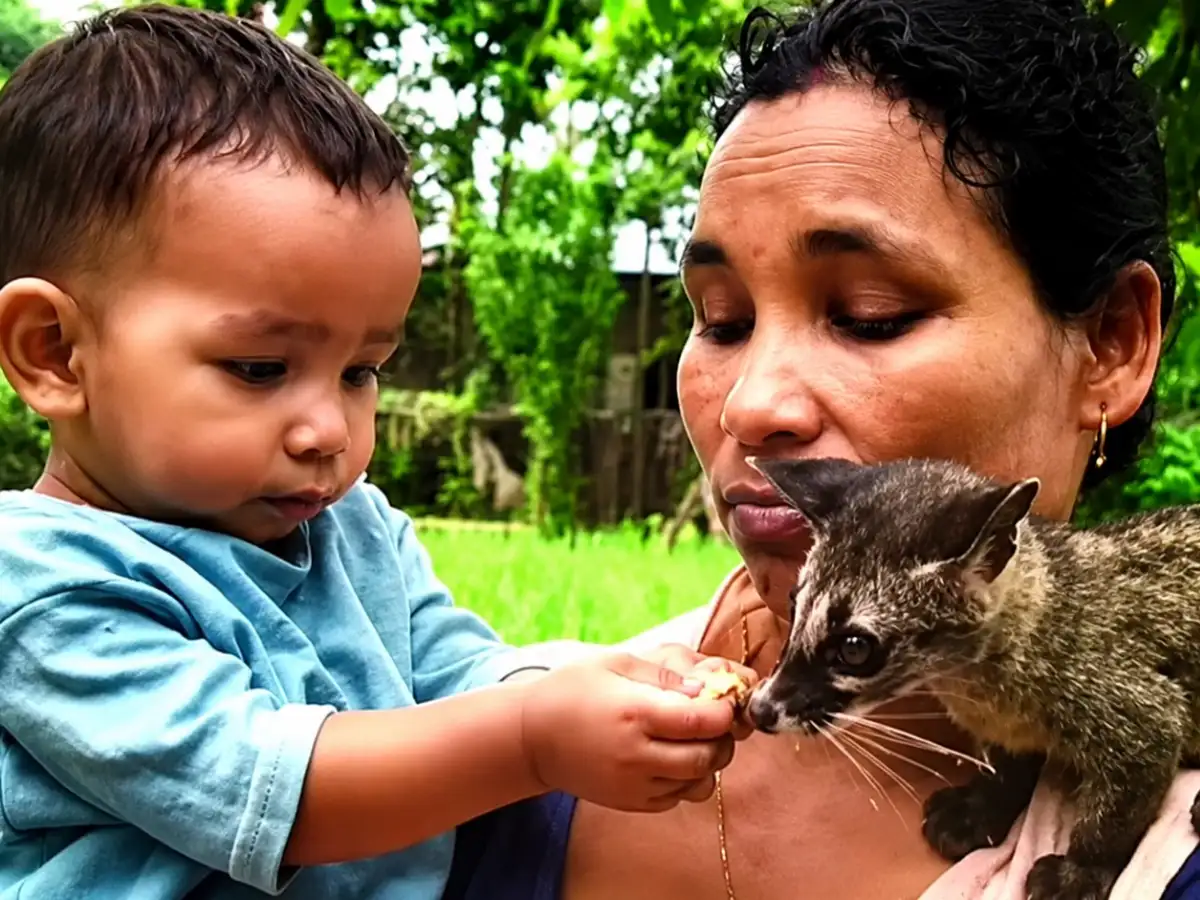
Anjali Saikia breastfed the civet cub alongside her infant son
Speaking to TOI, Anjali recalled how Bhakat became part of the family. "When my husband and elder son brought Bhakat home, my husband handed him to me saying that he perhaps wanted milk," she said. At the time, the couple's younger son Gibbon was only six months old.
Anjali decided to nurse both her baby and the orphaned civet cub. "I started to breastfeed Bhakat due to compassion and this continued for around 3 months," she told TOI.
The unusual arrangement helped the tiny cub survive and grow.
Bhakat became a member of the family
As the months passed, Bhakat adapted to life with the Saikias. Rather than being kept in a cage, he was allowed to roam freely around the house and village. According to Anjali, the civet quickly became part of the household routine.
"We never confined him," she said. "He used to eat biscuits and foods like humans."
The cub reportedly slept alongside the family's two sons and followed family members wherever they went.
What started as a rescue soon turned into a unique bond between humans and wildlife.
Documentary filmmaker helped preserve Bhakat's story
The remarkable tale might never have reached a wider audience if not for documentary filmmaker Rommel Shunmugam.
TOI reported that Shunmugam spent around 10 days in Tetelisara documenting Bhakat's life and the family's unusual relationship with the civet.
After filming was completed, contact between the filmmaker and the family gradually faded. The Saikias carried on with their lives, unaware that Bhakat's story would eventually find a much larger audience.
Family discovers Bhakat in NCERT Class X English workbook
Years later, the story resurfaced in the most unexpected way. After completing his Class X board examinations, Gibbon returned home carrying his NCERT English workbook, Words and Expressions 2. While reading Unit 6, he noticed a familiar photograph.
The image showed his father holding a civet cat. The chapter narrated Bhakat's journey from the animal's perspective and described how villagers rescued the fallen cub before bringing him to Dharani Saikia, whose name was reportedly spelled as "Dharini" in the textbook.
One line in the chapter reads: "If not for him, I would not be alive today!" The discovery left the family both surprised and emotional.
'It's bigger than any award,' says Dharani Saikia
Dharani told TOI that seeing Bhakat's story included in a national textbook was an honour beyond anything he had imagined.
"There cannot be anything more satisfactory. It's bigger than any award," he said.
"We never thought that our little Bhakat would get such a recognition."
For a family that had simply acted out of compassion, the recognition came as a deeply meaningful reward.
What happened to Bhakat?
Bhakat's story, however, remains partly shrouded in mystery. According to the TOI report, the civet disappeared around eight months after filming for the documentary was completed. Family members feared he might have been harmed by people upset over poultry losses in the area.
Around the same period, the Saikias relocated from flood-prone Tetelisara village to Kampur town. But the story did not end there.
Dharani's elder brother later reported seeing Bhakat return to the village accompanied by a mate.
Civets are still occasionally spotted around the family's ancestral home, although no one knows for certain whether Bhakat survived long-term or whether his descendants remain in the area.
A legacy that lives on in classrooms
While Bhakat's ultimate fate may never be known, his legacy has endured in an unexpected way.
The rescued civet's journey from a fallen cub in a remote Assam village to the pages of an NCERT textbook has introduced thousands of students to a story of kindness, compassion and coexistence with wildlife.
For the Saikia family, the discovery served as a reminder that even the smallest acts of care can leave a lasting impact, sometimes in places one would never expect.
Inputs from TOI