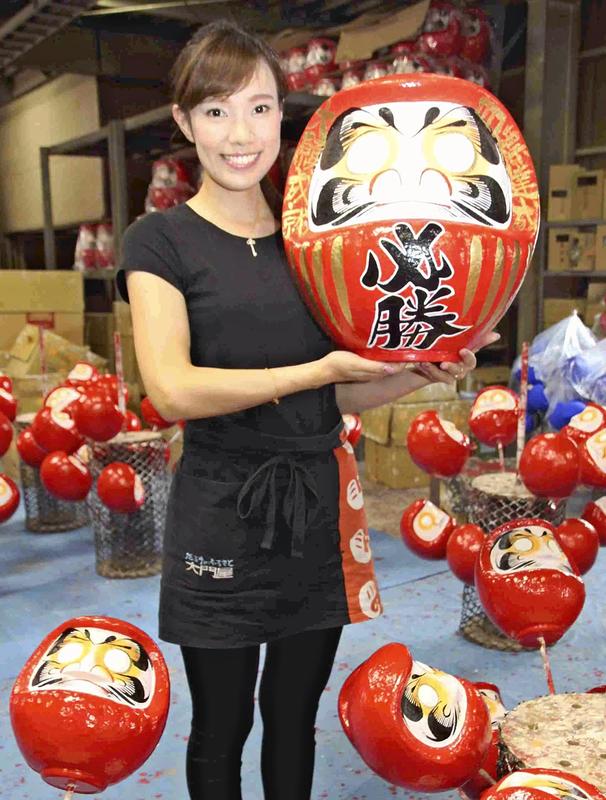
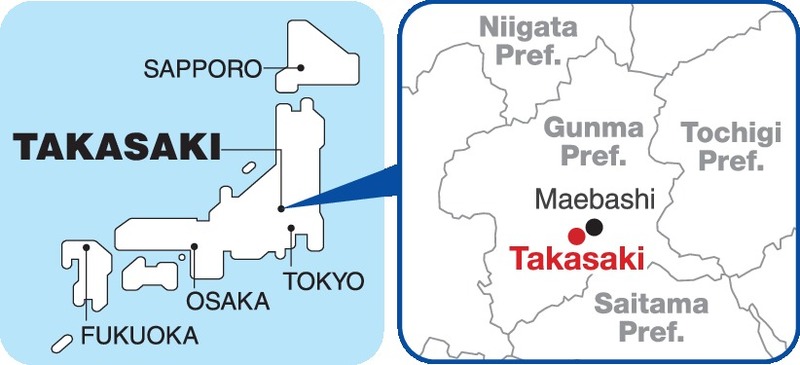
TAKASAKI, Gunma -- Chihiro Nakata, 28, works for Daimonya Bussan, a Takasaki, Gunma Prefecture-based company that produces about 70,000 daruma dolls annually. The company's products are traditional ones called Takasaki daruma.
Under the instruction of her 66-year-old father, Sumikazu, the fourth president of the company, she diligently writes onto the daruma the names of companies that ordered them. Her workplace is a factory where a large number of excellent products in various sizes and colors can be found.
She joined the company six years ago. Though she is seen as a successor to her father, Nakata said she feels it is too early to call herself a "craftswoman."
However, she has another face in the business. She also plays a role by promoting Takasaki daruma overseas.
On July 18, she returned from a two-week business trip to London and Paris, where she promoted Takasaki daruma to business partners with whom she built ties on her own.
"Basic Takasaki daruma, which attach importance to tradition, are 'lucky charms.' That's what I tell them [in those countries]. I've got a good response," Nakata said.
When she was a university student, Nakata helped her father's company sell daruma during the busiest period around the year-end and New Year holidays. While doing the work, she noticed an increasing number of foreign tourists. A sizable number of them were from Taiwan.
In her graduation thesis, she wrote about the evolution of Takasaki daruma and proposed selling the traditional dolls in other countries.
"I thought it would be good if a sales base for my father's company were established overseas and I would work there," Nakata said.
With such a dream, she joined Daimonya Bussan upon her graduation.
But the work was never easy for Nakata. The president's successor must be a craftsman or craftswoman.
Each time Nakata failed in the work, her father, who is also her master, harshly shouted at her, "Give up this job."
Extremely high-level skills are necessary for a process called naire, in which craftspeople write in kanji such phrases as "hissho" (prayer for victory) and "shobai hanjo" (prosperous business) on the front surfaces of daruma.
Several years after joining the company, Nakata was ordered by her father to add white edging around each kanji letter drawn in the naire.
Using an old Japanese brush that her father had used before, Nakata repeated the edging work for three years. She came to have afterimages of kanji letters drawn by her father appearing in her brain, even when she was off duty.
Her father, as her craftsman master, told her, "I can see each square on the front surface of bodies of daruma." Nakata said that she felt she finally understood what her father had meant.
Later, Nakata was ordered by her father to do the main work of the naire process, and thus the range of her work duties widened. She felt that gears were beginning to move in her mind.
Learning English, Chinese for business
Orders for daruma from overseas come in by email. Thus Nakata learned English in a practical manner. She memorized English words used in business situations. When people from Western countries visited the sales space of daruma, she tried to speak with them casually.
She deeply read lyrics of U.S. popular songs. Now she can explain in English the process of making the main body of a daruma, which includes drying paper naturally, and the meanings of the eyebrows and beards.
For the past two years, Nakata has also been learning Chinese. High school students on their school excursions and tourists in groups from Taiwan and other places are given opportunities to experience painting pictures on daruma dolls at the company's factory.
Nakata came to want to explain the cultural meaning of Takasaki daruma to them in her own words and without relying on their tour conductors.
When she told such visitors that traditional skills are utilized in each daruma, those who experienced the painting became more interested in daruma and bought the products, she said.
Finding clients on social media
Now she has more opportunities for sales promotion activities overseas.
Nakata visits a temple in Hualien, Taiwan, every two or three months because the temple sells Daimonya Bussan daruma. When she visits, she demonstrates her naire work and sells the daruma there.
Nakata has also found clients via people with whom she got acquainted through social media, and exports daruma to the United States and France.
She has also begun sales promotion aimed at travel agencies. She shows tourism route maps that indicate the times from Tokyo to her company and nearby tourist spots, so that visitors to Tokyo will also visit Takasaki.
Recently, Nakata made one more step forward as a craftswoman. She was given the duty of drawing eyebrows and beards of 9-centimeter-tall daruma.
The eyebrows are modeled after cranes and the beards after turtles. This is now widely known among foreign tourists and foreign businesspersons who visit Daimonya Bussan. However, maybe even Japanese do not know the meanings.
Nakata said with a smile, "Promoting daruma to foreign people is also making Japanese people recognize again what daruma are."
* * *
Nakata was born on Nov. 5, 1989. She is a native of Takasaki and lives in the city. She is the third daughter of Sumikazu Nakata, who is president of Daimonya Bussan and a daruma doll craftsman recognized as a traditional crafts master of the prefecture. Her two elder sisters do not engage in the family business. After graduating from Takasaki University of Commerce High School, she enrolled in the Faculty of International Studies of Kyoritsu Women's University. Upon graduating, she joined the company in 2012. In addition to making daruma, she sends out information about Takasaki daruma in English and Chinese. For the promotion and sales activities, she often visits Taiwan, other Asian countries and European countries.
Read more from The Japan News at https://japannews.yomiuri.co.jp/