If, following a dodgy patch after the death of Princess Diana, the latter part of her reign has been a PR triumph for the Queen, much of the credit must surely to go the woman who now appears to impersonate – or as one critic has it, “regally inhabit” – her on pretty much a full-time basis: Helen Mirren.
True, the actual Queen has, quite independently, also earned ever-deepening esteem simply for being the only thing that stands between us and King Charles III. Also, courtesy of Danny Boyle’s inspired direction, her appearance at the Olympic opening ceremony usefully reinvented Elizabeth II as a relaxed, fun-loving monarch who could teach Boris Johnson a thing or two about how to dangle from a wire. Indeed, how different things might have been had the Queen, during her annus horribilis in 1992, staged some airborne stunt with James Bond, as opposed to asking for more money to fix a burned-out castle.
But much of the transformation of the Queen’s image, from the chilly, notoriously philistinic matriarch who couldn’t care less about Diana to an ever more droll and sympathetic mentor to pitifully grateful prime ministers is surely attributable to Mirren’s superb acting, and to the writers who have increasingly depicted the monarch as – so long as you are not Margaret Thatcher – fabulous company.
In New York, where Mirren’s performance was recently declared a triumph, the New York Times critic, Ben Brantley, said: “Queen Elizabeth, you see, is one of us, or as much as she can be given her extraordinary upbringing and imprisoning public role. The compulsively watchable Ms Mirren brings out the humour and the pathos in this contradiction.” Weird, really, that we rarely see the same humour, pathos, etc in her similarly reared oldest son. But maybe Tim Pigott-Smith’s affectionate portrayal of the heir, in Mike Bartlett’s brilliant King Charles III, will finally set the Prince of Wales, too, on the road to dramatic redemption.
To have seen, way back, Alan Bennett’s A Question of Attribution (featuring a peerless Prunella Scales), followed by the Peter Morgan 2006 film, The Queen, in which, if memory serves, Mirren’s Queen is schooled in emotional intelligence by Alastair Campbell and Tony Blair, and more recently Moira Buffini’s Handbagged, followed by Peter Morgan follow-up, The Audience, is to have watched the Queen emerge as ever more appealing. Her stage version is sharp witted, broad minded, steeped in art history, a woman with a soft spot for gay men, even for lefties, who would never be mean enough to – allegedly – rebuke the police for eating her Bombay mix, or – really – pay below the living wage at Windsor Castle.
But maybe those Windsor employees currently embarked on industrial action have yet to recognise, not having seen Mirren in The Audience, that, under her crown jewels, the Queen is basically one of us. And vice versa: which of us can be sure, after all, that if we were empowered to create, say, admiralties we would not give them to our middle-aged children for their birthdays?
If the Queen’s observed behaviour does not always conform with the more disarming stage and film depictions, the latter are now so widely regarded as authentic, the reporting of the Windsor strike suggests, that this hardly matters. In fact, just as Mirren, the actress, has acquired the regal confidence to leave the theatre and command silence in the streets (when vexed by drummers), it has become easy to imagine her double deploring, if not a hereditary monarchy, then the lamentably few roles – outside her palaces – available to older working women.
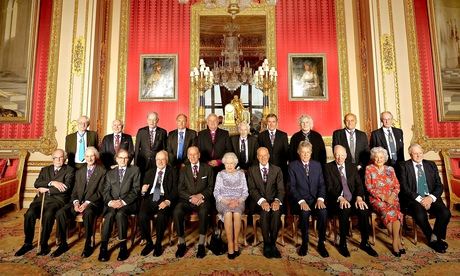
In fact, the Mirrenised, which is to say the ever more idealised monarch of public wishfulness, may partly account for the consternation, last week, when the publication of a group photograph of the holders of her Order of Merit suggested that the Queen is not, after all, much of a feminist. Betty Boothroyd, former Speaker of the Commons, is the solitary woman out of 23 (the death of Sir Anthony Caro in 2013 left an unfilled vacancy) holders of the order, one said to be unique for being the direct gift of the monarch. Extolled by leading grovellers as one of the finest honours available to humankind, or half of it, the OM was founded in 1902, it says on the royal website, by the gross libertine, Edward VII, who set the number of beneficiaries, for reasons too royal to bother with, to 24 at any time.
His prodigious love of women did not, it emerged, extend to his wanting any of them to win this “special honour awarded to individuals of great achievement in the fields of the arts, learning, literature and science”. It reportedly took the efforts of two prime ministers to persuade him finally to honour Florence Nightingale, in 1907, after which no further women were tolerated until Dorothy Hodgkin, in 1965, 13 years after the Queen was crowned. Roughly speaking, the rule would appear to be no more than eight women for every 190 men.
Why? If the imbalance does not result from primitive loyalty, on the Queen’s part, to the wishes of her repulsive ancestor (since we must surely rule out her violent antipathy towards all appropriately qualified women of the last 63 years), it is not impossible, in the household that saw off Diana, to imagine ungovernable misogyny among her courtiers. Maybe none of these functionaries thought it worth pressing to a potentially receptive, but preoccupied monarch, the cases of, among many others: Freya Stark, Rosalind Franklin, Agatha Christie, Barbara Hepworth, Lucie Rie, Rebecca West, Elizabeth David, Nancy Mitford, Barbara Pym, Elizabeth Bowen, Ivy Compton-Burnett, Rosamond Lehmann, Frances Partridge, Elizabeth Taylor, Muriel Spark, Penelope Fitzgerald, Elizabeth Jane Howard, Anita Brookner, Doris Lessing, Ruth Rendell, Elizabeth Anscombe, Miriam Rothschild, Iris Murdoch and Beryl Bainbridge.
To turn to the living, and recently ignored in favour of men, the Queen and her secretary have (supposing the honour was not refused) turned their noses up at, listing a few of the most obvious names, Mary Warnock, AS Byatt, Lisa Jardine, Onora O’Neill, Mary Beard, Claire Tomalin, Hilary Mantel, Diana Athill and JK Rowling.
If the Queen is a fraction as fair and as responsive to her people as we gather from her theatrical portrayals, she will probably wish to correct any impression that she struggles as much with the concept of female intellectual achievement as her great grandfather, when he was privately honouring Camilla’s great great grandmother. Assuming the Queen is, really, one of us, she will want to do more than replace Caro with the – I hope I do not exaggerate – 9th woman OM, ever, and make more generous reparation to the scorned.
If the Queen does not double the number of OM holders, or command that all replacements be women for the next five decades, or failing that, make all living female contenders into admirals, then either there is no point in being Queen or the plays show us only what we would like her to be.