I do not understand the debate over the feasibility of the Land Bridge project (LB). Opponents cite one study concluding the project is not feasible and therefore not worthwhile.
Supporters cite another study reaching the opposite conclusion. Faced with these conflicting findings, the government has appointed Deputy Prime Minister and Finance Minister Ekniti Nitithanprapas to make a decisive recommendation.
Is there not a better way than burdening a busy minister -- who is not a specialist in the field -- with judging a 1-trillion-baht project? Why not ask the potential users directly, namely the shipping companies currently sailing through the Malacca Strait?
The two conflicting studies were both commissioned by government agencies under different administrations. The first, commissioned by the National Economic and Social Development Council (NESDC), concluded the LB project was not feasible and would incur financial losses of 121 billion baht. The second, commissioned by the Ministry of Transport (MoT), reached the opposite conclusion, projecting profits of 257 billion baht.
What explains such sharply different outcomes? The key lies in differing pricing assumptions. One study based its pricing on the transit tolls charged by the Panama and Suez canals, while the other appears to have based its pricing on project costs.
Current tolls are around US$55–65 (1,791-2,117 baht) per Twenty-foot Equivalent Unit (TEU) for the Panama Canal and US$70–80 per TEU for the Suez Canal. The MoT study disregarded prevailing market prices and instead assumed a charge of US$126 per TEU. With a much higher transit fee, it is unsurprising the study produced a profitable outcome. But who would be willing to pay such a price?
That is why I would like to suggest the use of "market sounding" to test users' willingness to pay.
Market sounding is a widely used procedure. For readers unfamiliar with the term, one definition describes it as "a strategic process used to gauge interest, feasibility and feedback from potential investors, partners or market participants before formally launching a project or financial transaction".
Simply put, the government appoints a third party to interview potential users about their interest in using the LB. Questions could include: What factors would determine whether they use the LB? What concerns would they have compared with existing sea routes? What is the maximum charge they would be willing to pay? What proportion of their business would pass through the LB?
The information gathered through market sounding can then be incorporated into a financial model to determine whether the project's returns would be sufficiently attractive to investors. If the financial outlook proves attractive, the government could invite investors to bid for the project.
If the LB is found to be financially unattractive, the government would have two options. The first would be to abandon the project altogether. The second would be to subsidise the project so investors could still achieve satisfactory returns.
Such support could be justified if the economic internal rate of return is substantially higher than the financial internal rate of return, reflecting broader economic benefits such as making Thailand a global logistics hub, creating jobs, reducing domestic logistics costs and generating income from industrial estates developed around the LB.
Why do I know about these techniques? Because I spent several years working as a consultant on government infrastructure projects. After retiring from the financial sector due to illness, I became a professional consultant specialising in the economic and financial aspects of project studies.
One of the projects I worked on involved the LB. However, I was neither part of the NESDC consultant team nor the MoT consultant team mentioned above.
My study was commissioned by then-prime minister Gen Prayut Chan-o-cha. It was presented under the broader Economic Development Plan for Southern Thailand rather than as a standalone LB feasibility study. Consequently, it also examined other development proposals, including the Energy Bridge, a petrochemical complex, Rubber City and high-value tourism projects.
The study concluded that the LB was not financially feasible, estimating losses of more than 100 billion baht. Based on this recommendation, Mr Prayut dropped the proposal from consideration.
My study also used Panama and Suez canals transit tolls as the basis for calculations. There was no logical reason to assume container ships would pay significantly higher tolls merely for a shortcut bypassing the Malacca Strait. Naturally, the possibility of a blockade of the Malacca Strait was not factored into the analysis.
As for the argument that the Malacca Strait is overcrowded and that shipping companies are desperate for alternatives, the study found that alternatives already exist -- namely, the Lombok Strait and the Sunda Strait.
In addition, the Northern Sea Route, or Arctic Route, is also being developed. With global warming and advances in satellite navigation technology, some container ships are already sailing through the Arctic Ocean to Europe in roughly half the usual travelling time.
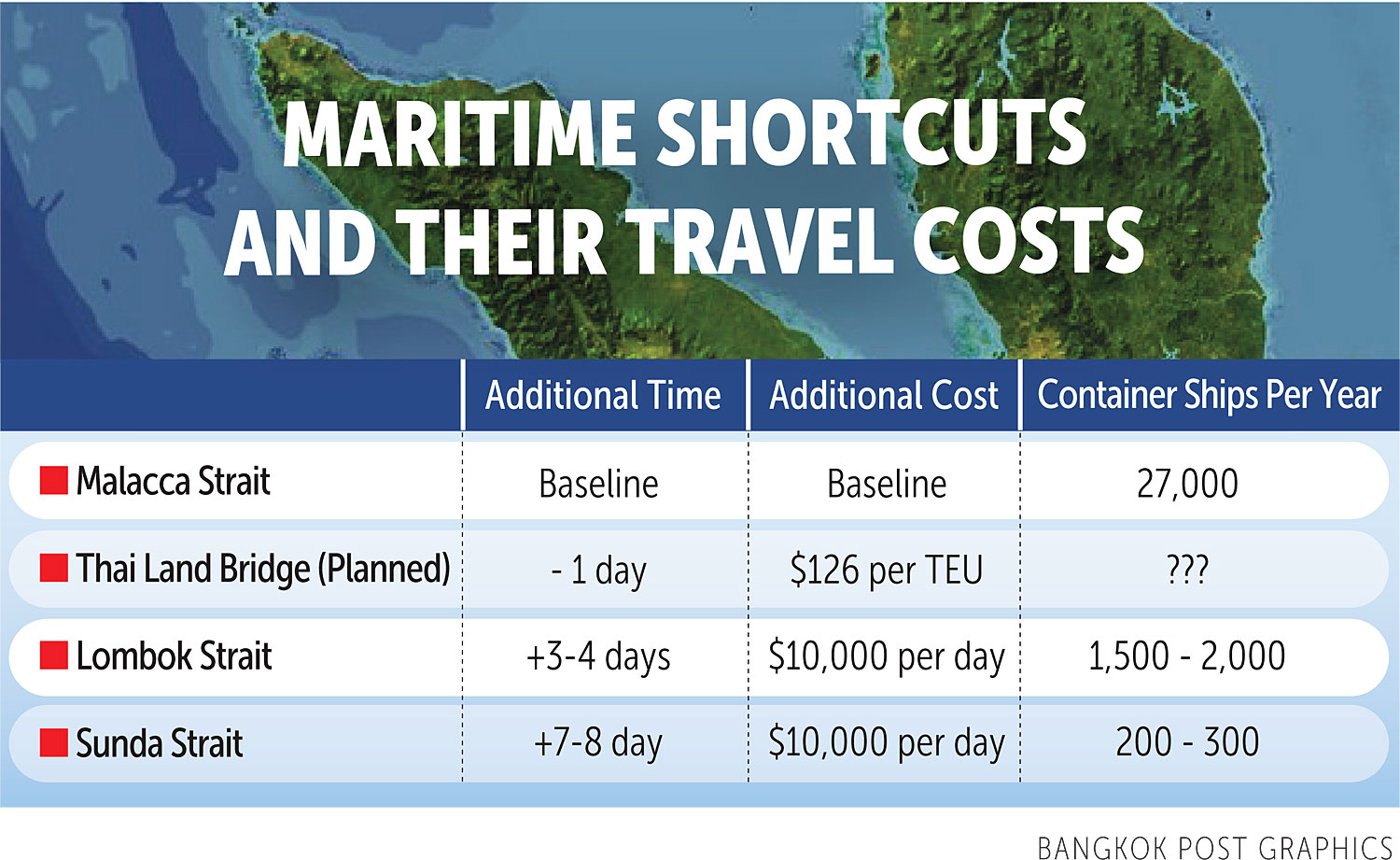
To illustrate the alternatives to the Strait of Malacca, I have prepared a table comparing the routes -- including the proposed LB -- in terms of time saved or lost, costs, and existing traffic volumes. (See table)
Based on the table, can anyone provide a convincing reason why a modern 10,000-TEU container ship would pay US$1.26 million to use the LB instead of paying around US$40,000 to divert via the Lombok Strait or US$80,000 via the Sunda Strait if the Malacca Strait became too congested or inaccessible?
But who am I to judge? That is precisely why the project requires market sounding to verify its feasibility.
I recently had the opportunity to obtain firsthand information from a respected shipping company that regularly uses the Strait of Malacca. Its candid assessment was that the LB is not an attractive project.
According to the company's estimates, the benefit amounts to only about one day of travel time saved. However, the risks are considerable, ranging from congestion at LB ports and the speed of container transfers between ports to the greatest concern of all -- mishandling of containers, including misrouting, damage or loss.
I personally conducted market sounding for another project I consulted on: the Aircraft Repair and Maintenance Centre. I organised meetings with international investors and potential users to gauge interest in the project, while separately conducting private interviews with Thai Airways.
For the LB, rather than holding a general meeting, I would recommend confidential interviews with the six major shipping companies that regularly use the Malacca Strait. It is crucial that the interviews be conducted by an internationally respected firm that interviewees trust and feel comfortable dealing with. Guarantees of anonymity would also be essential.
And what if no shipping companies are willing to participate? That alone would suggest the LB is not worth their time -- and if that is the case, the Thai government should not waste its own time on the project either.