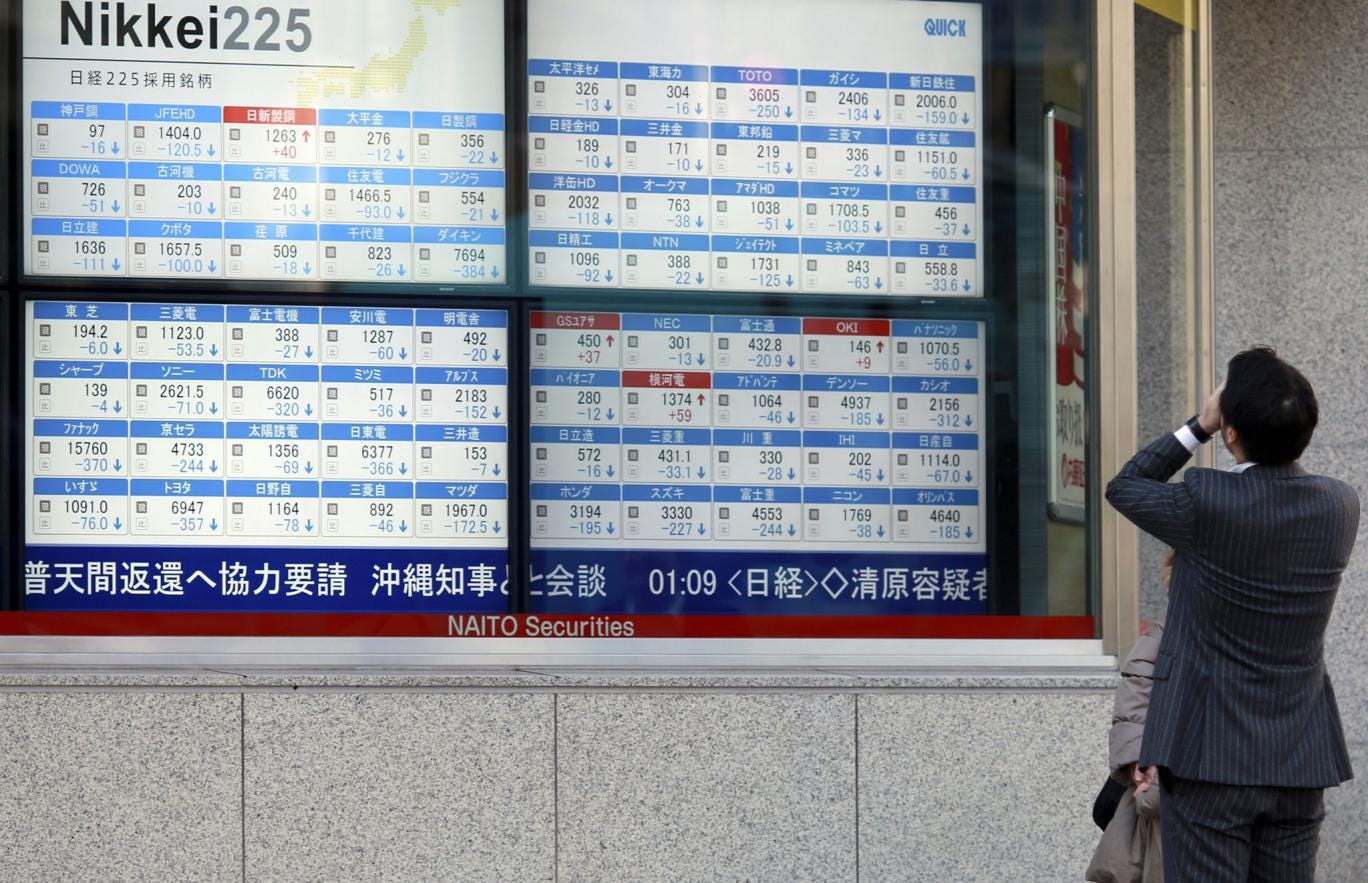
Asian markets sunk on Tuesday after European bank stocks sent investors running to so-called safe haven assets.
Japanese stock market the Nikkei dropped 5.4 per cent with investors choosing instead to park their money in gold, which surged to its highest value since June, and other assets.
Meanwhile Japanese government bond yields turned negative for the first time.
Bond prices have soared since the Bank of Japan made the shock decision to adopt negative interest rates on January 29.
This should have weakened the currency, but the opposite has happened. The yen surged to its highest in 15 months, prompting Japanese Finance Minister Taro Aso to warn that its rise was unstable.
“It is clear that recent moves in the market have been rough. We will continue to carefully monitor developments in the currency market," Aso said.
Kaneo Ogino, director at foreign exchange research firm Global-info Co in Tokyo, described it as a “panic situation”.
A combination of falling oil prices, fears over Chinese economic growth and uncertainty about the decision to raise US interest rates has weighed on markets since the beginning of the year.
“The combination of concerns that the United States could be heading toward a recession and the global stock sell-off is curbing risk appetite and is sending investors to the safe-haven yen,” Takuya Takahashi, senior strategist at Daiwa Securities, told Kyodo News.
European stocks and shares opened slightly up on Tuesday despite the difficult session in Asia.
The FTSE 100 was up 0.7 per cent at 5,726.55 points, the German DAX was up 0.3 oer cent at 8,981.12 points and the French CAC 40 was up 0.1 per cent at 4,070.37 points.
Additional reporting by Reuters