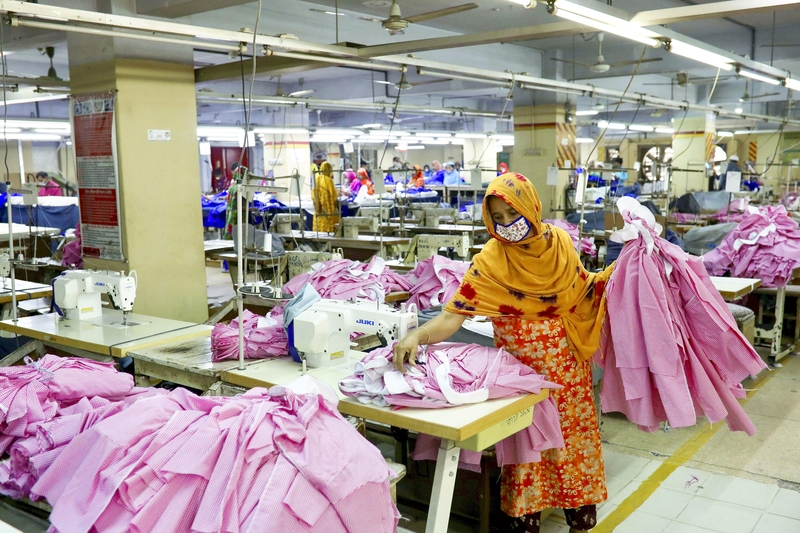
BANGKOK -- The sewing industry in Asia has been severely hit by the coronavirus pandemic, as a large number of orders have been canceled. The Asian sewing industry generally receives subcontracting work from apparel companies in the United States and Europe. However, since the virus outbreak the companies have reportedly made many one-sided requests, while issues such as unpaid wages and rising unemployment have become increasingly serious.
--Price cuts
Bangladesh is the second largest garment exporting country in the world, after China. It is said that there are more than 4,500 companies that receive orders from apparel companies in the United States and Europe, and they manufacture such garments as polo shirts and underclothes.
In late February, when coronavirus infections began to spread in Europe, Bangladeshi companies received a large number of order cancellations, a rush of price-cut requests and other such demands. This is because lockdowns in European countries led to a rapid decline in the demand for garments.
In April, a major British apparel company canceled orders placed to multiple subcontractors worth 8.22 million dollars (about 880 million yen), which created cash flow problems. As a result, these subcontractors were unable to pay wages to their employees. Finished and work in process products were also canceled, and Bangladesh Garment Manufacturers and Exporters Association (BGMEA) President Rubana Huq complained that it was an unreasonable request.
--Unemployment
In Bangladesh, coronavirus infections have been spreading since early April, and many subcontractors were forced to temporarily shutter their plants. Since the economic slowdown became grave, they resumed operations despite the fact that the virus outbreak had not dissipated. Still, orders have not been placed by U.S. and European companies. According to the BGMEA, about 4 million people are in financial difficulties due to unemployment and other reasons.
The international human rights organization Human Rights Watch has since alerted Western apparel companies to take measures to minimize economic damages to their subcontractors' employees and their families.
--Concern over sanction
Subcontractors in Cambodia have had difficulty getting raw material supplies from China where the virus spread first. Subsequently, many apparel companies in the United States and Europe canceled orders. At present, about 4 million plants have suspended operations and about 150,000 people have lost their jobs. In Myanmar, over 30,000 workers in the sewing industry are said to have become unemployed.
The Cambodian sewing industry is increasingly concerned about the future of an economic sanction to be imposed by the European Union, the largest export destination for the country. Since 2001, Cambodia has been granted the Everything But Arms (EBA) program that gives eligible countries access to zero tariffs on all exports except armaments. However, the EU expresses concern over violations of human rights by Cambodian Prime Minister Hun Sen's government -- which effectively adopts a one-party rule -- and plans to partially withdraw the tariff preferences granted to Cambodia from August 12.
A sewing industry association has sent letters to the EU twice, asking it to delay the partial withdrawal for 12 months. "We want to avoid the double whammy of the coronavirus and sanctions. We hope the EU will consider the significance of the impact," an official related to the association said.
Read more from The Japan News at https://japannews.yomiuri.co.jp/