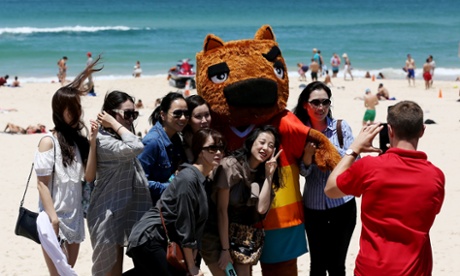
There are now just 29 days to go until the Asian Cup kicks off in Melbourne. The Asian Cup trophy is touring the country, and Socceroos coach Ange Postecoglou announced his mega 46-man provisional squad on Monday. Whether anybody will be interested, however, remains to be seen.
By the end of 2011, a local organising committee was established to administer the tournament. The LOC is operating on a budget of $75m, roughly $60m of which comes from the New South Wales, Queensland, ACT and Victorian governments. The remaining $15m is supposed to be recouped from ticket sales. This magical $15m figure, then, has been the primary focus of the LOC, which as a temporary organisation will be packed up and closed down soon after the event is finished.
Selling Asian football to Australians has never been easy. Although Australia joined the Asian Football Confederation in 2006, there is still precious little interest from fans about our immediate region. It’s not a football specific problem – indeed Australia’s slow embrace of Asia has frustrated people across a broad spectrum of political, economic and cultural pursuits.
“Our officials, and a majority of our fans are engrained (sic) with a ‘European’ or ‘British’ complex,” wrote Soccer World scribe Lou Gautier back in 1967. Nearly 50 years on, you have to wonder how much has changed. See, for example, the massive outpouring of emotion from 95,000 people at the MCG when Liverpool came to town for an exhibition match last year. An enduring example of the cultural cringe? Maybe. We can only wonder where these people are for local, A-League or Asian Champions League matches.
Perhaps this is overly cynical, but the effects of this obsession with Europe and the mother country is far-reaching. Asian players barely feature in our national competition, and outside of the A-League based Socceroos, for a moment there was just one – ONE! – A-League player likely to figure in the Asian Cup. And now that Ali Abbas is out of action with a long-term injury, there will be zero. It’s an embarrassing statistic, and a glaring indictment on our attitude towards Asian football. According to FFA an Asian-specific visa spot is a option to be looked at, but there is no time frame to see it happen.
Overcoming this Eurocentrism is a major hurdle for the LOC, but with less than a month remaining until the tournament, there are some positive signs. Socceroos matches are understood to be tracking well, although they are still no guarantee of selling out, while the matches involving Iran, Japan and South Korea are slowly ticking over.
While the tournament is aimed at mainstream Australia, ambassadors from Asian-Australian communities have been feverishly trying to move tickets and promote the event. “The diversity of Australia is one of our greatest strengths and advantages,” Damien de Bohun, head of the A-League, told Guardian Australia. “Embracing people supporting their country of origin is unique to most Australian sports, but something that we’ve been able to do well. It will hold us in good stead.”
However, the divvy-up of games between the major cities before the draw occurred hasn’t helped. Instead of being able to strategically place games where there are large Asian communities, games have simply been allocated at random.
Take China as an example. When they qualified for the tournament, a collective sigh of relief swept around the offices of the LOC. People of Chinese descent form a sizeable percentage of Australia’s migrant population, and it was expected they would makes the turnstiles click. However, China has been allocated two games in Brisbane and one game in Canberra during the group stages. This is disingenuous – there are huge numbers of Chinese in Sydney and Melbourne, and although community ambassadors have done plenty of work in the Chinese community in Queensland, it’s unlikely they are going to get the same numbers as they would in Sydney and Melbourne. Meanwhile, North Korea will play Uzbekistan in Sydney, and in truth organisers will probably be lucky to sell 5000 of the 80,000 tickets on offer.
Canberra is another issue. The city will host six games in the group stage, and one quarter final fixture. Anyone who knows Canberra will realise the folly of hosting any event there in January – half the city goes on holiday during the summer and are unlikely to be enticed to stay in town to watch United Arab Emirates vs Qatar, for example, or Iraq vs Palestine.
In the end it will be up to the Socceroos to generate revenue. Japan were the last nation to win the Asian Cup as host in 1992, but back then there was only eight teams participating, half the number this time around. As Postecoglou has been at pains to point out, host nations don’t often do well in the Asian Cup.
Still, the LOC will be silently praying the Socceroos can buck the trend. If the Socceroos can top their group and make it to the semi-finals, they could play Iran in Sydney on Australia Day, a dream matchup that should draw a healthy crowd considering the history between the two nations.
The LOC are quietly confident they can reach the $15m required revenue from ticket sales, but if the Socceroos flunk, however, Australians could lose interest fast, and that might spell disaster for the the largest and most prestigious football tournament ever held in this country. The pressure on the Socceroos isn’t just about winning a football game. It’s about guaranteeing the success of an entire tournament.