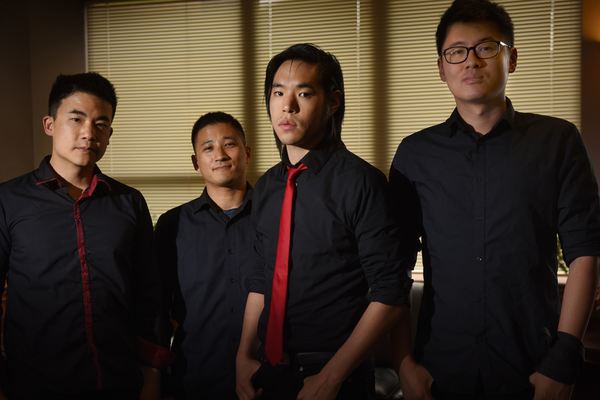
PITTSBURGH _ Simon Tam had the idea for his band name, The Slants, in 2004, and it finally formed _ with three other Asian-Americans from Portland, Ore. _ in 2006.
It was three years later that a friend told him he ought to get a U.S. trademark for the band name, to protect it for marketing.
But when Tam filed the paperwork with the government, he was told the band's name was offensive, and his application was denied.
Eight years later, he now awaits an expected June decision by the U.S. Supreme Court, which heard argument on the case in January.
"I should be able to say what I want to say that my community doesn't find offensive," Tam said. "At the end of the day, it's a lot bigger than the band."
On Thursday, Tam and his bandmates _ he describes their music as 80s-inspired synth pop _ spoke at a panel discussion at Duquesne University before an evening performance. It's part of a six-week tour that has hit clubs, law schools, intellectual property workshops and anime conferences.
The tour is to raise awareness of the ongoing court case, Lee v. Tam. In it, the U.S. Patent and Trademark Office appealed a decision by the U.S. Court of Appeals for the Federal Circuit, which found in Tam's favor in December 2015.
Tam's original trademark application, made in 2009, was rejected because it was found to violate the Lanham Act, which prohibits a trademark if it "consists of matter which may disparage persons, living or dead, institutions, beliefs or national symbols, or bring them into contempt, or disrepute."
In reaching its decision, Tam said, the trademark office relied on things such as the Urban Dictionary and white nationalist websites, where "slant" is used as a slur. Tam said the office did not care that he had the support of Asian-American organizations from across the country.
"The examining attorney relied on evidence that 'slant' is a 'negative term regarding the shape of the eyes of certain persons of Asian descent,' which has a 'long history of being used to deride and mock a physical feature of those individuals,' " the trademark attorneys wrote in their Supreme Court brief.
But the band has performed nearly 800 times, Tam said, and no one has ever complained that they found the band's name offensive.
Tam chose the name The Slants, he said, after he did an informal survey asking people what they thought all Asians had in common. The most frequent answer was slanted eyes. Because he grew up hearing that slur and being ridiculed, he thought he could take the term back, reappropriate the insult from decades ago.
He wanted to be an agent of societal change.
When Tam submitted his trademark application, he learned there were 800 other already existing trademarks with the word "slant" in them _ from skateboards, to restaurants, to radio shows.
His was the only one rejected. The trademark office, in its rejection, said, " 'it is incontestable the applicant is Asian,' " Tam said.
"If we were any other race, we would have gotten that trademark," he said. "In the name of fighting racism, they're denying me something based on my race."
Duquesne intellectual property professor Jacob Rooksby said that trademarks are a commonly sought protection by bands and musicians. The question in this case, he continued, is whether the statute is too broad or too vague.
"It's subject to interpretation and change over time," he said.
For example, the word "Hoosier" at one time was used as an epithet to describe people from Indiana. Now, it is used with pride.
"Shouldn't they be able to get the same kind of governmental benefit as other bands in choosing their names?" Rooksby asked. "Isn't it unfair and arbitrary for the government to be making these decisions in the trademark office?"
After Tam lost his battle at the office level, the case went to an appeal board. It agreed that The Slants trademark would be "disparaging to a substantial composite" of people of Asian ancestry.
The appeal board wrote that the trademarks status as " 'disparaging' does not depend on the applicant's purpose" in using it, meaning, the board didn't care that Tam was trying to reappropriate the word.
There was no First Amendment violation, the board found, because its decision does not suppress speech or prohibit Tam from using the name, but simply prevents him from "calling upon the resources of the federal government to assist him in enforcing the (trade)mark."
Eventually, the case moved up to the U.S. Court of Appeals for the Federal Circuit. In an en banc, decision, Tam won by a two-thirds majority. The court agreed that the trademark is disparaging under the language of the law, but that the patent office's ban on disparaging trademarks is facially unconstitutional.
The court viewed the office's ban on disparaging trademarks as a law that " 'penalizes private speech merely because (the government) disapproves of the message it conveys.' "
The government appealed the decision to the U.S. Supreme Court.