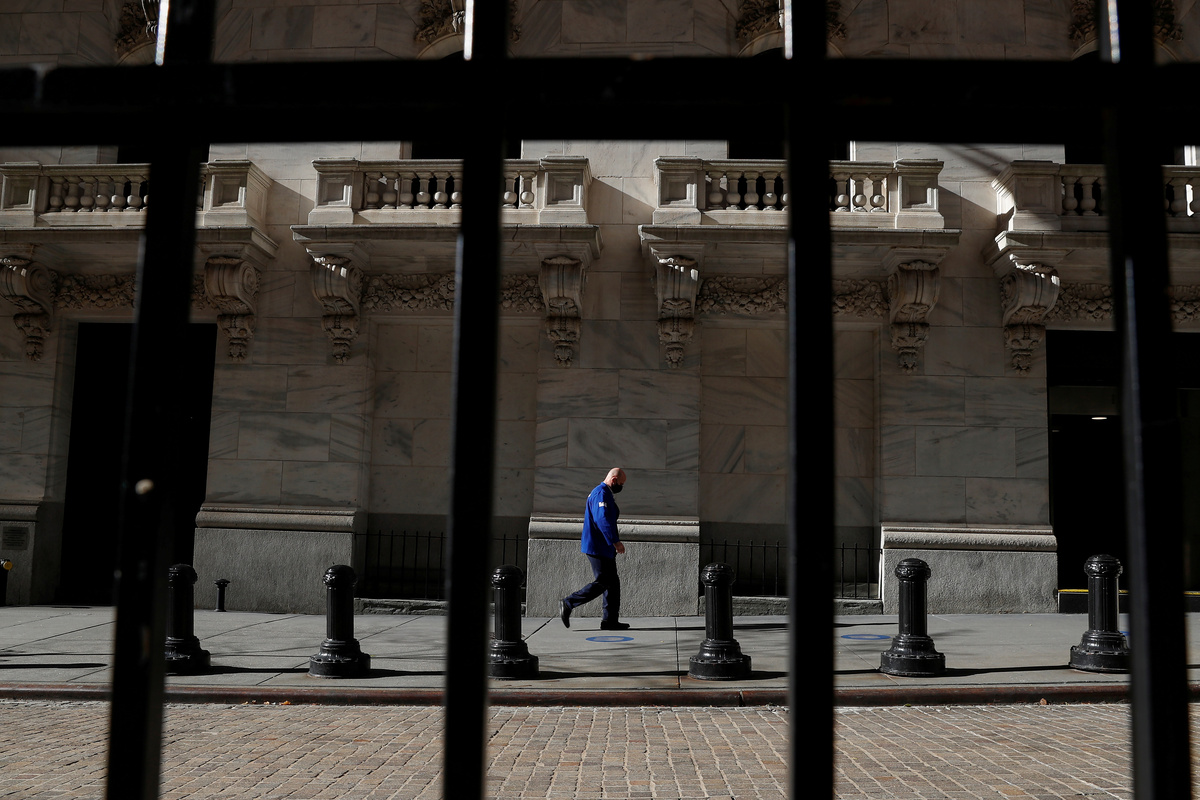
The Nasdaq recovered as the bond rout retreated on Friday, but most other equity markets swooned around the world as data showing a strong rebound in U.S. consumer spending kept fears of rising inflation alive.
Shares of Amazon.com Inc, Microsoft Corp and Alphabet Inc edged up after bearing the brunt of this week's downdraft to help the Nasdaq shake off its worst day in almost four months on Thursday.
The Nasdaq Composite advanced 0.56% while the S&P 500 slipped 0.48% after a late-session surge failed to hold. The Dow Jones Industrial Average fell 1.51%.
U.S. consumer spending rose by the most in seven months in January as low-income households got more pandemic relief money and new COVID-19 infections dropped, setting up the U.S. economy for faster growth ahead.
The benchmark 10-year Treasury note on Thursday shot to a one-year high of 1.614%, a move that rocked world markets. The note's yield is up more than 50 basis points this year and is now close to the dividend return of S&P 500 stocks.
Yields on the 10-year note fell steadily throughout the session to trade 11.7 basis points lower at 1.3981%.
The amount of money swirling through markets and U.S. stocks at close to all-time highs has caused investor angst, said JJ Kinahan, chief market strategist at TD Ameritrade in Chicago.
"Many people are taking some profits and not necessarily reinvesting that money quite yet," Kinahan said.
"The U.S. equity market is still the best game in terms of safety versus opportunity. But there is a shift going on."
The scale of the recent Treasury sell-off prompted Australia's central bank to launch a surprise bond-buying operation to try to stanch the bleeding.
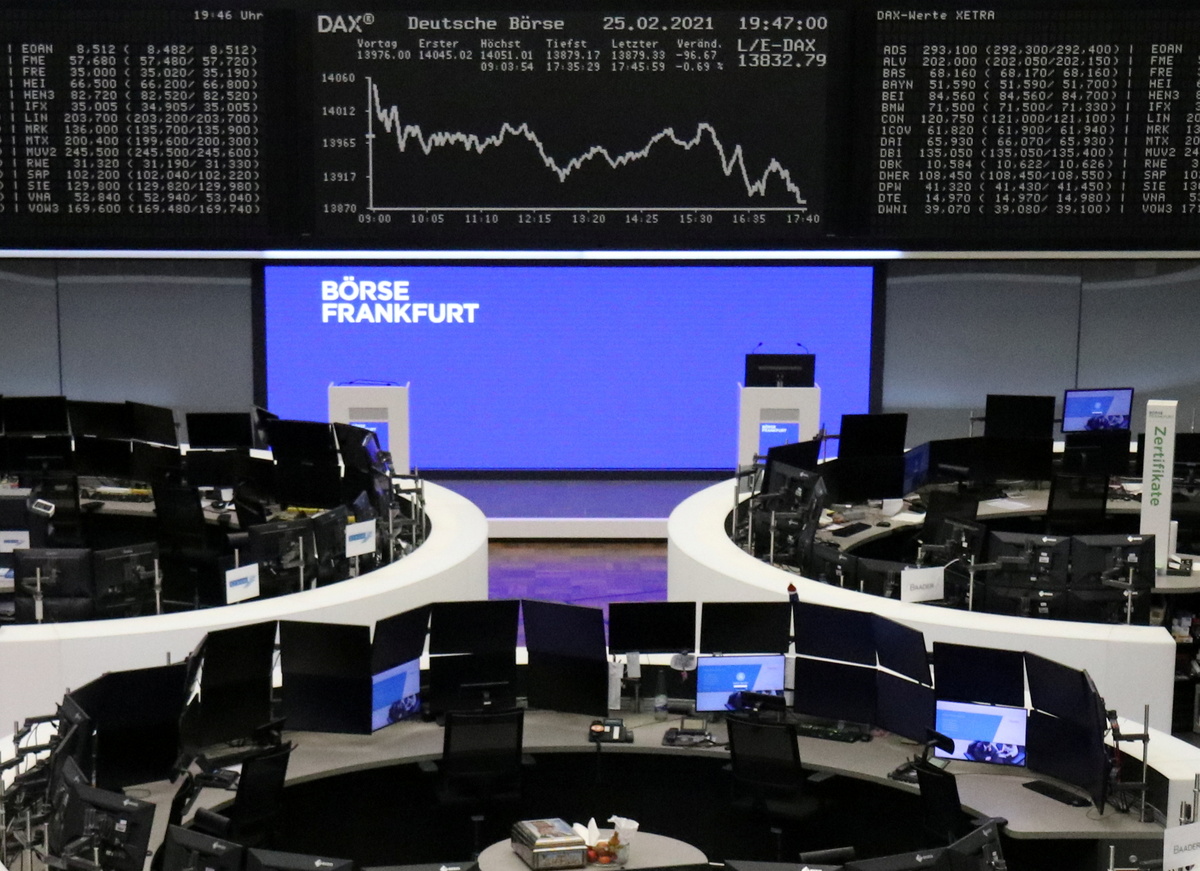
MSCI's benchmark for global equity markets slid 1.61% to 656.29 despite its large weighting to the U.S. tech heavyweights.
In Europe, the broad FTSEurofirst 300 index closed down 1.64% at 1,559.48. Technology stocks lost the most as they continued to retreat from 20-year highs.
The dollar rose against most major currencies as U.S. government bond yields held near one-year highs and riskier currencies such as the Aussie dollar weakened.
The dollar index rose 0.683%, with the euro down 0.9% to $1.2066. The Japanese yen weakened 0.31% versus the greenback at 106.55 per dollar.
Gold fell more than 2% to an eight-month low, as the stronger dollar and rising Treasury yields hammered bullion and helped it post its worst month since November 2016.
U.S. gold futures settled 2.6% lower at $1,728.80 an ounce.
Benchmark German government bond yields fell for the first time in three sessions but were still headed for their biggest monthly jump in three years after rising inflation expectations triggered a sell-off.
The 10-year German bund note fell 1.2 basis points to -0.271%.
European Central Bank executive board member Isabel Schnabel reiterated on Friday that changes in nominal interest rates had to be monitored closely.
Copper recoiled after touching successive multi-year peaks in six consecutive sessions, falling more than 3% as risk-off sentiment hit wider financial markets after a spike in bond yields.
Three-month copper on the London Metal Exchange (LME) slumped to $9,112 a tonne.
MSCI's emerging markets equity index slumped 3.36%, its biggest daily drop since markets plunged in March.
The surge in Treasury yields caused ructions in emerging markets, which feared the better returns on offer in the United States might attract funds away.
Currencies favored for leveraged carry trades all suffered, including the Brazil real and Turkish lira, which slid for a fifth straight day, erasing all the year's gains.
The heaviest selling earlier was in Asia, with MSCI's broadest index of Asia-Pacific shares outside Japan sliding more than 3% to a one-month low, its steepest one-day percentage loss since the market rout in late March.
Oil fell. Brent crude futures settled down 75 cents at $66.13 a barrel. U.S. crude futures fell $2.03 to settle at $61.50 a barrel.
(Reporting by Herbert Lash in New York; Additional reporting by Tom Arnold in London, Wayne Cole and Swati Pandey in Sydney; Editing by Nick Zieminski and Matthew Lewis)