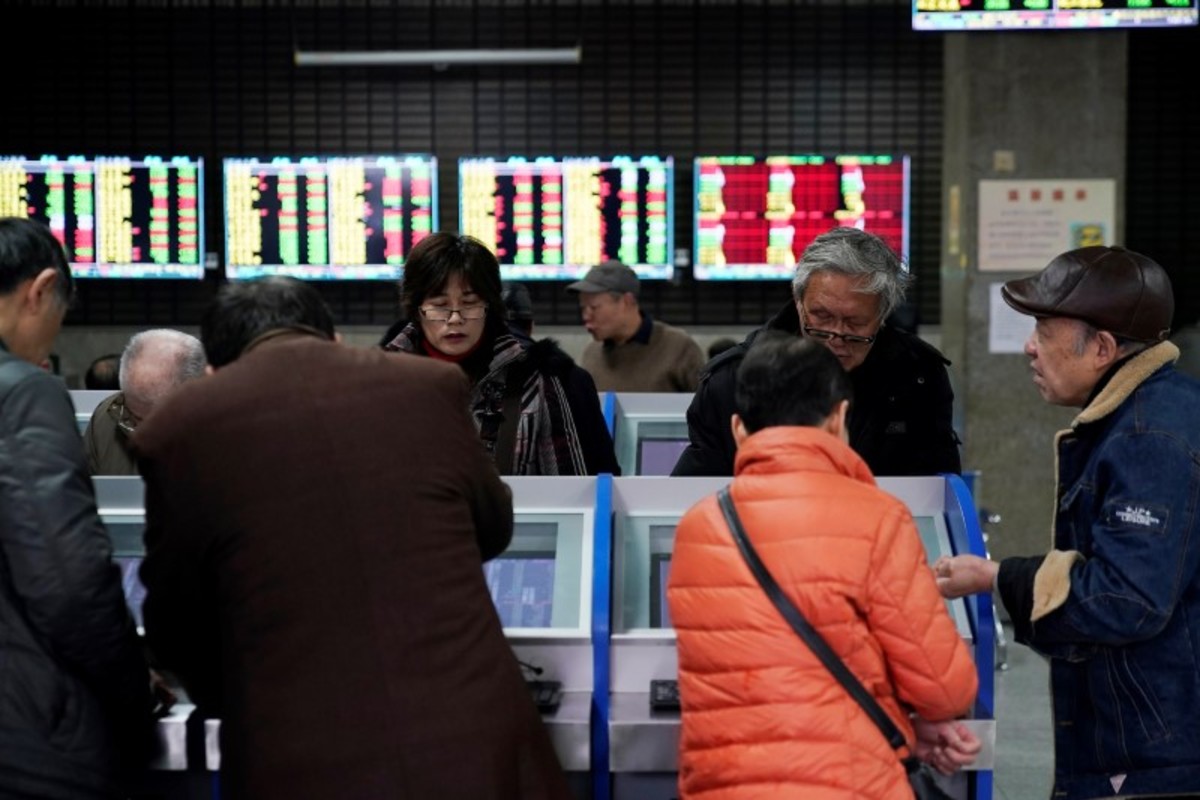
Asian shares took a sudden lurch lower on Tuesday as a ripple of risk aversion swept markets, though analysts could find no obvious trigger for the move.
Safe-haven bonds and the yen edged higher in what was very thin trade, leading dealers to look for likely culprits.
Some thought mounting concerns over the coronavirus outbreak in China might be having an impact given the threat of contagion as hundreds of millions travel for the Lunar New Year holidays.
"It's an essential enough development that markets will monitor it on the risk radar, as if things turn critical it could provide a massive blow to the airline industry and a knockout punch to local tourism," said Stephen Innes, Asia Pacific market strategist at AxiCorp.
While the trigger was uncertain, the price action was clear enough with MSCI's broadest index of Asia-Pacific shares outside Japan <.MIAPJ0000PUS> slipping 0.9%.
Japan's Nikkei <.N225> lost 0.8% and Shanghai blue chips <.CSI300> shed 0.9%. E-Mini futures for the S&P 500 <ESc1> eased 0.3%.
The mood has already been cautious after the International Monetary Fund trimmed its global growth forecasts, mostly due to a surprisingly sharp slowdown in India and other emerging markets.
The IMF now sees growth at 3.3% this year, down from 3.4% and also cut the 2021 forecast to 3.4% from 3.6%. Yet it still lifted the outlook for China to 6%.
There was some relief U.S. President Donald Trump and French President Emmanuel Macron seemed to have struck a truce over a proposed digital tax.
The two agreed to hold off on a potential tariffs war until the end of the year, a French diplomatic source said.
Trump is due to deliver a speech at the World Economic Forum in Davos later on Tuesday, and trade and tariffs could be on the agenda.
In a tweet late on Monday, Trump said he would be bringing "additional Hundreds of Billions of Dollars back to the United States of America! We are now NUMBER ONE in the Universe, by FAR!!"
ALL STEADY AT BOJ
Also due later is the outcome of the Bank of Japan's latest policy meeting.
Richard Grace, head of international economics at Commonwealth Bank of Australia, expects no further easing in policy in part because the government has launched fresh fiscal package worth around 1% of GDP.
"Also, Japan's 10-year government bond yield has been steadily lifting since declining to ‑29bp in late August 2019, and at 0.00%, is at a more than a twelve‑month high," he added. "It suggests a reasonable outlook for Japan's economy."
Japan's yen picked up a bid on the safe-haven move and the dollar dipped to 109.99 <JPY=> from an early 110.17 <JPY=>. It also gained on the euro <EURJPY=>, leaving the single currency flat on the dollar at $1.1092 <EUR=>.
Against a basket of currencies, the dollar was steady at 97.627 <.DXY> after touching a four-week high at 97.729.
Spot gold edged up to $1,566.71 per ounce <XAU=>, and back towards a seven-year peak of $1,610.90 reached last week.
Oil prices hesitated, after gaining on the risk of supply disruption in Libya.
Brent crude <LCOc1> futures eased 10 cents to $65.10 a barrel, while U.S. crude <CLc1> rose 11 cents to $58.65.
(Editing by Shri Navaratnam)