Summary
Senator McCain has adjourned the hearing, so we’ll wrap our coverage of secretary of defense nominee Ashton Carter with the summary below.
- Carter said he supports giving lethal arms to the Ukrainian government for its war against Russia-backed rebels in the nation’s east. He said he is “strongly inclined” to provide equipment, but not personnel, and that Europe must continue to inflict punitive sanctions to deal with “the big Putin lie”.
- Senators John McCain and Lindsey Graham grilled Carter about US strategy in Syria, Iraq and Afghanistan. The senators demanded “conditions-based withdrawal” from Afghanistan and a plan to deal with Syrian leader Bashar al-Assad.
- “The United States’ involvement is necessary, but not sufficient” to defeat Isis, Carter said, but he added that extremism will continue beyond a successful campaign. “We need to be thinking about terrorism more generally as a more enduring part of our national security mission,” he said.
- Cyber capabilites are “not anywhere near where we should be as a country,” and upgrades would be part of Carter’s defense agenda, he said. “Deterrence requires that a potential enemy knows that you have the ability to respond.”
-
“I don’t think it’s safe to keep bending” military strategy to accommodate the budget, Carter said, promising major reforms, a path out of “the wilderness of sequester” and to be “a stickler for chain of command.”
- Carter said he would not give in to pressure from the White House to accelerate the pace of releases from Guantánamo Bay. He also said he supported the exchange of five Tablian prisoners for US POW Bowe Bergdahl.
- Carter committed to reviews of the US nuclear weapons program, but staunchly defended the rationale for a ready US arsenal of nuclear arms. He also promised to review ways to improve the military’s efforts to combat sexual assault.
Senator Tillis asks about the size of the US navy fleet and its capabilities. “What would you share with us that should make us feel OK for some reduction in the fleet?”
“You have to look at quality and not just quantity,” Carter says.
“We are the paramount navy in the world. … It allows us to be present when things break somewhere, whether it be a conflict or a natural disaster. You see the Americans show up first. How dio they do that? One of the ways they do that through the navy. So I have a strong interest in doing that not just through the quality but the quantity as well.”
It’s all about the budget, he concludes.
Updated
Carter: 'Isis' defeat won't be the end of extremism'
Alaskan senator Dan Sullivan asks about the endgame in the war against Isis, and Carter responds by saying that even though he sees an end to the terrorist group he thinks the US should take a broader perspective.
“This won’t be the end of Islamist extremist terrorism,” he says. “Our experience has been that this is a movement that changes and shifts and floats around the world.”
He says that even though he hopes “Islamic extremism burns itself out” at some point, there are still dangerous and socially isolated groups and with outsize power provided by technology.
“We need to be thinking about terrorism more generally as a more enduring part of our national security mission … We need to be protecting people whatever [terrorists] are thinking.”
Updated
Ernst asks about surveillance versus privacy, albeit in euphemistic terms.
She asks whether Carter has an opinion “in regards to protecting our national security interests” versus protecting the privacy of normal citizens.
Carter dodges slightly, saying, the government can “do a lot more” to protect Americans without invading their privacy. “The federal government does have a role in protecting the country from cyber attack in the same way ti has a role in protecting the country from other attacks.”
The government can share information it has collected about threats with private companies, Carter says, as well as can conduct and sponsor research for network defense.
“We’re not anywhere near where we should be as a country,” he says, and people “would be clamoring to do more” if they understood the threats out there.
Joni Ernst of Iowa says that technological superiority is “one of our primary tools for dominance on the battlefield,” but worries about the advancing cyber capabilities of Russia, North Korea and other countries.
Carter embraces her pitch. “Not only is our civilian infrastructure susceptible to cyber attack, but we have to be concerned about our military infrastructure. As you say, there’s no point in having planes and ships and armored vehicles in today’s world if the network itself is vulnerable.”
He says the network security in the Defense Department “is not where it should be” to defend against cyber attacks.
Ayotte asks whether Carter thinks it wise to transfer Guantánamo detainees to Yemen, considering the current state of affairs in the peninsular nation.
“That doesn’t sound very sensible,” Carter says, predictably.
Ayotte’s last follow-up request is that Carter come to New Hampshire, showering Carter with yet another invitation to spend hang out with a senator in their home state.
Updated
Senator Kelly Ayotte now asks about Russian violations about the INF treaty on nuclear weapons, including a new cruise missile recently revealed to be in development by the Federation.
“I’m told it’s quite clear that Russia has violated the INF treaty. What are we going to do about it?”
We have options, Carter says: “I think we need to remind Russia that it’s a two-way street … if you’re absolved from your restrictions under this treaty then we are too. … I think there are defensive steps that we can take, there are deterrent steps that we can take, and there are counterforce steps that we can take.”
“The judgement behind the INF treaty was we’re both better off [with the treaty], but these are two way streets.”
Martin Heinrich asks a follow-up question about inmates at Guantánamo Bay, and Carter agrees with him that there are people there who must remain imprisoned.
“What can you do with the people in Guantanamo that need to be incarcerated,” Carter asks, “If not at Gitmo they need to be incarcerated.”
“That’s a very difficult question, it’s partly a legal one, it’s partly a practical one.” He says he’ll work with the committee and the administration to find a solution, but that “it’s plain as day that [some prisoners] need to be incarcerated in a super-max type place.”
Cotton moves to Russia. “Right now there’s fighting in Ukraine, much of it is over … the so-called Minsk line where forces were separated in September.”
He talks about the “little green men” – Russian soldiers wearing unmarked uniforms acting in support of the rebels. Cotton asks would those soldiers be in a violation of the Geneva conventions.
“I don’t know the international legal standard, Carter says, but “I think the little green men are part of the big lie, the big Putin lie, where he is clearly pretending he is not violating the integrity of a sovereign nation. … I don’t know the legal sense but from the common sense of it” Putin has violated Ukraine’s sovereignty.
Cotton says he wants Nato “on the lookout for the little green men.”
Arkansas’ Tom Cotton begins his second round of questions, and asks Carter whether he thinks a prisoner swap of five Taliban members for POW Bob Bergdahl was the right decision.
“I have read the letters from all the joint chiefs of staff … all of which express support for the decision. I don’t want to speak for them but just speaking fro myself, it does just boil down to one thing, which you from your own distinguished service understand, that we have for decades and decades and decades … have a sacred duty to bring back our fallen.”
“That was the motivation that the chiefs cited that motivated their support … It obviously was a difficult decision to make because of the five people you cite, but knowing what I know about the circumstances I would have supported it.”
Cotton is not happy: “Well I opposed it then and I oppose it now, and Bowe Bergdahl was not fallen, there were thousands of soldiers looking for him.”
Cotton says Congress was not notified as the law requires about the prisoner swap, and asks for Carter’s assurance that he will abide by the law. Carter assents.
Updated
Cruz: “How would you characterize our objective with respect to Isis?”
Carter: “To inflict a lasting defeat upon Isis. I only include the word ‘lasting’ because they need to stay defeated.”
Cruz: “What would be required militarily, to destroy, or as you put it to inflict a lasting defeat on Isis?”
Carter: “Militarily it would be a dismantlement of their forces and their networks, and to get to the point about lastingly, there’s a political ingredient to this that I need to add, which is to have them replaced in Iraq, and in Syria, with a government that the people want to be part of, so that they don’t have to be governed by maniacs and terrorists.”
Cruz harps on Israel and Iran, saying that it’s a matter of public knowledge that the nation possesses nuclear weapons. He says nobody wants nuclear weapons just because Israel does, but that the other nations in the area would desire them should Iran gain such arms.
“The prospect of Iran having nuclear weapons is a pretty fearful matter, and you don’t have to be an Israeli or an American [to think so],” Carter answers. Cruz keeps hunting for a condemnation of US negotiations with Iran over the latter’s nuclear program. He stops when Carter concedes “the negotiations have precisely the opposite objective” from keeping Iran completely free of nuclear technology.
Updated
Senator Ted Cruz now takes center stage: “I have been for some time critical of the Obama administration’s foreign policy,” Cruz begins, in understatement.
He says he wants to talk about threats to America, starting with Iran: what danger would a nuclear-armed Iran pose to the United States?
Carter: “In a phrase: exceptionally grave. That for two reasons, one: they might use them, and two: they might stimulate others to get them.”
Cruz: “What is it about the regime in Iran that poses a significant threat?”
Carter: “Well if you take at face value what they say, they have the ambition to wipe off the face of the map other nations, namely Israel. They have a along history of behaving in a disruptive way, of supporting terrorism, of trying to undermine other governments in the region.”
King asks a follow-up about European defense spending.
Carter: “I think they need to spend more on their own defense, because their own defense is our defense. That’s what being an ally is about. I’d like to see them carry their full weight of being an ally. As I said earlier i don’t think any American can be satisfied with the defense spending of our allies. I think it should be higher.”
Maine’s Angus King retakes the stage in the largely empty chamber, and asks another question about logistics.
“Time is money,” Carter says. “Technology changes very quickly and our enemies change very quickly, and you don’t have to be in a war … to realize you need to be able to turn the corner, field new technologies, field new assistance, than your enemies are able to.”
He compares the problem to that of a commercial company: if “you have a 15-year product cycle, you’re going to lose.”
King reaches for a historical example, saying how during World War II Americans churned out military supplies in weeks, rather than years, as became the norm during the Cold War.
Wicker asks about what would happen if Russia began a greater incursion into eastern Europe, and particular threatened the Baltic states of Nato.
Carter replies by saying that he’s thought about that he fully supports reinforcing the Baltic members of Nato with rotational forces: “An attack upon one is an attack upon all,” he says, “and we need to show we stand behind them.”
Mississippi’s Roger Wicker takes the microphone now, asking how the US can do better to convince European allies to invest in defense.
Carter: “Secretaries of defense that I have served for almost as long as I can remember, have pleaded with the Europeans to spend more on defense. And with very few exceptions those pleas have not been very fully heeded.”
“One doesn’t wish adversity on anyone, but one would hope that when they look at Russia, at Charlie Hebdo incidents, the European community would feel that they need to be part of their own defense.”
He says that defense spending is part of every nation’s responsibility to their allies.
“I hope that what they see around them that they don’t get this stuff for free. Security doesn’t come for free, you’ve got to pay for it.”
Senator Mike Rounds of South Dakota reels off facts about bombers and his thoughts on mission capabilities of aircraft, finally asking what sequester has done to the military’s readiness.
“Sequester has hit readiness very hard,” Carter says,” and has a ready example: “The Nellis training range, the air force’s premier training range, closed, for the first time that I can ever remember.”
Finally Rounds asked for a commitment from Carter to work on these issues, which Carter provides, saying “it’s going to take money also, and ultimately relief from sequester.”
Tillis asks “how do you feel you can break through the barriers that secretaries Panetta and Gates felt?”
He paraphrases from the former secretaries books, saying that Panetta described the president’s team as “amateur hour,” and asks “How are you going to be relating to the Pentagon and the president’s national security team?”
“I intend to be how I’ve always been,” Carter says. “I’ll be entirely up front with the president, and make my advice as cogent and as useful to him in making his decisions as I possibly can.”
Senator Thom Tillis says “we’re in a very dangerous time,” raising examples of everything from instability in the Pacific to Israel – “I think it’s unacceptable” that Benjamin Netanyahu was “called a coward by a person in the White House”.
Tillis moves to his question about why the Obama administration “refuses to name” a threat to America, seemingly meaning Isis and jihadi groups but not actually naming the threat he means himself.
“I agree that there is a difference between the Muslim religion and the kind of extremism that leads to terrorism. … I don’t think that we serve ourselves well as Americans by conflating this kind of barbaric extremism with an entire religion.”
McCain interjects “on the issue of Ukraine, what does it take?
“Do they [the Russians] have to send in more hundreds of tanks? … There’s more than 4,000 [actually more than 5,000 people] dead now.”
“Certainly Vladimir Putin has gone in, and there are some lessons of history that dictators and bullies have a history of aggression” to distract from other problems, McCain says.
He then grabs the analogy of closest reach: “This is reminiscent of the 1930s to me, and Neville Chamberlain might be proud.”
Carter: 'sanctions key to dealing with Putin'
King raises the prospect of escalation and proxy war in Ukraine, should the US arm Kiev.
“If we could arm the Ukrainians and give them some strategic advantage, the problem is we can’t rely on the Russians not responding, and then we’re in an escalation situation.”
“You’ve raised an excellent question,” Carter says, “you always have to ask yourself not what the next step but what’s the step after that.
“Much as I’m inclined in the direction that I indicated this morning, the economic and political pressure on Russia has to remain the main point of pressure. And the Europeans are critical to that … into dealing with the problem of Putin.
“As I consider what kinds of assistance we provide to the Ukrainian military, we do need to think not just two but three and four steps ahead of this, so we will be considering that.”
The senators have finally filed back into the committee, with senator Angus King taking the lead after the break.
King says “we’ve gained a lot” in Afghanistan, “we have a partner that wants to work with us now,” but that the Afghan security forces need support. He urges a review of the plan for withdrawal from the country
“I hope you’ll be candid to the point of annoying” with them, King says, about problems with the White House plan for troops in Afghanistan.
Updated
Senate Armed Services Committee writes to Kerry & Hagel request providing Jordan aircraft parts, smart bombs, night vision gear "w/ speed"
— Spencer Ackerman (@attackerman) February 4, 2015
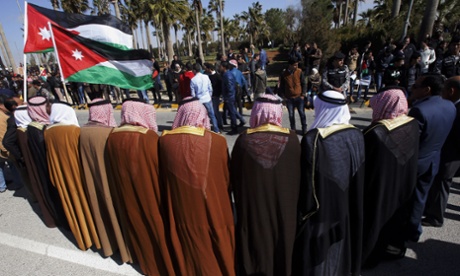
Jordan’s King Abdullah II met with leading members of the committee yesterday, including chairman John McCain, and gave what senators described as an emotional appeal for aid.
Part of that appeal was for the US to break through bureaucratic obstacles slowing the delivery of equipment. Jordan has taken a leading role in the coalition war against Isis, which murdered a captive Jordanian pilot this week.
Carter is not totally out of step with the president who nominated him. “He brushed aside an invitation to say Isis captives ought to be interrogated and detained at Guantánamo Bay,” Spencer writes, “and he said he backed Obama’s ‘overall thrust’ in foreign policy.”
But Carter said he “would like to see us spend more on defense”, a reversal of direction from Obama’s interruption of post-9/11 defense budget increases.
“Every company, state and city in the country has had to lean itself out in recent years and it should be no different for the Pentagon,” said Carter, who also promised, in perhaps a veiled jab to the top military leadership, which has recently pleaded poverty, to be “a stickler for the chain of command”.
Carter’s “bullish” tone on American power also included a characterization of the world as one of uncertainty and danger, with Carter saying he would confront “a time where the number and severity of the risks is not something that I’ve seen before in my life.”
You can read the full piece here.
Why are the senators taking so long to resume the confirmation hearing?
They’re snacking away at a “bipartisan lunch” and going off to fight about funding for the Department of Homeland Security, Politico’s Manu Raju says.
Senators say lot of kumbaya moments at bipartisan lunch about how the Senate used to be and can work together.
— Manu Raju (@mkraju) February 4, 2015
White House press secretary Josh Earnest has asserted the president’s authority over Carter – confirmation pending.
Rebuking Ash Carter even before he's confirmed at the Pentagon, Josh Earnest says arming Ukraine is Obama's decision.
— Spencer Ackerman (@attackerman) February 4, 2015
Ashton Carter is “pretty widely respected” on Capitol Hill, the Military Times’ Leo Shane tells C-Span – and his confirmation mostly a foregone conclusion.
Shane says that the Senate is using this hearing to wrangle for Pentagon funding, criticize Obama’s foreign policy and try to ferret out answers about where Carter wants to take the American military.
As for Ukraine, Shane says “he was fuzzy on the specifics there – he said he supported the idea and will look into it more. This is one of several issues he’s going to have to wade into immediately.”
“Carter repeatedly called the US ‘the indispensable nation’ for global security,” the Guardian’s Spencer Ackerman (@attackerman) notes, writing that this is “a coded term that Obama’s critics consider a rebuke to the president’s perceived military disengagement.”
Spencer’s first take on the “hawkish tone” of the hearing finds a number of discrepancies between the nominee’s statements and the Obama administration’s official lines.
Iran – with whom the Obama administration is negotiating a potentially legacy-sealing nuclear deal – rivals the Islamic State in Carter’s mind for the greatest threat to the Middle East.
Drawing apparent distance from one of Obama’s most ardently expressed security priorities, Carter pledged not to be pressured into accelerating the pace of detainee transfers from Guantánamo Bay. Rumors are swirling that additional transfers of detainees no longer considered security risks are imminent, and opposition from the current defense secretary, Chuck Hagel, is said to have hastened his November firing.
You can read the full piece here.
Carter’s tentative support to give armaments to Ukraine could herald a major gain for the riven European country, which has asked for more aid ahead of a visit by US secretary of state John Kerry.
My colleague Shaun Walker (@shaunwalker7) reports from Kiev:
Ukraine’s problems are “very solvable”, according to Tim Ash, senior strategist at Standard Bank, but the country has not received enough support from the international community. “Ukraine’s main problem is a lack of leadership in the west,” he said.
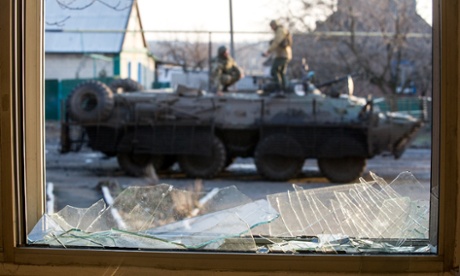
“The west has to bite the bullet and decide it has to be now or never. This is a reform-oriented government and the best chance we will ever have to help Ukraine,” Ash said.
Ukrainian leaders are also likely to talk to Kerry about the need for weapons. The US has been reluctant to provide lethal military aid to Kiev, but there have been signs that the mood in Washington is changing.
“We’ve been getting closer to receiving more military-technical assistance,” foreign minister Pavlo Klimkin said. “It’s not about buying a couple of tanks … It’s about modern warfare, training, logistics, organisation.”
He said Ukraine desperately needed hi-tech radio, radar and reconnaissance equipment to stop Ukrainian soldiers having their communications intercepted and improve battlefield efficiency. “We can’t win the war against Russia … But what we need to counter the aggression and to defend our country is not to lose the war,” Klimkin said.
You can read the full piece here.
Updated
The Guardian’s national security editor checks in with the State Department and already hears a divergence in the lines:
Ash Carter says he's inclined to army Ukraine. State's Psaki: "Our policy hasn't changed. obviously there are a range of different views."
— Spencer Ackerman (@attackerman) February 4, 2015
Spencer also notes that Carter said he’d break with the White House and advise against the US troop withdrawal in Afghanistan, if necessary.
Summary
The Senate is now taking a longer recess before it resumes the confirmation hearing of secretary of Defense nominee Ashton Carter.
- Carter said he supports giving lethal arms to the Ukrainian government for its war against Russia-backed rebels in the nation’s east. He said he is “inclined” to provide equipment, but not personnel.
- Senators John McCain and Lindsey Graham grilled Carter about US strategy in Syria, Iraq and Afghanistan. The senators demanded “conditions-based withdrawal” from Afghanistan, a plan to deal with Syrian leader Bashar al-Assad and said cooperation with Iran to fight Isis is “immoral”.
- “The United States’ involvement is necessary, but not sufficient” to defeat Isis, Carter said, saying that regional partners and removing safe havens were priorities in the war.
- Pre-emptive cyber strikes and boosted cyber defenses would be part of Carter’s defense agenda, the nominee said, saying “deterrence requires that a potential enemy knows that you have the ability to respond.”
-
“I don’t think it’s safe to keep bending” military strategy to accommodate the budget, Carter said, promising major reforms, a path out of “the wilderness of sequester” and to be “a stickler for chain of command.”
- Carter said he would not give in to pressure from the White House to accelerate the pace of releases from Guantánamo Bay.
- Carter committed to reviews of the US nuclear weapons program and ways to improve the military’s efforts to combat sexual assault.
Updated
Carter grilled about Syria and Assad
Graham reaches full pitch: “How in the world are we gonna dislodge Isil from Syria without a ground component?
“I agree with Senator Kaine that the ground component has to be regionally based. Saudi Arabia says you can have our army, the emir of Qatar said we’ll pay for it … how in the world can you train somebody to fight Isil and then expect them to turn on Assad without him killing them? How do you deal with Assad?”
Carter replies: “The forces we’re supporting have first and foremost the job of fighting Isil, but I also believe they need to be creating the conditions for the removal of Assad. That’s a much more complex task, I don’t want to simplify, but that’s got to be at the end of the road.”
Senator McCain juts in angrily, saying – “with all due respect” – that Carter didn’t really respond about why the US would allow “young Syrians to be barrel-bombed by Bashar al-Assad.”
He says he hopes Carter will “rethink his answer” because “this idiocy of cooperating with the Iranians” and of “Isis-first” is “immoral,” McCain says.
Updated
Graham searches for a silver lining: “Canada is in good shape, by the way, so we appreciate Canada being a good neighbor.”
He gets to his point: Afghanistan.
“In 2017 the plan in Afghanistan, as of now, is to have 1,000 troops now on the ground, Kabul based. Do you agree with me … that we would be wise to have troops outside of Kabul?”
Carter says “that is not the plan.”
Graham’s temperature is rising: “Can you please tell me why I am wrong? … If you’re going to be secretary of defense you should know the plan. The plan is to go down to 1,000. I think that is beyond unwise.
“That will destroy our ability to see, to hear, and to listen, to what I believe is a growing threat in the Afghanistan and Pakistan region. I want to withdraw from Afghanistan responsibly…”
Carter tries to mount a defense: “A comprehensive counterterrorism strategy begins with defenses but has other conditions … such as removing safe havens … so it’s a complex issue.”
Graham retorts: “To me it’s not complex. The only way we can keep them from coming to America is to keep them over there. … Keep them poor, and on the run, and less entrenched.”
Updated
Graham: “Do you think the Russians are being provocative at a time of chaos?”
Carter: “Yes.”
Graham: “Do you think a cyber Pearl Harbor is a threat we face?”
Carter: “Yes.”
Graham: “And that we’re not ready for it?”
Carter: “Yes, that is something I agree with.”
Graham: “Do you think China is intimidating its neighbors?”
Carter: “I think they’re trying.”
Graham: “Can you explain to me with all that why Congress would [cut the military’s budget] at a time when all of this is going on?”
Carter: “I cannot. I am against sequestration.”
Senator Lindsey Graham lets loose a staccato string of questions: “Do you believe the only reason 3,000 Americans died on 9/11 is that the radical Islamists that attacked us could not find a way to kill more of us?
Carter: “That’s probably true.”
Graham: “Do you think Isil represents a threat to our homeland?”
Carter: “I do.”
Graham: “Well they say they want to attack us, there’s no reason to believe they’re kidding. … Everything they said they would do they’ve done and they’ve said they want to hit us. … but it’s not just about the reason. The reason I’m worried about Isil is they want to hit us. They have a large territory, they’re rich, and they have a lot of crazy people under their control. … Do you think AQAP wants to hit us?”
Carter: “Yes.”
Carter asked about Afghanistan
Kaine moves on to Afghanistan: “I really hope we have a conditions based strategy and not a calendar based strategy. Now I think it’s OK to have a plan, and you indicated that a plan is a plan and can be adjusted.”
“I worry the same reason you do. We’ve – at the expense of blood and treasure – achieved a lot in Afghanistan,” Kaine says, using a statistic of a 17-year increase in life expectancy as an example of an accomplishment of the coalition.
Carter comments at McCain’s request: “2,106 American service members lost their lives in Afghanistan. Afghanistan was the place from which the 9/11 attacks emanated, so I think finishing the job there is very important. I’ve been part of that war in my previous time in the department, it was what I woke up to every morning, so I am very committed to success there. And we have been adjusting continuously as we went along.
“I don’t have anything to add but that the Afghan security forces are who we’ve trained … They are going to need support.”
“It’s not just about American troops, it’s about the overall commitment so that the Afghan security forces can keep the peace there past 2016.”
Updated
Senator Tim Kaine says King Abdullah of Jordan told the committee that “We need you desperately but this is a fight that’s the region’s fight,” the king said in Kaine’s paraphrase.
Carter agrees, more or less, saying “there needs to be conditions created where Isil is now occupying territory that don’t make it a breeding ground for that kind of, uh, malignant terrorism.”
“So the United States’ involvement is necessary, but not sufficient” to defeat the jihadi group, he says.
Carter: Pentagon strategy 'not safe to keep bending'
Lee asks about a report that Iran launched a new satellite into orbit, possibly with military functions.
Carter says that’s why up-to-date missile defense systems are necessary “both for the Iranian threat and the very real North Korean ICBM threat.”
Then Lee brings up “the lessons” of sequestration was to prepare for the worst sorts of budget cuts, even though nobody wants them. “What can you do to make sure that we’re not caught flatfooted and that we’re ready?”
Carter: “We’ve made adaptations to our strategy to accommodate the budget squeeze that are getting to the limits of what we can do, and that’s why I really want to see an end to sequester.”
“We need to do more to spend the defense dollar better, and I’m all for that as well. But basically it’s the truth where we are getting to the point where we have bent the strategy, as the phrase goes, and I don’t think it’s safe to keep bending it.”
Updated
Senator Mike Lee starts off by talking about the F-35, new weapons systems, and “getting our money’s worth” out of all these new plans.
He asks how will Carter reform logistics to improve operations and the lifespans of these weapons systems.
“The lion’s share of the costs is not in buying it but in having it. … We have to work on cost control in sustainment, exactly as you say.”
Lee then asks about security at the border, and “the possibility of terrorists” crossing across the borders. “That’s something you will watch out for, if confirmed for this position?”
Carter: “Absolutely.”
Senator Claire McCaskill again brings up sexual assault and the recent survey that found that reporting incidents is up, trust in superiors is up – and that 62% of victims felt retaliated against by peers.
McCaskill uses the platform to push her cause, and is calling the sexual assault report a victory, saying that “we made retaliation a crime” and “crimes are being pursued”. She asks Carter what he plans to do to further efforts to combat sexual assault in the military.
Carter says that “as you say, although not to the exclusion of, chain of command [retaliation comes] from peers and subordinates. You’re right that it’s a crime, and its prevalence suggests that we need to do everything we can and we’re not doing everything we can to root out that [crime].”
He says that (if confirmed) he’ll do what he can to be rid of “that scourge.”
Updated
Carter: 'US needs cyberwar deterrence'
Fischer moves on to cyberwar:
“Can we achieve relative cybersecurity by improving defenses, or do we perhaps need to go on the offense and impose more, I guess you could say visible costs?”
Carter: “I think both are important, we need to improve our defneses but we also need to improve our abilities to respond, and those responses can be in cyberspace or in other ways, but they should certainly include the option to respond in cyberspace.”
“Would that include demonstrating that we have the capability?” Fischer pushes, apparently eager to flex the United States’ digital muscles and strike first.
Carter cautiously takes her up on the proposal to sometimes hit first: “I agree with you, deterrence requires that a potential enemy knows that you have the ability to respond … but they certainly should know that you can respond and would respond if necessary.”
Updated
Senator Deb Fischer asks Carter about logistics, modernizing the military, and new command units.
“Should we elevate cyber to its own command?” Fischer asks, or have a “joint-readiness command”?
Carter: “I’m all for paying much more attention to cyber, and think we need to do that, but the creation of new command and new headquarters in this budgetary environment is something I think we need to look at very closely and very cautiously.”
Senator Mazie Hirono asks about acquisitions – logistics.
“As you review our DoD program, with its various cost overruns, delays, etc … what would be your first priority to review the acquisitions process, for instance would you look at contracts, training, process – what would you look into?”
Carter picks up on her example of contracts. “Contracts are a way of providing incentives to industry, to control costs and schedule, that’s an important way of strategy. And to get to the other side of your question we need people in the government who are capable, who understand contracts and industry.
“There’s no one silver bullet, there are many things we need to do to improve acquisition.”
Inhofe moves on to US military presence in Europe in the face of Russian actions in east Ukraine: “Are we adequate? Are we becoming inadequate?”
Carter: “I think our strength in Europe is our alliance with Nato and the political solidarity that that represents when it comes to the Baltic states.”
“And certainly our response to Ukraine [is part of the US role in Europe], which while not a Nato nation is a European nation.”
“There I understand that we are adding rotational forces to the Baltic states as a presence there, as a deterrent, to any kind of Russian adventurism. … And I support that.”
“I wish the European states, and many secretaries of defense have said this over the years, that they were investing more in the security of their own states.”
Senator Jim Inhofe asks about a strategy against Isis, which he says he simply doesn’t see.
Carter answers by saying that the world is much more “multi-faceted” than when he first joined the Defense Department. “When I started there was one big problem…”
Inhofe chuckles: “Those were the good old days.”
Carter goes on to say that now there’s “one enemy, two locations,” and that strategy in Iraq is about support on the ground – namely the Iraqi security forces and Kurdish peshmerga.
He again recites his refrain that “strategy is about “matching ends with means” and says a similar strategy is in place in Syria.
“In order to do [defeat Isis] we need a partner, and we are trying to build that partner, in terms of a moderate Syrian force and local forces from the region, that with our air power and with other kinds of assistance, inflict defeat on Isis. … And that’s what I see, obviously I’m not in the circles of government [to give further details].”
Shaheen asks now about logistics, and Carter seizes an opportunity to decry the pitfalls of bureaucracy.
He says that the state of affairs for getting material into the hands of men and women who need it is simply not up to snuff, and that during his experience with operations in Iraq and Afghanistan, he would be told that moving supplies would take years.
“We all recognize immediately that that response is nonsensical, because they needed those materials to protect against IEDs now, and they got in the habit during the cold war of doing things very slowly.
“It was the Soviet Union, things happened very slowly, and we would have programs that would extend over 10 to 15 years, and you can’t do that when there’s a war going on, and people are dying.
“This is something I obviously feel passionately about … We’ve got to turn faster as a military. And it’s not just in war, it’s a competition with other countries.
“If we’re going to be the best military in the world we can’t take steps in 15 year increments, we have to turn faster than that.”
Senator Jeanne Shaheen asks Carter about keeping weapons of mass destruction out of the hands of Isis and other extremist groups “who seem willing to do anything.”
Carter says the US can and should do more “to secure fissile materials,” Carter says, including nuclear and biological weapons.
He also says the US needs a nuclear arsenal to deter others, “no matter how much we’d like to see nuclear weapons off the face of the earth.”
Cotton asks a question way out in the weeds about the Pentagon’s budget and sequester, throwing out numbers such as $70bn and $40bn for Carter to give his take on for what he thinks the Defense Department needs.
Carter doesn’t pass judgment on any particular figure, taking a realist’s approach to the vicissitude’s of Congress’ generosity, and instead again hits the point that he wants to restore the Pentagon’s budget.
“I think the Defense Department budget has been under pressure in the last three or four years in a way that’s damaging.
“We have to accept risk in the execution of our strategy, as a result of our funding problems, that I would rather see us not accept.”
Senator Tom Cotton now asks a hypothetical about what could happen should the US capture Abu Bakr al-Baghdadi or another high level leader of Isis, in particular whether the US could or should interrogate the leader of Isis.
Carter says he would want proceedings to follow the establish protocol, but supports “a provision that allows for interrogation” for an individual such as Baghdadi.
We’re back in session, and senator Martin Heinrich asks about defensive military equipment for Ukraine.
“We’ve also heard testimony in recent weeks about deterring Russian aggression in the Baltics … particularly by positioning more Nato troops … Are we doing enough to deter Russian aggression in the Baltics?”
“I do think it’s important,” Carter says, “I’m familiar with what we’re doing, I’m not in a position to confer with our military commanders.” He says he supports the continued rotation of Nato troops through those countries to bolster defense there and deter Russia.
Summary
The hearing is taking a 15 minute recess, during which a few Code Pink protesters were quieted down by security. For the interim, a summary of the morning so far.
- Secretary of Defense nominee Ashton Carter told the Senate armed forces committee that he supports giving lethal arms to the Ukrainian government for its war against Russia-backed rebels in the nation’s east. He said he is “inclined” to provide equipment, but not personnel.
- Carter gave open-ended answers to questions about the campaigns in Iraq, Syria and Afghanistan. He said each timeline required evaluation, and that the priority against Isis is to prevent them from gaining a foothold.
- Carter said he would not give in to pressure from the White House to accelerate the pace of releases from Guantánamo Bay. Senator Kelly Ayotte suggested that the Obama administration pressed outgoing secretary Chuck Hagel to release dangerous inmates.
- Carter said he would be “a stickler for chain of command,” and hinted toward major budget reforms of the Pentagon and a path out of “the wilderness of sequester” cuts of recent years.
- He defended the US “pivot” to Asia and the Pacific, and said that he would be committed to reviews of the US nuclear weapons program and ways to improve the military’s efforts to combat sexual assault.
Updated
Sullivan brings up energy “and using that, to help our national security,” clearly angry that Obama has set aside a huge tract of land for preservation in Alaska rather than open it for oil and gas exploration.
He asks whether Carter thinks barring this land from energy prospecting is a threat to US energy security, and by extension national security.
Carter gives a lateral answer, saying that US investments in natural gas have borne major fruit in recent years. As for the Alaska land, “I’m simply not knowledgable about it.”
Sullivan refuses to be denied his talking point: “I think those kind of actions undermine our national security significantly.”
Senator Dan Sullivan of Alaska is next up. “I want to start with a little history and geography.”
Back in 1935, general Bill Mitchell, “founder of the air force” testified before Congress and “he said this blank, whoever held this place,” would hold sway over a huge part of the world. “Do you know what place he was referring to?”
Carter plays along. “I believe that place was Alaska.” He says the US as a major missile base there, and he and Sullivan share a chummy moment.
McCain points out that the fellow in Sullivan’s anecdote was court-martialed. Sullivan says he had a drinking problem, and moves along to a more pertinent question.
The senator asks whether Carter agrees with some of President Obama’s pronouncements on foreign policy, such as “the shadow of crisis has passed” and that Iran’s progress been halted.
Carter dodges, saying he considers it his responsibility to craft policy for the president and analyze the problems at hand. Sullivan presses, and Carter dodges again: “The United States is indispensable to the solution of those challenges, is what I would say.”
Updated
Senator Joe Manchin again brings up the committee’s meeting with King Abdullah of Jordan, which apparently left quite an impression on the senators.
Manchin says, “I couldn’t believe what I heard yesterday about all the red tape about what they have to get through to get something that they need on the front line … They just need the weapons to do the job.”
Carter says that “even for Americans, assistance for our own forces, way too much red tape stood in the way” during his time in the Pentagon.
He says he’s not familiar with the Jordanian situation, considering his status only as nominee, but that he’s “pretty familiar” with cutting through bureaucratic obstacles and would make it a priority.
Newly elected senator and national guard veteran Joni Ernst takes the microphone and brings up the sequester. She asks how it has or will affect the national guard.
Carter says it’s affected the guard the same as it has the other branches of the military, “sad to say.”
Ernst then asks “how to we ensure in the guard the ability to reinforce our active duty” forces, considering the budget problems the Pentagon faces.
“The reserve forces need to be as prepared as any active duty element,” Carter says. “I think it’s important that the guard and reserve are at a state of readiness that is commensurate with the need we have for them.
“And one other thing I’ll add, not incidentally at all, very importantly, they play a role in responding to disasters in our own country.”
“That’s another important, and by the way amply demonstrated, responsibiltiy in recent years,” he concludes. “They need to be fully ready when we need them.”
“Are you committed to allowing women to serve in all positions, and to gender neutral standards?” Gillibrand asks.
“I am certainly committed to gender neutral standards. What I do know is this: the services are examining whether” there are any positions that they do not think women should serve in, Carter says.
“I am strongly inclined toward opening them all to women, but I am also respectful of the circumstances involved in military judgment.”
“I am not involved in those decisions,” he says, but says he will be if confirmed.
Gillibrand points out that 62% of the people who reported sexual assault in the military in a recent report said that others had retaliated against them for speaking out.
Carter says it’s a dimension of the problem, and says “we need to get at that.”
Then she asks about chain of command, which she says Carter places “a premier” on, and asks him to develop ways to reform the military justice system. Carter says he will.
Senator Kirsten Gillibrand brings up sexual assault in the military.
Carter: “This problem of sexual assault persists in our militiary, it’s something that is widespread in our society but it’s particularly offensive in our military. The military ethos is one of honor, and of trust – you have to trust the person in the foxhole next to you – and these are violations of honor of trust.”
“It’s more offensive in military life even than in civilian life.”
He says he’s grateful for Gillibrand’s leadership fighting sexual assault and “for keeping the heat on.”
Updated
Ayotte says she’s pleased that Carter supports providing defensive weapons to Ukraine.
She asks about Ukraine and the Budapest Memorandum of 1994, under which Ukraine gave up its nuclear weapons with assurances from Russia that it would respect its sovereignty.
Carter: “I was in Ukraine the day the last nuclear weapon rode across the border from Ukraine into Russia, and that agreement provided for Russia to respect the territorial integrity of Ukraine, which it obviously has not done.”
“That was part of the climate and context under which Ukrainians agreed to give up nuclear weapons in the first place. By the way the US took up the same agreement to respect and assure, as the phrase goes, the ability of Ukraine to find its own way as an independent country.
“That is its state today, and that is why I think we need to provide support for the Ukrainian government to find their own way in Europe.”
Senator Kelly Ayotte asks about inmates and former inmates of Guantánamo Bay, mentioning reports that two former inmates have rejoined jihadists abroad.
She wants to know whether Carter would give in to alleged White House pressure to accelerate the pace of releases from the prison.
“I would ask you, secretary Carter – er, soon to be secretary Carter – to ask you to ensure that you will not succumb to any pressure … not to increase the pace of releases from Guantanamo.”
Carter says “absolutely.”
Ayotte continues, asking whether he would “allow the release of someone who will re-engage with terrorism.”
“I do, senator, I understand my responsibilities under that statue. … As in everything else I’ll do I’ll play it absolutely straight.”
Donnelly asks about nuclear arms, bringing up a classified but “very sobering” report on the state of US nuclear weapons.
Carter says he doesn’t have access to that report, but “is a strong believer in a safe secure and reliable nuclear arsenal for the United States. That encompasses both the nuclear weapons themselves and the delivery systems of the department of defense, and the control systems.”
He says he understands the report’s concerns, and that he’s committed to excellence of US nuclear security.
“That’s another thing that’s not in the newspapers everyday, thank God … but it’s a bedrock of our security.”
Democrat Senator Joe Donnelly asks about a timeline for the war against Isis in Iraq and Syria.
Carter evades a bit, stressing stability on the ground and prioritizing keeping land out of the hands of Isis.
“I think it’s important to strike back at Isil as we’re doing from the air, but to begin to retake territory as soon as we can build the forces on the ground, which will be local forces, that are capable of sustaining defeat when we have achieved defeat in a given location.”
“It’s important to get that territory back soon because you don’t want them to settle in and you don’t want the population to settle in and get used to letting them rule in their barbaric way.”
Carter says that military drills and coordination with allies in the region are not mutually exclusive
“Those things can be done at the same time that we’re doing what we need to do in Ukraine and we’re doing what we need to do in Iraq and Syria.”
“I think the world needs to know that the United States can do more than one thing at the same time.”
“We’re adding ships, we’re adding electronic warfare that’s improving our forces qualitatively, a new bomber … so we’re buying new capabilities that won’t necessarily have a role in the Middle East but are principally designed for that theater.”
Wicker keeps asking about whether resources will be shuffled from one theater to another, to which Carter stresses partnerships in the region – India, Thailand and others, and says “I think we need to keep our investments going.”
Senator Roger Wicker now begins by asking about the Obama administration “pivot” to Asia, saying that the challenges in Europe and the Middle East have grown greater since that policy was born.
Carter: “The rebalance to the Asia Pacific region, as the term goes, is in my eyes a commitment to continue the pivotal American role in the Pacific theater, which has been to keep peace and stability.
“It is that commitment to peace stability [in a region with many rivalries] that has allowed the Japanese miracle, the South Korean miracle … and today the Chinese miracle. … I think to us the rebalance is a commitment to keep that going.
“While Isil and events in Ukraine are terribly important, and require a lot of attention and take a lot of attention – they’re in the headlines while Asia and the Pacific is not – but half the world’s economy is there.”
Reed now pushes the same point. “Weapons systems differentiate from equipment and American military personnel,” he says, and now asks whether Carter makes that distinction.
Carter: “I was suggesting the provision of equipment to the Ukrainian military, yes.”
Carter backs lethal weapons for Ukraine
Should the US supply weapons to Ukraine against Russia-backed rebels, McCain asks.
Carter: “I am very much inclined in that direction … The nature of those arms I can’t say right now because I haven’t conferred with our and Ukrainian military leaders.”
He says he is inclined to provide lethal arms to the Ukrainian military.
McCain asks about Syria and Iraq.
McCain: What do you understand the strategy to be?
Carter: “I think the strategy connects and ends and means. Our end with respect to Isil needs to be its lasting defeat. I say lasting because it’s important that when they get defeated they stay defeated. That’s why it’s important that we have those on the ground there who ensure that once defeated, still defeated.”
“It’s two different contexts [in Iraq versus Syria]. In Iraq it’s the Iraqi security forces … in Syria we are trying to build the side.”
McCain: “That doesn’t sound like a strategy to me, but maybe we can flesh out your goals. Sounds like a series of goals to me.”
McCain asks about the timeline of the Afghanistan campaign and how Carter would manage a possible drawdown
“I understand we have a plan, the president has a plan, I support that plan, but at the same time it’s a plan. And if I am confirmed and ascertain down the line over the years that we need to change that plan, I will tell the president.”
McCain says it’s not a matter of years, “it’s a matter of weeks.”
McCain now asks whether Carter agrees with Henry Kissinger that Iran has exploited opportunities from the war and strife in regions around the Middle East.
Carter agrees.
Updated
The questions begin, with chairman McCain starting with Jordan’s request for weapons.
McCain: “Are you aware of the problems the Jordanians are having with acquiring the weapons they need?”
Carter: “I’m not, I learned of the problems this morning as well. If confirmed I want to be aware of what the problems are and resolve them, because we need strong allies on the ground.”
“If I am confirmed as secretary of defense I will be a stickler for chain of command,” Carter says, alluding to the accusations of overreach and miscommunication between the Pentagon and the White House.
He moves on to the budget, saying he wants to find a way “out of the wilderness of sequester.”
“It conveys a misleadingly diminished picture of our power,” he says. “The taxpayer cannot comprehend it, let alone support the defense budget [in light of a] lack of accountability, needless overhead, and the like. This must stop.”
Next Carter pledges to protect the American military and take the “greatest reflection” before sending armed forces into dangerous of a “turbulent” world.
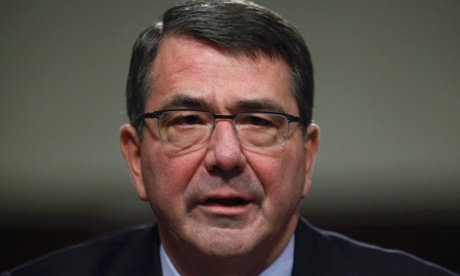
“We do indeed have the finest fighting force in the world,” he says, and “our country has friends and allies, and our adversaries have few.”
“All this makes me proud, and hopeful,” Carter continues, before he hits the major points already brought up by senators: the “savage terrorism” and “turmoil” emerging from the Middle East and North Africa; a “reversion to old thinking” in parts of Europe; cyber defense and warfare; the balance of power in east Asia.
Updated
Carter begins his opening statement.
“I’m honored by his [the president’s] trust and confidence, and also by the prospect of serving the troops and the country that I love so much.
“If confirmed, I will take the office of secretary of defense after one of the most honorable and conscientious public service, Chuck Hagel.”
Carter says he particularly admires “the tireless care which [Hagel] carried out the solemn duty of secretary of defense, which is to the care of the relatively few men and women” who defend the US.
Lieberman gets nostalgic about visiting Russia with Carter, saying that together they held their own downing “vodka toasts” with the Russian military leadership on a mission to oversee the elimination of nuclear submarines.
“When you think about what Russia is doing today and what Russia is doing outside its borders, those memories are really quite poignant. Too much has changed for the worse.”
Then he praises Carter’s logistical skills, saying he got MRAPs to troops in need in Afghanistan “in record time” and noting several other examples.
Updated
McCain now hands off the floor to his “beloved friend,” former senator Joe Lieberman.

Lieberman makes a crack about age: “It was a great comfort to me when I arrived during the Coolidge administration to find you’d already been here for several years.”
He then introduces Carter, noting that he graduated from Yale with a dual degree in physics and medieval European history. “It would be hard to find somebody for secretary of defense with so much practical Pentagon experience.”
Carter is “a brilliant and strategic thinker,” and has worked “directly or indirectly for almost every secretary of defense, no matter their political party,” Lieberman says.
Updated
Money troubles are also the primary matter on Reed’s mind. He says “Congress must find a balanced and responsible solution and repeal sequestration.”
Reed says Carter’s most important job will be to oversee the personnel of the military. “They are tired and overtaxed with a decade of war” and financial instability, Reed says, and “they are wrestling with the same issues as the civilian society, issues like sexual assault and suicide.”
Senator Jack Reed, the ranking Democrat, now takes the mic and also extends the Senate’s condolences to the family of Moath al-Kasasbeh, the Jordanian pilot killed on Tuesday by Isis.
Reed says the “staggering” challenges that the Pentagon faces include the “depraved and violent campaign” by Isis, preventing “a breeding ground for foreign fighters,” ensuring stability in Afghanistan with the Afghan military, Russia’s support of separatists in Ukraine, and “the looming and complex challenge of cyber-warfare.”
He says that the hacking attack on Sony should be seen as “a watershed moment”.
McCain points to a chart of future combat systems spending, illustrating how costs ballooned up to $40bn “with nothing to show for it.”
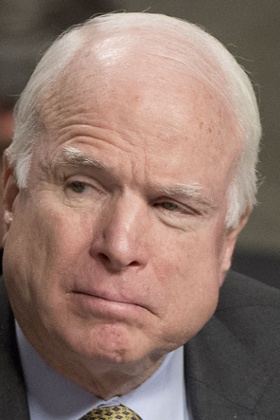
McCain itemizes the many growing costs of aircraft carriers, weapons systems, missiles and aircraft, all with charts showing the millions and billions “squandered and wasted”.
“No individual has been held responsible for these massive cost overruns,” McCain says, and he calls on Carter to change the acquisitions process and reform the way the Pentagon manages its business.
Budget issues are Carter’s specialty – much of his work at the Pentagon with departing secretary was tidying up the books of the Defense Department.
Updated
McCain rattles off the list of foreign policy concerns that the next defense secretary will have to confront, including Isis and “a revisionist Russia and rising China.”
He says the US needs “a comprehensive” and “reality-based” strategy, and rails against sequestration – Pentagon budget cuts. “Readiness is falling across the services, and morale is falling right with it.”
“The navy’s fleet is shrinking to pre-world war one levels,” McCain says, bemoaning the current state of the air force and army as well. He says “the American military can no longer be held hostage to political disputes.”
McCain continues: “I’d like to express my sincere gratitude to Chuck Hagel, for his years of service as an infantry sergeant in Vietnam, for his years in the Senate, and for his time as secretary of defense.”
“This committee wishes Chuck the best in his future endeavors.”
“Dr Carter, even in the best of times the position for which you’ve been nominated is one of the most challenging in government.”
McCain then goes on to praise Carter’s credentials, which most recently include serving as deputy secretary of defense.
“I have known him and members of this committee have known him to be an honest, hard-working public servant.”
“But I must candidly express concern,” McCain says, about the influence over the Pentagon, pointing out that other Obama defense secretaries have criticized the White House for what they called overbearing control over military operations.
Updated
McCain begins with the standard set of questions for a confirmation hearing, eg: “Have you adhered to applicable laws and regulations regarding conflict of interest?”
Carter makes all the nods and noises the committee wants to hear.
“We’d like to extend our deepest condolences to the family of the Jordanian pilot” killed by jihadi militants, McCain continues.
He says the pilot is a hero, and that his death should spur a more comprehensive US policy against Isis.
“Let there be no doubt, we still do not have a viable strategy to counter Isil. And if you’re not winning in war you are losing.”
He then promises Jordan support from the US to fight Isis and reaffirms US support for King Abdullah.
The Senate armed services committee is filing into the Capitol, led by the new chair, Republican senator John McCain. Democrat Jack Reed is the ranking member.
Carter is taking his seat surrounded by the usual scrum of photographers.
Spencer Ackerman (@attackerman), the Guardian’s national security editor, has this to say about Carter, Hagel, the president and the next few years in the American military:
Just because Ashton Carter faces no meaningful opposition doesn’t mean his confirmation hearing today to become Barack Obama’s next secretary of defense will go smoothly. Ask the man he’s replacing: Chuck Hagel confusedly misrepresented Obama’s policy positions – containing a nuclear Iran, for instance – and was barely able to articulate his own. Hagel’s 2013 Senate armed services committee debacle set the tone for his poorly received tenure at the Pentagon.
Which is what makes Carter’s turn, two years later, so important. A technocrat long in the Democratic foreign-policy firmament and recently a deputy secretary of defense, Carter is not known for unorthodox or controversial positions.
The flip side of that is he has yet to expand on the front-burner issues he’s tasked with confronting: the scope of an open-ended war against the Islamic State; transferring detainees from Guantanamo Bay; when the US ought to attack adversary data networks; a US war in Yemen that now lacks a reliable local proxy; and preventing Afghanistan’s US-developed military from collapsing, as Iraq’s did.
How Carter fills in those blanks, Spencer says, will indicate a lot about the direction of the Pentagon in the final stage of Obama’s presidency.
Carter is much, much more predictable about the Pentagon’s bread-and-butter concerns around military budgeting; and purchasing major ships, planes and weapons systems. If he stumbles on those, Carter could be in real trouble, even if, as expected, he sails through his upcoming Senate vote.
Updated
Hello and welcome to our live coverage of the Senate nomination hearing for Barack Obama’s new Pentagon chief.
Ashton Carter, a former Pentagon deputy, will face a grilling from the Senate Armed Services committee at 9.30am in Washington. Republicans on the committee are sharply critical of Obama’s military drawdown plan in Afghanistan. “I think he’s well qualified. He’s going to have to do well. He’s going to have to defend the president, but not to a fault,” Senator Lindsey Graham told Reuters today.
If confirmed, Carter will become Obama’s fourth secretary of defense. He will replace outgoing secretary Chuck Hagel, who was pressured to resign last year.