Putting Shane Warne to one side, which is never the easiest of manoeuvres, spin bowling has seldom decided an Ashes series in modern times. But the spin bowlers still have a vital contribution to make.
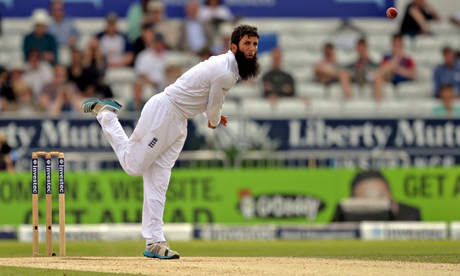
The sun has been shining and the pitches are drying out, which does not necessarily mean the ball will be turning square at Cardiff or Lord’s. But it does mean that the fast bowlers are less likely to prevail easily. They will need help and rest, and the modern spinner has to provide that. Nathan Lyon and Moeen Ali, despite the inclusion of Adil Rashid in England’s 13 for Cardiff, are likely to be busy in the next fortnight.
Unlike pace bowlers, Test spinners seldom have the reassurance of hunting in a pack. Lyon may get occasional help from Steve Smith or Adam Voges; so might Moeen from Joe Root; but essentially the pair are each responsible for providing their side’s spin, which is becoming a more challenging undertaking.
Take as an example Australia’s first game of the tour at Canterbury. Admittedly it was a relaxed occasion, lacking the intensity of a Test match. Even so it gave an indication of how modern batsmen view the advent of a spinner. Adam Riley, Kent’s promising young off-spinner, bowled 35 overs which yielded four for 201; Fawad Ahmed, Australia’s leg-spinner delivered 26 overs and four for 156. Six runs an over was the norm, whichever side was batting.
Modern batsmen see the introduction of the spinner as respite and an opportunity to grab quick runs. Even the soft-spoken Daniel Bell-Drummond of Kent, who hit a splendid century, said he decided to attack Fawad at Canterbury because the pace bowlers would probably get him sooner rather than later. The old stalwart, Rob Key, adopted a similar philosophy. The Essex batsmen were equally aggressive against Lyon. Meanwhile Australia went after Riley against Kent and the inexperienced Aron Nijjar at Essex. That will be their strategy against any England spinner in the Tests.
The balance of the spin attacks has fluctuated wildly over the past 30 years. For more than a decade the Australians had Warne; hence they had a huge advantage. Then Graeme Swann overshadowed whomever they chose in the post-Warne era – and they tried just about everyone available. Now the perception is that Lyon, whose 146 Test wickets is the biggest haul of any Australia off-spinner, gives the tourists the edge. It is hard to argue with that even though Moeen has taken his 33 Test wickets more cheaply than Lyon (at 32 apiece rather than 34).
Lyon has learned on the job; Moeen is still doing so and in this series the Australian’s task may be less daunting. Off-spinners prefer bowling to left-handers, especially now umpires recognise all those lbw possibilities. England will probably have seven of them in their team – though Lyon will have to be at his most persuasive to keep the ball in his hand when Stuart Broad and Jimmy Anderson are at the crease. Moreover, three of those left-handers, Alastair Cook, Adam Lyth and Gary Ballance, are not inclined to take the attack to the off-spinner. Even if Lyon does not dismiss them he should be able to keep them quiet.
England should take a positive approach against the spinner – recall how they were becalmed by the relative novice Mark Craig during New Zealand’s win at Headingley in June – but this is easier for right-handers and they have only three in their first eight batsmen. It may well be that Lyon will not bowl so much to Ian Bell, Joe Root and Jos Buttler in the first innings.
In the second innings this could change. The other factor for the off‑spinners of both sides will be the rough outside the right-handers’ off stump later in the game. This will be created by Australia’s left-arm pacemen (the anticipation here is that they will play Mitchell Johnson and Mitchell Starc). Land the ball in the rough consistently and the batsmen cannot trust what will happen.
There is more debate over whether Moeen is the right man for the job rather than is the case with Lyon, who has finally become unassailable. The inclusion of Rashid fuels that discussion though the expectation is that his wrist-spin will be required only at Cardiff in the unlikely event England opt for a second spinner in their XI. Moeen’s stock off-break is superior to that of his finger-spinning rivals; he imparts more spin than James Tredwell or Riley and often manages to get the ball to dip more at the end of its flight path. He lacks experience of bearing the burden of the frontline spinner, though, which was highlighted in Barbados in the final Test against West Indies, when the ball was turning and expectations of him soared.
Moeen performed excellently last summer against India and needs to remember how. He kept it simple; there was no pursuit of cunning variations of pace or flight, no indulgences with his over-hyped doosra. There were no frills; he did not chase wickets; he bowled relatively quickly and accurately, whereupon Cook kept him on and the wickets somehow came. It will be trickier this time since the Australians will attack him from the start, a challenging proposition but one that also gives him opportunities.