A is for AB
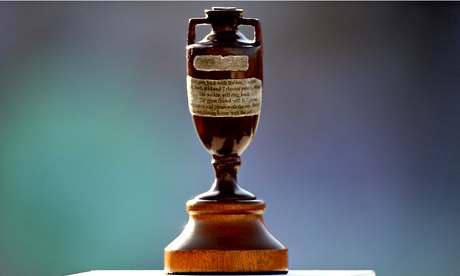
A man so good he colonised the first two letters of the alphabet, Allan Border revitalised and revolutionised Australian cricket with a ferocious toughness that underpinned a generation of glory. In the first instance an unwilling leader, his players soon knew him as Captain Grumpy – but they quickly learned that it was worth it. In 1987 he led them to World Cup victory, beating England in the final, and then, in the 1989 Ashes, his team dispensed one of sport’s great surprise kickings. Hitting six half-centuries in a 4-0 win, Border’s contribution to the cause earned him the Australian of the Year award, and things continued in similar vein, the urn retained by 3-0 in 1990-91 and 4-1 in 1993. The culture he imposed sustains even now.
B is for Bradman
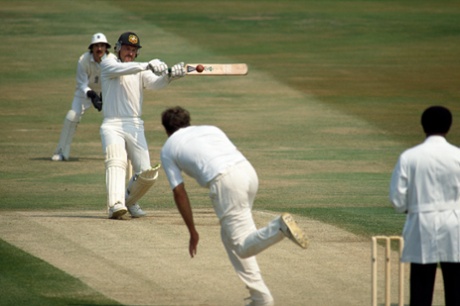
To the extent that sport is about being the best, Sir Donald Bradman is the greatest sportsman of all time; statistically only Phil Taylor, with 16 world titles to Eric Bristow’s next-best five, can compare to Bradman’s batting average of 99.94 to Graeme Pollock’s next-best 60.97. Naturally, he made England suffer – though he was made to suffer too, the focus of the controversial leg-theory bodyline attack deployed by England to win the 1932-33 Ashes. But, champion that he was, he wrought a terrible revenge, inspiring Australia to win four of the next five series – the other was drawn, so they retained the urn nonetheless – and on retirement his average in 19 Tests played in England stood at a preposterous 102.84.
C is for Cans
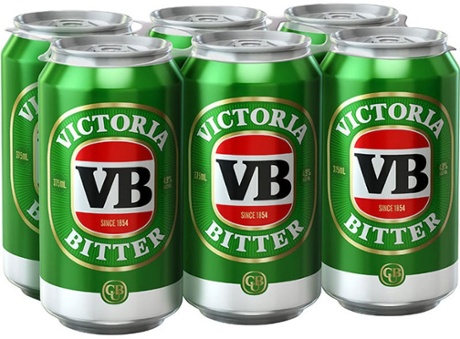
A good deal of cricket’s allure lies in its nuanced, textured relationship with intoxicating elixir. So it was that in 1973, Doug Walters and Rod Marsh calculated that a 30-hour flight home from the Caribbean should see them enjoy 35 cans – in Australian, “tinnies”. Though their beer supply was exhausted before they were, the concept was clearly eternal, so by the time they visited England in 1977, in true baggy green style, idle relaxation had become macho competition. It was Walters who won, his mark of 44 standing until 1989, when David Boon, that most Australian Australian, finished, with moving poignancy, on 52 not out. Soon after, he hit the runs that gave his country its first Ashes series away win since 1975.
D is for Davis
In 1975 Australia headed into Headingley for the third Test of a four-Test series leading 1-0 and needing only a draw to retain the urn. But they scored only 135 in their first innings and were eventually set a target of 445 runs to win. At the end of day four they were 220 for three, the match delicately poised. But the following morning the groundsman discovered that oil had been poured on the pitch, a hole dug in one crease and graffiti scrawled on a wall nearby proclaiming: “George Davis is innocent.” After consultation with the captains the game was abandoned, ending England’s Ashes hopes. Davis, who was serving a 17-year sentence for armed robbery, was indeed declared innocent the following year, but in 1978 went back to prison – for armed robbery.
E is for Edgbaston
This unassuming ground tucked away just off the A38 as it scurries south-west from Birmingham has been the venue for two of the greatest Ashes Tests. The first was in 1981, hot on the heels of perhaps the greatest ever. Edgbaston 1981 may always be just the sequel to Headingley’s blockbuster but it was still a belter – Judgement Day to Headingley’s Terminator. England had set Australia 151 to win on a track that did not share the demons of the Leeds pitch a fortnight earlier and they were on track at 105 for five. But Ian Botham then took five wickets in 28 balls to reduce the tourists to 121 all out. England won by 29 runs but that was a landslide compared to the finish of the Edgbaston Test in 2005: Harmison, Kasprowicz, Jones, that Flintoff handshake and an England victory by two runs.
F is for Fleetwood-Smith
Left-arm spinner Chuck Fleetwood-Smith played in seven Ashes Tests for Australia, experiencing the heights of glory and the troughs of ignominy. The peak came in Adelaide in 1937 when he produced a notably brilliant delivery to take the crucial wicket of Wally Hammond and help Australia recover from 2-0 down to win the series 3-2. His captain, Don Bradman, said that “if ever the result of a Test match can be said to have been decided by a single ball, this was the occasion”. At the Oval the following year he snared Hammond once again, in the first innings. Less happily he also conceded 298 runs (still a record) as England scored 903 for seven declared (another record) and won by a laughably emphatic innings and 579 runs (another).
G is for Gabbatoir
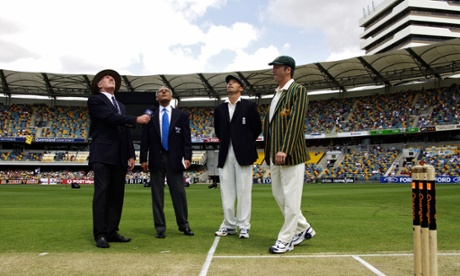
In Woolloongabba, Brisbane, Queensland, Australia is found the Brisbane Cricket Ground, known as the Gabba, as well as the Gabbatoir. According to tradition, it is where England are pulverised in the first Test of every Ashes series. In 20 matches, Australia have won 11, lost four, the last of those defeats coming in 1986. They have twice conceded draws since then but have won the remaining five contests by margins of 10 wickets, 184 runs, 384 runs, 277 runs and 381 runs. Arguably the most famous of these humiliations came in 2002, when a petrified Nasser Hussain won the toss, opted to field and watched Australia end day one on 364 for two, en route to a first innings total of 492 all out.
H is for Hands
Hands are generally, um, handy in cricket, and Greg Chappell owned a particularly fine pair, his 61 catches being an Ashes allcomers record which included seven in a single Test in Perth in 1974. Graham Gooch’s are also memorable, for in using them to stop the ball reaching his stumps at Old Trafford in 1993 he became the only man in Ashes history to be out handled the ball. On the final day of the first Test he was on 133 as England desperately tried to avoid defeat, when a Merv Hughes delivery came off Gooch’s body and was prevented from looping stumpwards by his gloved fist. Dickie Bird raised his finger, Australia won the match, and the tourists took the series 4-1.
I is for Invincibles
In 1948, Don Bradman led Australia’s touring party to England for his final Test series. Playing 112 days out of 144, he and his team cut a swath, winning 25 and drawing nine of their 34 fixtures, 31 of which were first-class; true Invincibles do not lose in any circumstance. But their legacy extends beyond that, thanks to two of cricket’s many famous numbers: Essex bowled them out in a day, but not before 721 runs had been scored – still a record – and in the final Test a demoralised England collapsed to 52 all out, helping cement a 4-0 series victory.
J is for Johnston
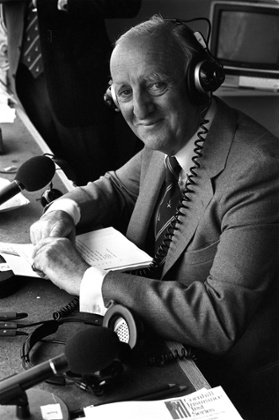
There was no shortage of England heroes in 1953: Alec Bedser took 14 wickets in the first Test; in the second Willie Watson arrived at the crease on day four with England in desperate trouble on 12 for three and left it with the score at 236 for five and all but safe; in the third Johnny Wardle collected remarkable second-innings figures (five overs bowled, seven runs conceded, four wickets taken). But despite their efforts the first four Tests were drawn, so a sixth day was hurriedly scheduled to guarantee a result in the fifth. It took only four, and the man whose contribution is best remembered was in the commentary box, where Brian Johnston greeted England’s winning runs with a famous scream of “It’s the Ashes! It’s the Ashes!”
K is for King
The first time a reigning monarch turned up at a Test, England were not even playing, George V catching some of Australia’s game against South Africa at Lord’s during a triangular tournament in 1912. George VI was more hands-on, being patron of Surrey, Lancashire and the MCC and a decent cricketer, and hosted the Australians at Balmoral in 1948.
Even he is trumped by Queen Elizabeth II, who in 2013 met both teams at Lord’s and also happened to be visiting a bowls club when England won the first Test; on being told the news from Trent Bridge a patron spotted her doing “what looked like a little fist pump”.
Ashley Giles, England’s King of Spain, is ruled out of the top-monarch running on a technicality.
L is for Lord’s
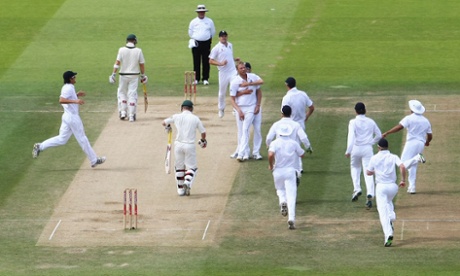
Home of cricket, and also of Australian chirpiness. When England bowled out Australia for 53, including five ducks, on the first day of the first Test in 1896 to set up a six-wicket win, they had won four and lost one of the first six games between the teams in St John’s Wood. The next 113 years featured just one more England victory, alongside 13 draws and 13 defeats. Then came 2009, and surely Andrew Flintoff’s finest spell on his last Test appearance at the ground, his second-innings five-for accounting for the openers and, perhaps most importantly, the obstinate Brad Haddin as England secured their first Lord’s win over the Aussies for 75 years. Another victory in 2013 suggests Australia’s spell has been definitively broken.
M is for Massie
Australia lost the first Test of the 1972 series, so presented Bob Massie with his baggy green. His swing, in tandem with Dennis Lillee’s pace, obliterated the England order in the second Test at Lord’s. Massie took eight for 84 in the first innings, then another eight for 53 in the second. He became the first bowler to claim more than 12 wickets on his Test debut, and his match figures of 16 for 137 were the third best of all time, behind Jim Laker’s 19 for 90 and Sydney Barnes’ 17 for 159. For the record, Lillee mopped up the other four wickets. Sadly, there was nowhere to go but down. England retained the Ashes that year, after which Massie quickly misplaced his outswinging mojo and played only five more Tests.
N is for Northamptonshire
The county from which England famously plucked David Steele in 1975. Australia had won the first Test, causing England to replace the captain Mike Denness with Tony Greig. The new skipper identified Steele, an uncapped 33-year-old with grey hair and spectacles, as the premier player of fast bowling in the country. As Steele walked to the crease in the second Test at Lord’s, with England 49 for four, he was greeted by Australia with derision. “Who the hell’s this? Groucho Marx?!” But Steele was no shyster. His half-century steadied England, who secured a draw. In the final two Tests, Steele scored 73, 92, 39 and 66. Not enough for a win to level the series, but Steele was later rewarded for his work with the BBC’s Sports Personality of the Year award.
O is for Old Trafford
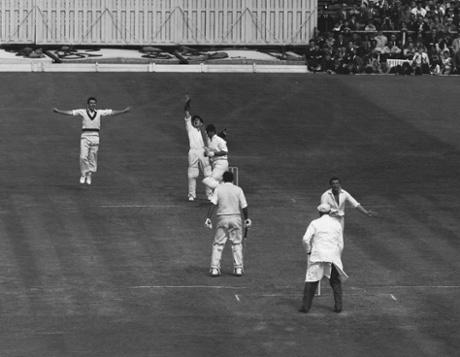
The scene of Richie Benaud’s career-defining smash-and-grab in 1961. On the final day of the fourth Test, with the series level, England looked set for victory. Chasing 256, Ted Dexter and Raman Subba Row put on 110 for the second wicket to take England to 150 with time remaining for the final push. Enter Benaud, whose spin teased Dexter into making a rash cut, edging to the wicketkeeper Wally Grout. The new man Peter May tried to sweep against the spin and was bowled round his legs for a duck. Grout had to inform the thoroughly discombobulated May what had just happened. Cue a sorry collapse: May’s was the first of eight wickets to tumble for 51 runs. Australia, having faced defeat, were guaranteed to retain the Ashes.
P is for Pint
We’ve had Cans, so it’s only fair the tinny’s more sophisticated sibling, big brother Pint, has his say too. In 1956, few expected anything other than a draw at Old Trafford – there had not been a decisive result in Manchester, thanks to the rain, since 1905. Step forward Jim Laker.
After tea on the second day, Australia were 62 for two. Within 35 minutes, they had lost their last eight wickets for 22 runs. Laker had taken seven of them, for eight runs, in 22 balls. He ended the innings with figures of nine for 37 – then skittled the Aussies all by himself as they followed on, 10 for 53. On his way home, he stopped off to celebrate his 19 for 90, never bettered to this day. A quick pint. Quietly. Modestly. On his own.
Q is for Quick
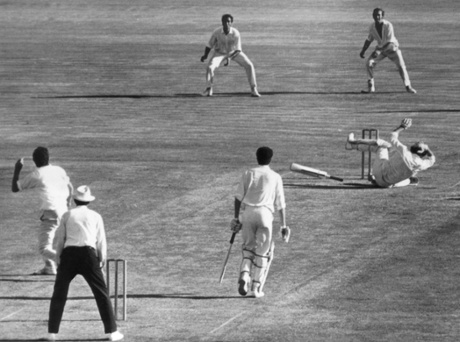
Australia couldn’t handle John Snow, who bowled fast and pitched short. The super-aggressive Snow – the son of a vicar – rattled the Australians twice at Sydney in 1971. In the fourth Test, he posted career-best figures of seven for 40, dismissing Rod Marsh and Ian and Greg Chappell, forcing Garth McKenzie to retire hurt after taking a bouncer in the face, and packing off three men for ducks. Back at the SCG in the seventh and final Test, a short delivery sent Terry Jenner back to the pavilion. Snow was pelted with pies by the crowd, then taken forcefully by the throat by one lubricated fan, desirous of trenchant debate. England won both Tests, and the series 2-0. Snow’s 31 wickets – and attitude – had been the difference.
R is for Randall
The 1977 Centenary Test ended as the very first Test between the sides did: with Australia beating England by 45 runs in Melbourne. The star of the show however was English. Derek Randall, despite at one point being cracked upside the head by a Dennis Lillee bouncer, smashed his way to a spectacular 174. Randall continued his good form when the Ashes came round later in the year. He scored two half centuries in the first two Tests, then in the third was run out by Geoff Boycott, on his home ground of Trent Bridge. Randall kept running, to the pavilion, close to tears. But there was a happy ending, as he hit the winning runs in the second innings, then took the catch that secured the Ashes at Headingley.
S is for Spofforth
The 6ft 3in Australian fast bowler Fred Spofforth would have had a place in the history books anyway: he was the first man to get to 50 Test wickets, and the first to take a Test hat-trick (against England, naturally). But one performance in particular assured him of everlasting fame. At the Oval in 1882, England required only 85 runs to beat the Aussies, and made their way to 66 for four. At which point Spofforth whistled down 11 unplayable overs, conceding just two runs and claiming four wickets. England, shattered, collapsed to 77 all out. It was their first defeat on home soil, Spofforth ending with match figures of 14 for 90. And so Reginald Shirley Brooks, society gadabout and wit, placed a mock obituary in the Sporting Times, mourning the death of English cricket. You know the rest.
T is for Thomson
Australia were not shy in coming straight back at England after being buried by the Snow storm of 1971. Announcing himself on England’s next visit down under, in 1974-75, was one Jeff Thomson, commonly regarded as the fastest bowler in the history of the Ashes (though Frank “Typhoon” Tyson might have disagreed). Thomson, a former competitive javelin thrower, set about terrorising England with a constant barrage of bouncers. After four-and-a-bit Tests, Thomson had taken 33 wickets and seemed certain to break Arthur Mailey’s Australian series record of 36. At which point he injured his shoulder playing tennis on the rest day during the fifth Test. Out for the series. But the serious damage – the stuff inflicted on England – was already done, the series already in the bag.
U is for Underwood
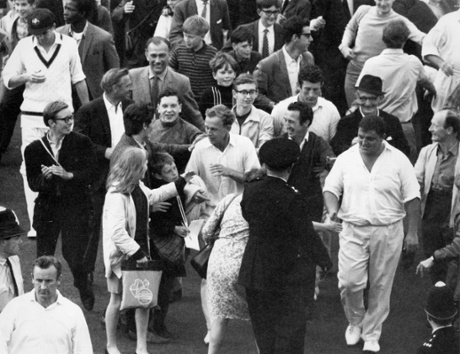
Going into the final Test of the 1968 series, Australia had already retained the Ashes, winning at Old Trafford, the weather robbing England at Lord’s and Edgbaston. The series then seemed destined to end in more meteorological woe for England. The Aussies, battling on the final day of the final Test to force a draw, found themselves five down at lunch – but then a three-hour thunderstorm drenched the pitch. More play looked unlikely, but scores of fans desperately mopped up the excess water, and the match resumed. With 30 minutes left, Basil D’Oliveira bowled Barry Jarman, and suddenly the climate closed in on Australia: Derek Underwood took four quick wickets for six runs, capturing John Inverarity leg before to tie the series with six minutes to spare. Everyone went home happy. Sort of.
V is for Verity
Under normal circumstances, the top line of Australia’s 1934 series win would be the scoreboard-bothering antics of Don Bradman and Bill Ponsford in the final two Tests: they shared partnerships of 388 at Headingley and 451 at the Oval, Ponsford helping himself to scores of 181 and 266, Bradman 304 and 244. Yet arguably the most memorable contribution came from one of the losers. Australia hadn’t lost at Lord’s for 38 years, a home away from home. They weren’t expected to lose this one. But Hedley Verity, benefiting from spin-friendly sodden conditions, ran through the Aussies, taking 15 wickets for 104 runs, including Bradman for 36 and 13. Fourteen of Verity’s wickets came on the third day, still an Ashes record. England didn’t beat Australia at Lord’s again for another 75 years.
W is for Warne
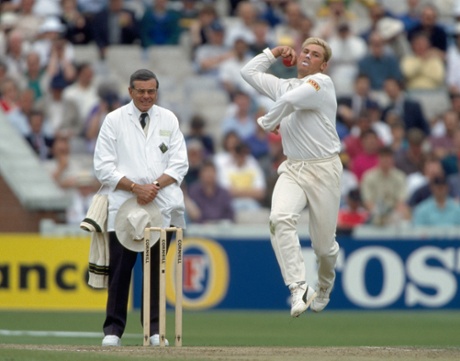
June 4, 1993, First Test, Old Trafford. Mike Gatting, new at the crease, has just found the boundary with a square drive. He looks in the mood. England are going well, at 80 for one, Australia having posted an average first-innings total of 289. Allan Border throws the ball to an Ashes debutant, the wrist spinner Shane Warne. His first delivery drifts to the right, pitches 18 inches outside leg, then breaks at a right angle across Gatting’s body to clip the outside of off. Gatting – a renowned player of spin – stood stock still, in shocked disbelief, though in fairness the Aussie keeper Ian Healy had followed it down the leg side too. England crumbled to 210, losing the Test, then the series 4-1. It took England a dozen years to recover from that one epochal ball; Gatting never did.
X is for Castlemaine XXXX
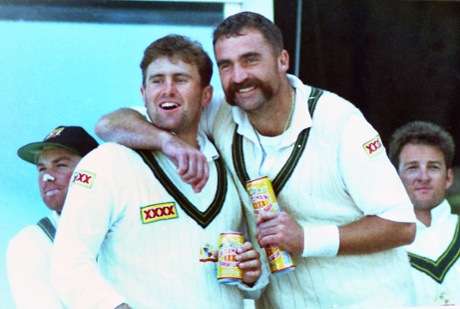
A popular isotonic sports beverage shilled by the Australians during the 1989 series. The glamorous poster boy for the Castlemaine campaign – “Australians wouldn’t give a XXXX for anything else” – was Victorian dad Merv Hughes, his hairy face saturated with foam. Appropriately for this most loyal of brand ambassadors, Merv had a dirty XXXXing mouth on him. “You can’t XXXXing bat,” he told Robin Smith during the Lord’s Test, the England batsman having played and missed several times as Hughes applied the pressure.
Smith hit back with one of the famous sledges. Whistling the very next ball away for four, he replied: “We make a fine pair. I can’t XXXXing bat and you can’t XXXXing bowl.” Other Antipodean refreshments are available.
Y is for Yabba
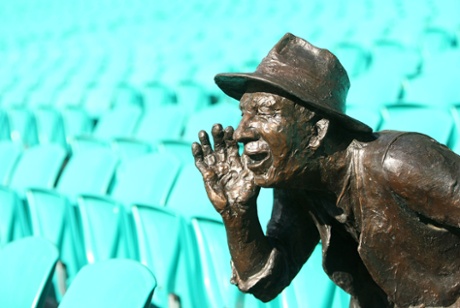
Stephen Harold Gascoigne, better known as Yabba, used to frequent The Hill, a grassy mound at the SCG long since lost to seating. Yabba spent his time there dishing out lyrical abuse. Having started acting up in the early 20th century, when matches were watched in hushed reverence, he quickly became something of a legend, delivering some splendid harangues, not least “Your length is lousy but you bowl a good width.” But his masterpiece came during the final Test of the infamous 1933 bodyline tour. As Douglas Jardine took guard he swiped a fly from his face. “Hey Jardine,” cried Yabba. “Be careful with our flies. They’re the only friends you’ve got!” One suspects Yabba would have faced down the Barmy Army all on his own.
Z is for Zillion-to-one
We could have gone for Tim Zoehrer, who put a stop to Phil Edmonds’ incessant yap with a pointed reference to his writer wife: “At least I have an identity. You’re just Frances Edmonds’ husband.” Or we could have mentioned the Zooter, Shane Warne’s mystery ball, possibly a fictional construct but a very real psychological gambit. But let’s settle on the improbable series of circumstances – a zillion-to-one shot, surely – that arguably won the Ashes for England in 2005. Brought on at Trent Bridge as a substitute fielder for the injured Simon Jones, Durham’s Gary Pratt took a shy at the stumps from cover, ran out an in-form Ricky Ponting, and tilted a match, and an entire series, that had been on a knife-edge in England’s favour.