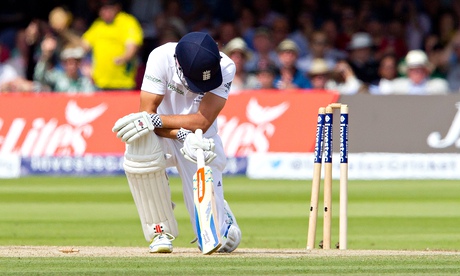
So overwhelming was England’s defeat by Australia in the second Ashes Test that, as they pick their way through the wreckage of their shattered confidence, a thorough examination of historical statistics is unlikely to figure high on their priority list. And perhaps that is just as well, for they will find little succour there.
The stark fact is this: it is 30 years since a team have lost the second Test of an Ashes series and won the urn. In the past 15 series the second Test has been drawn twice, and on 13 occasions won by the team that would eventually end their campaign high on man-hugs, serotonin and champagne.
It may improve English spirits a little to know that back in 1985 it was Australia who pulled level with victory at Lord’s, and England who accelerated away to win the series. But there are few similarities between the 1985 series and this one. This England side has a horribly misfiring top order; then England’s top four was settled and confident – David Gower, Mike Gatting, Tim Robinson and Graham Gooch all ended the series with averages above 50. Australia meanwhile were heavily reliant on their captain, Allan Border, who had won the second Test almost single-handedly with a first-innings 196.
England’s bowling was less impressive, and they thrashed around for much of the summer in search of a winning combination, on the way handing Ryan Sidebottom’s dad Arnie his only cap and the future commentator Jonathan Agnew his third and last, before in desperation recalling Richard Ellison with two games of the series remaining. Ellison had laboured through a tour of India the previous winter, taking four wickets in three matches, but given another chance he took 10 at Edgbaston and another seven at The Oval – with a bowling average over the two games of 10.88 – to help England to a 3-1 series win.
The differences between the sides then and now were if anything more stark away from the field of play: this Australian side has refused to socialise with their opponents until the series is over; in 1985 it was hard to keep them apart, to such an extent that Border spent the rest day in the middle of the second Test playing golf with Ian Botham.
To an extent, the success of second-Test victors since that tour merely reflects Australia’s dominance for most of the intervening years. Famously, between the last Test in Sydney in 1987 and the first Test at Lord’s in 2005 England won only seven of 43 matches, and just one while the urn was still at stake. In other words, for nearly 20 years Australia almost always won the second Test, had normally won the first as well, and absolutely always won the Ashes. Six times in nine series from 1986 to 2002-03 they ended the second meeting 2-0 up, and on one of the others they led 1-0.
The lack of proper contests means that 15 of the past 17 Ashes series have been taken by the first team to win a Test. Since the glory decade of 1962-1972, a period of unusually close combat when England won seven Tests, Australia six and 18 were drawn, the average series score has been 3.1-0.7.
The greatest comeback in modern Ashes history, such as it is, came in 1997, the only time since the legendary 1981 series that a team have fought their way from being behind after two Tests to win the Ashes. Even then the optimism of the England fans, who deliriously sang that the Ashes were coming home as Nasser Hussain and Graham Thorpe put on a fourth-wicket stand of 288 in the first Test at Edgbaston – Australia having won the toss, chosen to bat and lost seven wickets before 50 runs were on the board – always felt a bit misguided.
England won that first game but were bowled out for 77 at the start of the second, in which they were rescued by rain and held out for a draw, lost the next three by massive margins, and then sneaked victory in a curiously low-scoring sixth and final Test in which Australia, eventually set 123 to win – a target even the current England side might feel reasonably confident about – fell 19 runs short.
England’s great success in that game was a recalled Phil Tufnell, who took seven in the first innings and four more in the second. “It was such a tight game, every ball I bowled seemed like it was win or lose. The intensity was something else,” he later recalled. “And that was a dead rubber with the Ashes already lost.”
Only once before in all of Ashes history has either side won a Test by a margin of between four and five hundred runs. It was also the second meeting of a series, also played in Lord’s, and also won by Australia, who eventually prevailed by 409 runs, precisely four more than they won by this year. There are no good omens here either: it was 1948, and the Aussies went on to win six of the next seven meetings as well, drawing the other.
In short, whatever happens when the teams next meet on Wednesday week, a chorus of The Ashes Are Coming Home will probably be best avoided.