So in the aftermath of their comprehensive win at Edgbaston, England have that elusive thing called momentum going into the fourth Test at Trent Bridge starting on Thursday. Or do they? They had plenty of momentum after the victory in Cardiff too, and look what happened at Lord’s. Then the momentum was with Australia after that, and much good it did them in Birmingham.
Isn’t the current situation similar to the one England found themselves in after their draw at Edgbaston in 2009, with a win in the fourth Test all that was required to take the Ashes? They lost by an innings at Headingley to leave things in the balance for the final Test. The present sequence of England swinging violently between the twin imposters of triumph and disaster – WLWLWLW starting with the victory over West Indies in Grenada in May – has already made them the most consistently inconsistent side in the history of Test cricket.
Thus, when it comes to Nottingham, it is anyone’s guess whether it will be Australia, stung by defeat, responding in the strongest possible fashion, or England who will continue the bizarre sequence that, were it to continue to the end of the Test summer, would still result in England regaining the Ashes.
Will punch and counterpunch be met with yet more counterpunching, or – in a manner unforeseen by most pundits, let’s be perfectly honest – have England finally broken the back of the Australian effort?
There is no question that the burden of scrutiny is pressing down hard on the Australia side, particularly the captain, Michael Clarke, who is starting to feel the heat from his own media in a manner about which Alastair Cook could well give him a discourse.
The groundswell of goodwill created by the impressive way in which Clarke led a grieving nation following the Phillip Hughes tragedy has dissipated as his team lose and his own batting, surely hampered by a chronic back condition in particular that will probably be the eventual catalyst that draws his career to a close, is failing. A captain likes to lead from the front, and Clarke is failing to do that at the crease. And, as the skills of his vaunted pace attack have been found wanting, so his captaincy has looked lacklustre and at times disconnected.
In terms of leadership Cook has more than had his measure so far. There is disquiet in the Australian ranks, too, against which, win or lose, the England team are a spirited bunch. There is too much anecdotal evidence from well-informed sources for there not to be substance to the idea that the coach Darren Lehmann and his captain do not see eye-to-eye, a situation that can be traced back to when the coach first took the job only on the understanding that Clarke would be removed from the selectorial process.
There is scarcely a press conference passes without Clarke making a pointed reference to the fact that he does not pick the side. The squad are by no means unanimous in their loyalty to him. But the omission of Brad Haddin at Edgbaston raised waves the other way because although it was a perfectly pragmatic decision based on performance, the wicketkeeper, who would have played after Cardiff, had only opted out of selection at Lord’s to be with his sick child.
Clarke, first and foremost a self-absorbed cricketer, can also see the threat to his position from Steve Smith who, despite Clarke’s best efforts while injured last year to get Brad Haddin appointed interim captain, revelled in the role as batsman and leader and the team responded to it.
For public consumption, Lehmann is saying all the right things in backing Clarke but the captain’s position in the side is being gradually undermined and Smith is the heir-very-apparent. Talk of Clarke moving himself down the order to a position in which his overall record is better (something achieved in no small part because of the quality of players above him) will only exacerbate the opprobrium, a captain on the retreat rather than being expedient. He will presumably see the series out come what may, but were Australia to lose, there is no way he can survive beyond that.
What of England? When Jimmy Anderson left the field midway through his ninth over in the second Australia innings at Edgbaston, he did so not with the air of someone who had suffered an intercostal injury, which can be excruciating and is the bane of pace bowlers, but instead of one who felt a twinge and was being cautious. It may even be that the medical staff saw him stretching and rubbing his side and called him in. Instinct says he will be back for the final Test at The Oval with the possible caveat that the series is already over. In the interim, the calls-up for Liam Plunkett and Mark Footitt are interesting bearing in mind the venue.
Seeking a like-for-like replacement for Anderson would have been one way to go, with Chris Woakes, brisk fast-medium but with a full natural length, the closest. But just because Anderson takes wickets, it does not mean that others cannot.
When the ball swings, or moves off the seam, as it can do at Trent Bridge, then the key is harnessing it rather than trying to make the ball do something, a skill that was singularly lacking among the Australia pacemen at Cardiff and Birmingham.
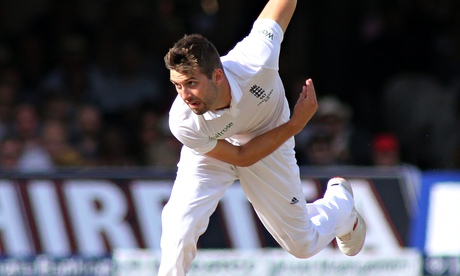
The likeliest outcome will be that Mark Wood plays and opens the bowling with Stuart Broad, with Steven Finn, who took six for 79 in the second innings at Edgbaston, as first change again. This is a ground on which Wood has already excelled for Durham and if the bowlers have control of the movement then the quicker they can get it through, the better.
Of the two reserves, it is Plunkett who has the Test experience and the uncapped left-armer Footitt the form this season, albeit for Derbyshire in the second division.
A left-arm paceman, something England have possessed only rarely down the years (Bill Voce remains the most successful and the only one to reach 100 wickets) would provide an angle of attack that Australia would find new in the middle but not in the nets. Plunkett can be rapid, and although his default method might be thought to be back of a length, can actually bowl to hit the top of off-stump without floating the ball down as some do when asked to pitch it up further. If Wood is not fit (and all the indications are that he will be) then it should be to Plunkett that they turn.