Ashes series are generally won by the pacemen. Think Harold Larwood, Frank Tyson, Dennis Lillee and Jeff Thomson, John Snow, England’s Fab Four of 2005, Glenn McGrath and Jason Gillespie, Mitchell Johnson and Ryan Harris. In all probability the pacemen will be decisive this time as well. Each side will have at least three of them at their disposal.
However, in Cardiff the pacemen did not always predominate. Of the 40 wickets to fall, 13 were taken by off-spinners, all of whom have, at some point in their careers, been derided as lightweights. Nathan Lyon may now be the most prolific ever Australian off-spinner but initially he was showered with faint praise. He eventually established himself as the least worst replacement for Shane Warne amid a host of rejected candidates.
The suspicion remains that Moeen Ali is really a batsman who bowls – despite his remarkable Test record. It may be a statistical quirk, and it may not last, but Moeen currently takes his Test wickets more cheaply than Fred Titmus or John Emburey did. Hence it is a source of concern that Moeen has been struggling with a side injury, but he will still play in the Lord’s Test. Meanwhile, it is an absolute certainty that Joe Root resides in the category of a bowling batsman.
Yet the unlikely trio of off-spinners in Cardiff picked up wickets at regular intervals. Admittedly the pitch offered a little help, while being frustratingly slow for the Aussie pacemen. But it was hardly a “bunsen burner”. So why were they so successful?
Well, they had a bit of help from the batsmen. (Here, it must be noted, there is a challenge for old spinners, denied the revolution brought about by DRS, which has multiplied the number of lbws, not to sound resentful). Of the 13 wickets to fall to spinners in Cardiff nine came about as a consequence of the batsmen having a whack and succumbing. Arguably only one dismissal was the consequence of a very fine ball – Adam Lyth edged a sharp-turning delivery from Lyon in the second innings, which was very well caught at first slip by Michael Clarke.
The most vivid example of the batsmen’s wantonness came from Stuart Broad. He battled nobly against his bête noir, Johnson, in the first innings. He did not look particularly comfortable but it was a gutsy effort.
Thereafter he faced three balls from Lyon in the match and was dismissed by two of them, having a horrible heave both times. Such generosity to a toiling off-spinner seldom occurred in days gone by (at least not when I was bowling).
Perhaps more culpable still were Steve Smith and Clarke in Australia’s first innings. Both fell attacking Moeen. The subplot was: “This bloke can’t really bowl; we are going to expose him.” This may well have been a sound strategy and a typically Australian one, but it did not work. It may be that the off-spinners of both sides have been underrated. As a consequence many wickets came their way in Cardiff.
Do not mistake this observation to mean that bowling spin is easier now than in decades past. But it is very different. Now the spinner is constantly on a knife-edge. The days of “milking” him seem to have passed; instead the batsmen seek to marmalise him. Hence running up to bowl even in a Test match becomes a more nerve-racking, “him or me” undertaking. By and large Moeen, despite his horrible 17-run second over on the final day, held his nerve well in Cardiff in the knowledge that the batsmen were after him. Moreover Alastair Cook handled him sensitively. The same can be said of the more experienced Lyon.
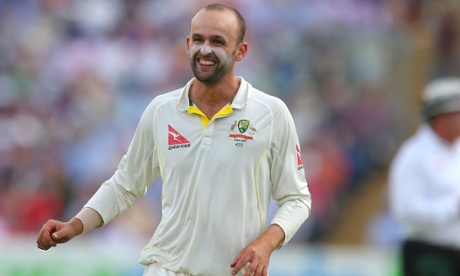
In this era the batsman’s attitude towards spin enhances the opportunity for taking wickets – and for being smashed around the ground and humiliated. Moreover the modern approach to spin bowling provides the clearest indicator of how Test cricket has changed over the decades.
Brace yourself for a mini-history lesson. In Cardiff last week the off-spinners bowled 77.4 overs between them and took 13 for 302. Now let’s transport ourselves back to the Ashes series of 1964 (pay attention at the back there). There is often the dewy-eyed perception that all was wonderful in the 60s when Lord Ted [Dexter] and Fiery Fred [Trueman] were decorating England’s Test team. Think again.
Consider the fourth Test of 1964, a match when not a single spot of rain fell at Old Trafford, and look at the output of the off-spinners. For England there was Titmus with figures of 44-14-100-0 and John Mortimore (49-13-122-0); for Australia Tom Veivers (95.1–36-155-3). It was a ghastly affair in which Australia scored 656 for 8 declared from 255.5 overs; England replied with 611 from 303.1 overs, whereupon the two captains, Bobby Simpson, who had just secured the Ashes, and Dexter, shook hands. What an abomination of a cricket match, despite a gloriously rapid over-rate. Much of the rest of the series, won by Australia 1-0, was played at a similar pace. The figures of Titmus, an acknowledged master of his art, throughout the five matches are illuminating: 202-92-301-10.
Bowling off-spinners was a peaceful occupation then, unsullied by reverse-sweeps, slog-sweeps and railway sleeper bats that can send the ball routinely into distant stands. All too often Test cricket in the 60s was a dour war of attrition in desperate need of a transfusion. There was not much attrition at Cardiff last week. Nor do we expect the sides to go into their shells at Lord’s. But after studying the evidence of Cardiff, the batsmen may not be quite so gung-ho from Thursday onwards when the innocent spinner, be he Lyon, Moeen or even Root, is called into the attack.