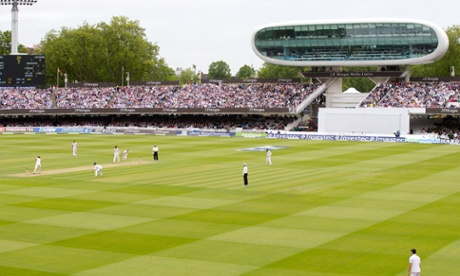
1 The current Lord’s is the third ground to bear the name of its founder, Thomas Lord. A plaque marks the site of his first, Dorset Square off Marylebone Road, where Middlesex played Essex in the inaugural game in 1787.
2 In 1825, Lord’s was nearly sold for housing. In his old age, Thomas Lord obtained planning permission to build over the ground. Thankfully, he was persuaded to sell the lease and keep the site for cricket.
3 Many footballers have been fine cricketers, including Gary Neville, brother Phil (who played for Lancashire 2nd XI at the age of just 15), Joe Hart and Gary Lineker. The England striker turned out for MCC against Germany at Lord’s in 1992 but was dismissed for just a single. “I always score one against Germany,” quipped Lineker afterwards.
4 A more unlikely celebrity to grace the Lord’s turf was Lord Byron, who played for Harrow against Eton in 1805 – the first encounter between the schools in a series that continues to this day. Byron had to bat with a runner due to his club foot and scored just 7 and 2. He later wrote: “After the match we dined together and were extremely friendly. To be sure, we were most of us rather drunk and went home together to the Haymarket where we kicked up a row. How I got home after the play, God knows.”
5 Lord’s was the spectacular venue for archery during the London 2012 Olympics, with competitors shooting arrows across the square. Baseball has also been played on the ground – American and Canadian teams took part in a fundraiser during the first world war, watched by a crowd of more than 10,000.
6 The first Australian cricketers to tour the UK were an Indigenous Australian team who played 47 matches in the summer of 1868. The tour was set up to satisfy public curiosity about “exotic races” following the publication of Charles Darwin’s On the Origin of Species, with demonstrations of boomerang and spear throwing alongside the cricket. The Lord’s authorities had serious misgivings about allowing such “tribal demonstrations”, but eventually agreed, admitting that “the public would have been much disappointed if the sports had not taken place”. Sadly, star player King Cole became ill after the match at Lord’s and died of pneumonia two weeks later.
7 “Sparrow stopped play” was the unfortunate event at Lord’s in 1936, sadly followed by “play stopped sparrow”. The bird was hit and killed by a ball delivered by Cambridge University’s Jehangir Khan during a match against the MCC. The poor victim was stuffed and mounted, rather perversely, on the ball that hastened its demise – you can see both in the MCC Museum.
8 How deep is the MCC’s ownership of Lord’s? The answer: 18 inches. Below that level belongs to developers who bought the network of tunnels beneath the ground, one of which still carries trains out of Marylebone station. A dispute about development has rumbled on for years, with proposals ranging from a new home for the MCC Museum to a subterranean extension for a neighbouring hospital.
9 The current Lord’s pavilion opened in 1890 after the original was destroyed by fire. Even with today’s big bats and power hitting, the only player ever to hit a six over the top of the pavilion is Albert Trott ... in 1889.
10 During the Ashes’ second Test (16-20 July), the pavilion will be crammed with MCC members wearing an “egg and bacon” tie, blazer or hatband. The club colours were sky blue until the 1860s and the best explanation for the change, perhaps appropriately, involves gin. William Nicholson, owner of Nicholson’s Gin Company, lent money to the MCC to buy the ground’s freehold. Nicholson’s colours were red and yellow; the story goes that the MCC adopted them in gratitude.
11 The England and Australia players must negotiate a labyrinthine route from the pavilion dressing rooms to the pitch. With nerves and adrenalin affecting even the calmest, it’s a walk that has flummoxed many. On his Test debut in 1975, England batsman David Steele took a wrong turn and ended up in the basement toilets.