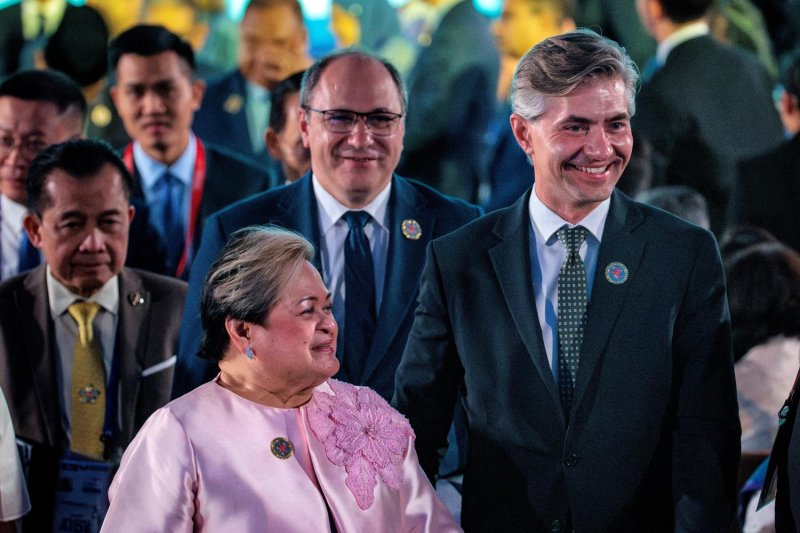
The Asean annual meeting under the leadership of the Philippine Foreign Secretary Maria Theresa Lazaro deserves a thumbs up. She demonstrated Asean-style diplomacy to engage and further strengthen ties and cooperation with all of Asean's partners.
The four-day rendezvous in Manila from July 20–24 will be remembered as one of the most consequential conferences, as the bloc implements the aspiration laid down in the Asean Community Vision 2045. It also prepares to mark its 60th anniversary next year.
At the conference, leaders from Asean and its dialogue partners display their faith that the bloc still has "unique convening power" in an emerging multipolar world. To do so, Asean must also possess sufficient convincing power. Bringing leaders from major powers to discuss global crises and winning support from these superpowers is entirely another matter.
After all, convening and persuasion go hand in hand. Since its inception, Asean has already proved beyond doubt that the institution is fit for the purpose of maintaining peace and promoting stability. Convening meetings and platforms -- in the form of treaties and cooperation -- has been the path to attaining that goal. It has the Treaty of Amity and Cooperation (TAC), formed in 1976, as an important guardrail for cooperation among its members and partners. Initially, the TAC was intended for member states to preserve peace and cooperation. However, in 1989 it was amended to allow non-Asean members to accede to the treaty, with Papua New Guinea as the first signatory.
As the bloc entered its third decade, partners were eager to associate with the regional code of conduct. China and India were the first two Asian countries to accede in October 2003, allowing them to further strengthen bilateral ties and establish strong pillars for the present-day relationships with Asean. The TAC now has 64 signatories, including Poland, Sweden, Romania and Lithuania, which acceded last week. The TAC parties span all geopolitical regions of the world, comprising nearly one-third of UN member states.
With the growing number of signatories, Asean also held the first-ever High-Level Conference of TAC High Contracting Parties to ensure all signatories are on the same page. As Ms Lazaro put it, the TAC is the "most reliable anchor" of Asean's security architecture.
One frequently asked question is whether the TAC can transform into a common regional diplomatic instrument. That will depend on the political will of Asean members and other TAC signatories in the years ahead. Since 2016, Asean has been promoting and elevating the TAC principles internationally.
In addition, the expansion of Asean's external relations now includes Türkiye as its 12th full dialogue partner, following a decade as a sectoral dialogue partner. Having one of the Middle East's most influential countries in Asean will strengthen long-term cooperation across all sectors through tangible plans of action. In addition, Denmark, Germany and Qatar have been accorded sectoral dialogue partner status.
It is interesting to note that Pakistan has remained a sectoral dialogue partner since 1993 -- the only longstanding partner that has not been upgraded for more than three decades. Islamabad has raised its international profile through a widely reported mediating role in the US-Iran conflict. Meanwhile, India, which was admitted as a sectoral dialogue partner at the same time, has since risen to the highest level of engagement as an Asean Comprehensive Strategic Partner.
The role played by diplomats from countries that do not maintain resident missions in Jakarta is equally important. At present, a total of 97 non-Asean ambassadors are accredited to the Asean Secretariat in Jakarta. Furthermore, the 56 Asean Committees in Third Countries and International Organizations are an important driving force to promote Asean's collective interests through regular meetings and consultations.
Kudos must also go to the chair for adopting softer diplomatic language in the joint communiqué on regional and international issues. For instance, on the situation in the South China Sea, the tone shifted from highlighting tensions to encouraging stability. At the same time, the communiqué places stronger emphasis on maintaining peace, security and stability, exercising self-restraint, promoting confidence-building measures, upholding the United Nations Convention on the Law of the Sea and advancing dialogue and practical cooperation. These narratives occurred during the China-Philippines confrontation.
On the maritime issue in the South China Sea, Ms Lazaro revealed that the Code of Conduct could be completed within this year and that offers the most optimistic outlook for the long-running negotiations since 2002. To accomplish this aim, there must be stronger political will and compromise at play from all concerned parties. As chair, the overriding Asean consensus remains sacrosanct.
On the Korean Peninsula and the Myanmar crisis, Asean remains firm on nuclear de-escalation and compliance with all UN Security Council resolutions, while displaying a degree of diplomatic flexibility. On the Korean Peninsula, the current emphasis is on the resumption of dialogue between South Korea and North Korea. Over the past year, inter-Korean relations have deteriorated. At the post-ministerial conference with South Korea, Seoul expressed its desire to see Asean play a more active role in encouraging dialogue with North Korea.
Regarding Myanmar, its return to the Asean fold will depend on how the new military-backed administration under President Min Aung Hlaing engages and implements the bloc's Five-Point Consensus in measurable ways. At the press conference, Ms Lazaro was blunt in stating that Myanmar's return to its Asean seat at this juncture is "still far off".
She is scheduled to visit Nay Pyi Taw on a humanitarian mission before the upcoming Asean Summit in early November. Asean leaders will comprehensively assess developments following Myanmar's recent election and decide whether to end the sanctions imposed on Myanmar five years ago.
Despite angry and condescending views directed at Asean, the bloc continues to strengthen its centrality and unity and forge stronger ties among themselves and with external partners. The leaders of its 11 member states know full well that they must stand together to confront and overcome increasingly unpredictable challenges.
Kavi Chongkittavorn is a veteran journalist on regional affairs.