The government is coordinating efforts to rename the Air Self-Defense Force, using "aerospace" instead of "air," The Yomiuri Shimbun has learned. The move comes amid increasing threats to the use of space, such as the development of anti-satellite weapons by China and Russia.
The name change is intended to clarify that outer space is also an area of defense for Japan, and to enhance the ASDF's defense and deterrence capabilities. The government aims to change the name as early as fiscal 2021.
This would be the first time for any of the three Self-Defense Forces to be renamed since they were created in 1954.
The government seeks to submit bills to revise related laws such as the Self-Defense Forces Law and the Defense Ministry Establishment Law during the extraordinary Diet session expected for autumn 2020. The legal changes would focus on adding the concept of space to the ASDF's mission.
Outer space is generally considered to start at an altitude of 100 kilometers, where the atmosphere has almost completely disappeared.
The ASDF currently has an authorized strength of about 47,000 members. Efforts such as introducing unmanned surveillance methods are expected to enable the ASDF to fulfill its mission with 70% of its current personnel, allowing the remaining 30% to handle new missions including space-related duties.
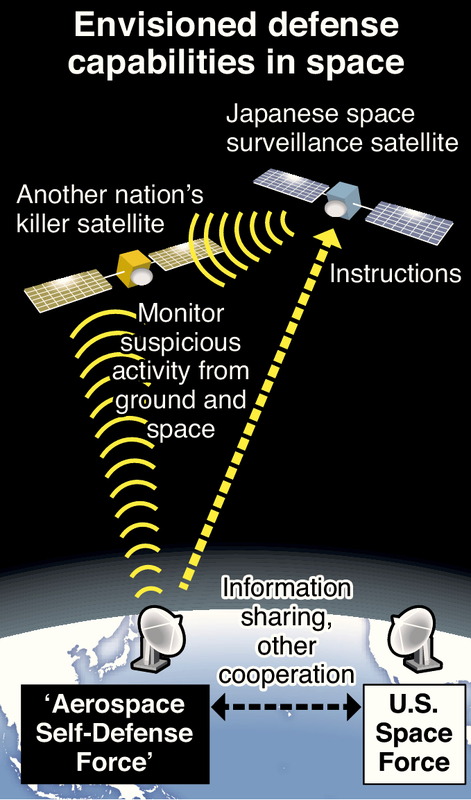
At its core would be the tentatively named "space operation unit" of about 20 members that the ASDF plans to create in fiscal 2020. The SDF's first space unit would establish a ground-based surveillance system, then start space surveillance in fiscal 2023 and expand its staff to around 120. The government plans to launch a satellite around 2026 to monitor suspicious satellites and other objects from space.
The government's focus on space security has intensified as major countries have accelerated the development of their capabilities in a bid to secure military superiority. China and Russia are developing so-called "killer satellites" capable of attacking other countries' satellites through such means as capturing them with robot arms, as well as anti-satellite weapons that destroy satellites with missiles and lasers.
Destroying information-gathering satellites would significantly reduce a nation's ability to track enemy military activities. Causing communications satellites to malfunction would mean secret transmissions cannot get through.
In the National Defense Program Guidelines approved by the Cabinet at the end of 2018, the government stated that "it has become essential that Japan achieve superiority in new domains, which are space, cyberspace and the electromagnetic spectrum."
A reorganization of the ASDF began in the summer of 2019. In September, Prime Minister Shinzo Abe said at a meeting with senior SDF officials that evolving [the ASDF] to an Aerospace Self-Defense Force is no longer a fantasy. The government will also consider acquire logistics for protecting satellites from killer satellites.
The U.S. military launched a Space Force separate from its Air Force last month. The ASDF is already working on strengthening cooperation efforts, such as participating in multilateral simulation exercises of space surveillance conducted by the U.S. military.
Read more from The Japan News at https://japannews.yomiuri.co.jp/
.jpg?w=600)