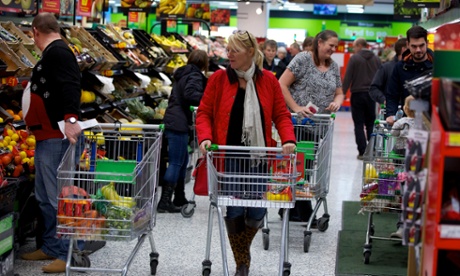
Asda has revealed its worst sales figures since the 1990s, confirming that it is now the poorest performing of the “big four” supermarkets.
Sales at established Asda stores fell 3.9% in the 15 weeks to 19 April, the worst since the UK’s second largest grocer began reporting quarterly figures in 2006.
However, it is understood that the last time Asda performed so badly was back in the days ahead of its 1990s turnaround under Archie Norman and Allan Leighton.
The decline at the Walmart-owned chain compares with a fall of 2.9% at Morrisons and a 1.9% dip at Sainsbury’s over similar periods. Tesco’s sales dropped 1% in the three months to 28 February.
“I can’t remember a time when our industry has seen such a dramatic change in market structure,” said Andy Clarke, Asda’s chief executive. “It’s clear the big grocers are losing market share and the discounters are continuing to grow.”
All the major supermarkets are under pressure as grocery discounters Aldi and Lidl, together with other value retailers like Poundland, B&M and Wilko, attract more shoppers.
Changing trends towards online shopping and local convenience stores are also hitting traditional supermarket operators, along with shoppers keeping a tight rein on their grocery shopping budgets.
Clarke said half the fall in sales during the “challenging” quarter was the result of price cuts as the group battles to compete in a bitter supermarket price war.
Echoing comments from Sainsbury’s boss Mike Coupe, Clarke said he expected prices to continue to fall across the grocery market for at least the rest of this year and potentially into next year.
He insisted that Asda would stick to its plan on cutting prices and investing in its large stores while expanding into new growth areas including petrol forecourts and online groceries.
“We’re only two years into a five-year plan and the strategy is working,” he said.
Asda was the first of the major supermarkets to respond to the threat of the discounters. In 2013 it pledged to spend £1bn on price cuts over five years and has since admitted it may have to spend more than that. The retailer has also axed more than 1,000 store management roles to cut costs.
“Sales are for vanity, profits are for sanity,” said Clarke. “I am not afraid of taking tough decisions for the long term. Short-term tactics may win quarters but our strategy is for the long term.”
He said all Asda’s stores were profitable, including its largest stores, and so it would not be writing down the value of its property in the same way as all its major rivals. “Our balance sheet is very robust and probably the strongest of the big four,” Clarke said.
One analyst said Asda’s poor performance seemed surprising given that it had been swift to respond to changes in shoppers’ behaviour.
“Asda has not been immune to the challenge to the superstore arising from complacency, competition and new customer behaviour. Adjusting to the new circumstances is time-consuming and painful with more sorting to do,” said Clive Black of Shore Capital.
Asda has cut prices by as much as 4% on some product categories, such as fresh meat, as it tries to bring its prices closer to those of Aldi and Lidl. Clarke said these price drops had resulted in increased market share.
The company is also in the process of converting 15 petrol stations it bought last year into Asda outlets. Clarke said the stores were performing “well ahead of expectations” and he expected to have 100 such outlets within the next five years.
However Clarke said Asda had no plans to open small stores in other locations in order to tap into the fast-growing convenience store market. “Online and click & collect is our convenience solution,” he said.
The company has increased the number of click and collect pickup points by 94% to 611 in the past year.
Asda is also investing £21m in extending store opening hours to improve customer service.
Alex Russo, finance director, said: “The idea that large stores are something from the past, we don’t subscribe to that.”
Asda is now leading the development of online retailing for its parent group Walmart Stores. The US retail giant said spending on e-commerce as well as worker pay increases and currency fluctuations contributed to a 7% drop in first-quarter profit, behind expectations.