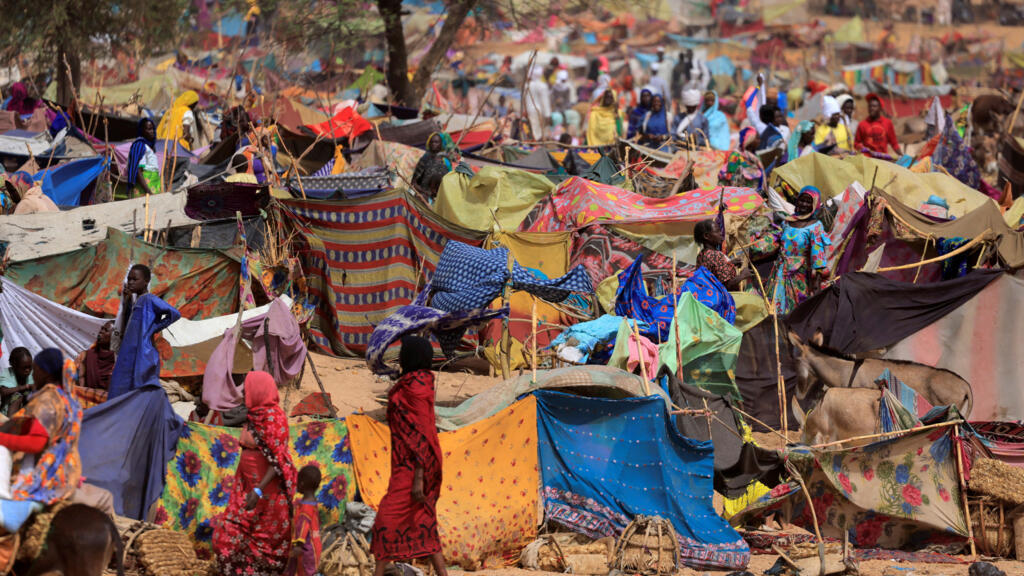
Chad has become a refuge for hundreds of thousands of people fleeing the conflict in Sudan – and, as violence against civilians intensifies in Darfur, even more people are crossing the border. The influx is straining already scarce resources in one of the poorest countries in Africa. Fresh from a visit to eastern Chad, Charlotte Slente of the Danish Refugee Council tells RFI why the escalating humanitarian crisis needs the world's attention.
Two and a half years into the war in Sudan, the United Nations and aid organisations are expecting a wave of new arrivals across the border. El Fasher, the city in North Darfur where reports suggest paramilitary forces have committed mass killings and other atrocities, lies some 300 km from eastern Chad.
But Chad's humanitarian response remains shockingly underfunded, raising profound questions about how the country will cope.
Slente, the Danish Refugee Council's secretary-general, this week visited transit camps in Adre and Aboutengue, where she told RFI she saw signs of "one of the most complex humanitarian crises one can imagine".
RFI: What did you see on the ground?
Charlotte Slente: The situation in Sudan is that in 2025 the fighting has shifted more towards very densely populated towns, and that has amplified civilian casualties. We see a war with a very expansive use of explosive weapons in very densely populated areas, with high levels of civilian casualties. We see widespread destruction of homes, markets, health facilities, infrastructure, etc. Following the events at the end of October in El Fasher in Darfur, we know that more than 110,000 people are on the roads, heading out of Sudan, fleeing these atrocities.
Social media videos, satellite images capture snapshot of atrocities in Sudan
And here in Chad there could be very many new arrivals – thousands and thousands of refugees, but also Chadians that have been living in Sudan for a number of years and now have to return to Chad due to the situation in Sudan.
We already see an increasing number of people arriving, around 50 people per day in the latest weeks. That is a little bit less than expected, because the direct road from El Fasher to Adre is too insecure to travel through. So many are seeking other entry points into Chad further north, with longer routes, also dangerous.
On other border points, we are seeing an increasing number of people arriving and we expect that there will be more people arriving in the coming days, weeks and months.
Sudan’s civilians flee mounting atrocities as Darfur’s war deepens

Do Sudanese people feel they would be safer if they crossed the border?
I want to tell you the story of a family I met here in Adre to explain the situation. It was a family of three people, a mother, a father and a young child of not even two years. They arrived here a few days ago, and they appeared, as I talked to them, in a state of shock and disorientation. Their seven-year-old son was shot dead as they left their own burning house, hit by a bombardment. The brother of the husband was likewise shot dead. What they described to me was a nightmare situation of random attacks and massacres of civilians.
They had been travelling by mule cart, car and by foot; they passed more than 40 checkpoints on these 250 km, were looted on the way, losing the very few belongings that they had left, including all their money and phones.
Nevertheless, the situation is such that people really need to escape from Sudan because they don't feel safe any longer in the country. Several families have been escaping a number of times, displacing themselves first internally a number of times before they decide to take the very dangerous journey out of Sudan. That is why people are arriving and expected to be arriving here in bigger numbers.

It's not easy for refugee camps in Chad to deal with more people. What would you recommend, as an organisation that has worked there for a while now?
Chad continues to welcome the refugees from Sudan. They automatically offer them refugee status when they arrive. The traditions of hospitality remain very strong. But Chad is experiencing one of the most complex humanitarian crises one can imagine.
As of the end of September of this year, [UN refugee agency] UNHCR reported around 1.4 million refugees in the country. And with hundreds of thousands of potential new arrivals in the coming weeks, we could reach even higher numbers of refugees and displaced people in Chad.
We must remember that Chad is one of the poorest countries in Africa, and the eastern region is the poorest in the country. So refugees are arriving into a host community that is welcoming, but in dire need for very basic stuff to survive as well. It's difficult to distinguish the level of needs of the host community from the refugees' – the difference being that the refugees come here with a lot of traumatic experiences.
Chad, WFP warn of 'catastrophic' food insecurity amid influx of Sudan refugees
So what needs to be done? Support Chad to host refugees from Sudan. The world also needs to step up. Chad's generosity is not met with sufficient international engagement at this time. The humanitarian response plan is only 17 percent funded. Important donors remain engaged, but much more is needed at this very critical moment when humanitarian organisations, including ourselves, are preparing for the new large-scale displacement movements into already overwhelmed camps.

Last April, a year into the conflict, an international conference produced promises to raise funds. Would you say it has not been enough?
I think not enough is being done. There was a donor conference, yes, and new commitments were made, but that was before we knew that the crisis would come to the levels that we are seeing now. And there is a humanitarian funding crisis not only in Sudan, but in general. So we are very concerned that the levels of support will not be sufficient to meet the needs of people who are already hosted here as refugees in the many camps.
A lot of people enter with trauma and need psychosocial support, medical treatment, but also psychological treatment for violent attacks, violence against women and girls, etc. We also need to look into the longer-term perspective. So what we are gearing up to do is to support income-generating activities, and retraining people so that they can earn a living by themselves.
Podcast: In two years of devastation, Sudan’s war claims thousands and displaces millions
Finally, a core message: we need the war in Sudan to stop. All parties to the conflict must immediately cease the use of explosive weapons in populated areas in line with the obligations that they have under international humanitarian law.
This is a civil war that cannot be resolved by weapons. It needs a politically negotiated solution, and we need civilians to be protected and not be a target in this war. So immense pressure needs to be put on all the parties to this conflict for it to end with a political and negotiated peace.
This interview was lightly edited for clarity.