No matter that winter winds and snow still come and go in much of the country. The sun’s earlier rising and higher climb into the sky let us know that spring is on the way. Even houseplants indoors feel the changing season.
Take a closer look at the stems of your houseplants. Any young, new leaves? Swelling buds? Inside their pots, roots might likewise be awakening. All of this makes today, tomorrow, or sometime soon a good time for repotting and pruning.
HOW TALL IS TOO TALL?
The most obvious reason to prune a houseplant’s stems is to keep the plant manageable. For example, growing in the ground in a tropical climate, branches of weeping fig, a familiar houseplant, will reach skyward and spread as high and wide as a sugar maple’s. Indoors, at the very least, your ceilings limit the desired height of a houseplant. For looks, you might want to keep the plant smaller, perhaps much, much smaller.
When pruning the stems of a houseplant, the goal is to reduce its size without giving it a hacked-back look. For a plant with many stems, such as a weeping fig, a few severe cuts usually gives better results than many small cuts. Trace one of the tallest stems down to its origin, and cut it off right there. Perhaps do this with another tall stem too.
After one or more drastic cuts have lowered the plant, go back over the plant to make some smaller cuts. Cut back any dead or diseased stems, and any that look gawky or out of place.
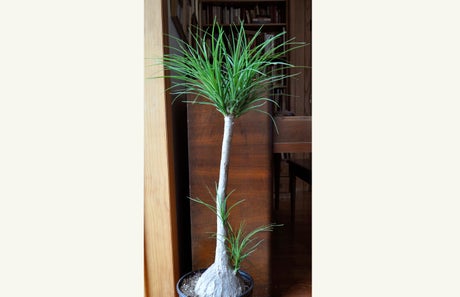
There are houseplants, such as dracaena and ponytail palm, that naturally sport only one or very few stems. These rarely need pruning; when they do, it’s because they’ve finally grown too tall. Lop back the stem to lower than the final desired height. New growth will appear near the cut, perhaps even a couple of new stems. If you want to keep the plant single-stemmed, remove all but one of the emerging stems.
CHECK BELOW GROUND ALSO
Pruning the stems of a houseplant is just the first step. After a few years, depending on how fast a plant grows, roots will fill a pot until they have no room left to grow. Roots attempting to escape out the drainage hole of a pot is one indication of overcrowding.
More telling is to have a look at the root ball itself. Slide the root ball out of the pot. If it’s a large plant, the easiest way to do this is to first tip the pot on its side. Are the roots cramped together and circling around and around the outside edge of the root ball?
If the roots are overcrowded, you could just move the plant to a larger pot. Of course, then it will grow even bigger, which may or may not be your wish.
If the plant is to go back into its old home, root pruning is needed. Stand the plant upright and — brutal as it might seem — slice off the outer edge of soil and roots all around the root ball. The bigger the root ball, the more you can slice off.
Stand the plant back in its old pot and pack new potting soil in the gaps between the shorn root ball and the container. Use a stick or your fingers to firmly press it in place.
Water the plant, and it’s ready for spring.
NOT FOR EVERY PLANT
No need to prune and repot every houseplant every year. Many grow very slowly, so might need this treatment only every few years. And some plants -- clivia and amaryllis, for example -- grow in clumps rather than skyward-shooting stems, and actually do better with their roots cramped in their pots.