The population of Japan logged a record drop of more than 500,000 in one year, the highest number since the first such survey was conducted in 1968 and the 11th straight year of decline since its peak in 2009, according to a government report. The report also revealed that the population is concentrated in Tokyo.
The Internal Affairs and Communications Ministry announced Wednesday the Japanese population was 124,271,318 as of Jan. 1 this year, down by 505,046 -- or 0.4% -- from the previous year. The decrease is almost equivalent to the population of Tottori Prefecture, which is 556,195.
On the other hand, Tokyo topped the list in terms of both increase in population numbers and rate of increase. To stop this trend, the central government plans to step up efforts to disperse businesses and workers in both the public and private sectors outside of Tokyo through digitization, among other measures. However, none of the parties seem to be prepared to decisively resolve the issue.
-- Pressing issue
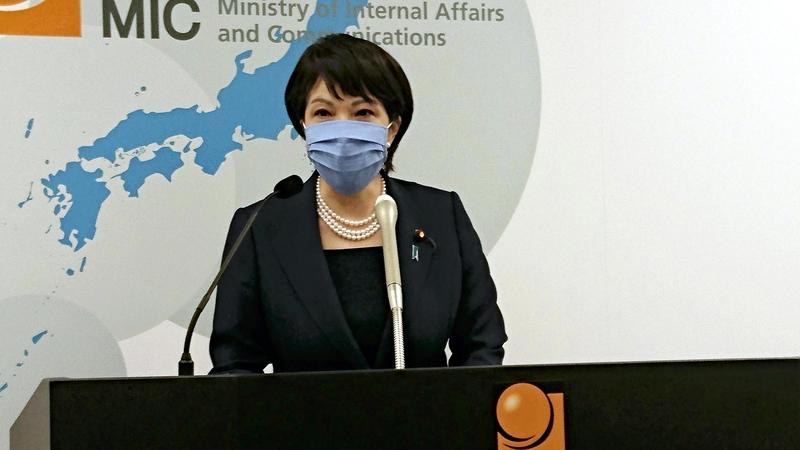
"Rectifying the overconcentration is an urgent task. It goes without saying that further efforts are required," Internal Affairs and Communications Minister Sanae Takaichi stressed at a press conference on Tuesday.
Amid declining populations in 44 prefectures, the rate of population increase for Japanese nationals stood at 0.52% in Tokyo, far higher than increases of 0.16% in Okinawa Prefecture and 0.05% in Kanagawa Prefecture. The working-age population, aged between 15 and 64, is highest in Tokyo at 64.92%.
The pattern seems to be that young people from rural areas flock to Tokyo to go to university or find jobs at large companies. The other major metropolitan areas have already entered a period of decrease, as the population in the Kansai area that comprises Osaka, Kyoto, Hyogo and Nara prefectures declined by 0.37%, while that in the area centering on Nagoya -- Aichi, Gifu, and Mie prefectures -- fell by 0.38%. There are no signs of the population concentrating only in Tokyo being curbed.
-- Postponed target
The excessive concentration in Tokyo poses many problems, including the maintenance of administrative and social functions in the event of a major disaster, and the growing shortage of workers in local areas.
In the Basic Policy for Overcoming Population Decline and Vitalizing Local Economy adopted by the Cabinet in July, the government announced a series of plans, such as increasing the number of students at regional national universities, with an aim to cut down on the excessive number of people moving into the Tokyo metropolitan area by fiscal 2024.
However, there has already been an increase in how many people are moving into the Tokyo metropolitan area, despite the government setting a goal in its Comprehensive Strategy for Regional Empowerment for Japan's Growth in 2014 to balance the number of people moving in and out of the metropolitan area by 2020.
"There is no magic bullet for correcting overconcentration," a senior internal affairs ministry official said.
-- Coronavirus crisis
Under these circumstances, the government considers digitization of rural areas the key to strengthening decentralization.
This year's "four government programs" including the Basic Policy on Economic and Fiscal Management and Reform contain a series of statements calling for digitization of the public and private sectors, as well as decentralization.
If digitization of rural areas is improved and telework and other activities become more established, people will no longer have to live in the suburbs of Tokyo to commute to their workplaces in urban districts, and the measures may result in rectifying overconcentration. They can also avoid the Three Cs (closed spaces, crowded places and close-contact settings), in light of the spread of the novel coronavirus.
The rate of telework was 20% in fiscal 2019, and increased to 35% in May and June this year in response to the pandemic. In a Cabinet Office survey, 25% of those who had ever worked from home said that they became more interested in moving to rural areas, but just over 10% of those who commuted to work as usual were interested.
However, actually moving to rural areas presents high hurdles. Moreover, some observers say the number of people seeking jobs in Tokyo could increase if the domestic economy cools due to the spread of the coronavirus.
Meiji University Prof. Hisakazu Kato, who specializes in demographic economics, said: "It will become important to strengthen local cities that can secure jobs for young people. If telework spreads, there will be no need for job transfers, and that could end up encouraging some people to leave Tokyo for rural areas."
Read more from The Japan News at https://japannews.yomiuri.co.jp/