On July 26, hours after the Cockroach Janta Party called off its 36-day agitation, journalist Yaqut Ali uploaded an interview with Vijeta Dahiya, the outfit’s former spokesperson, on his Instagram account. The two discussed the trolling of Sonam Wangchuk. Neither said anything about the prime minister, abusive or otherwise.
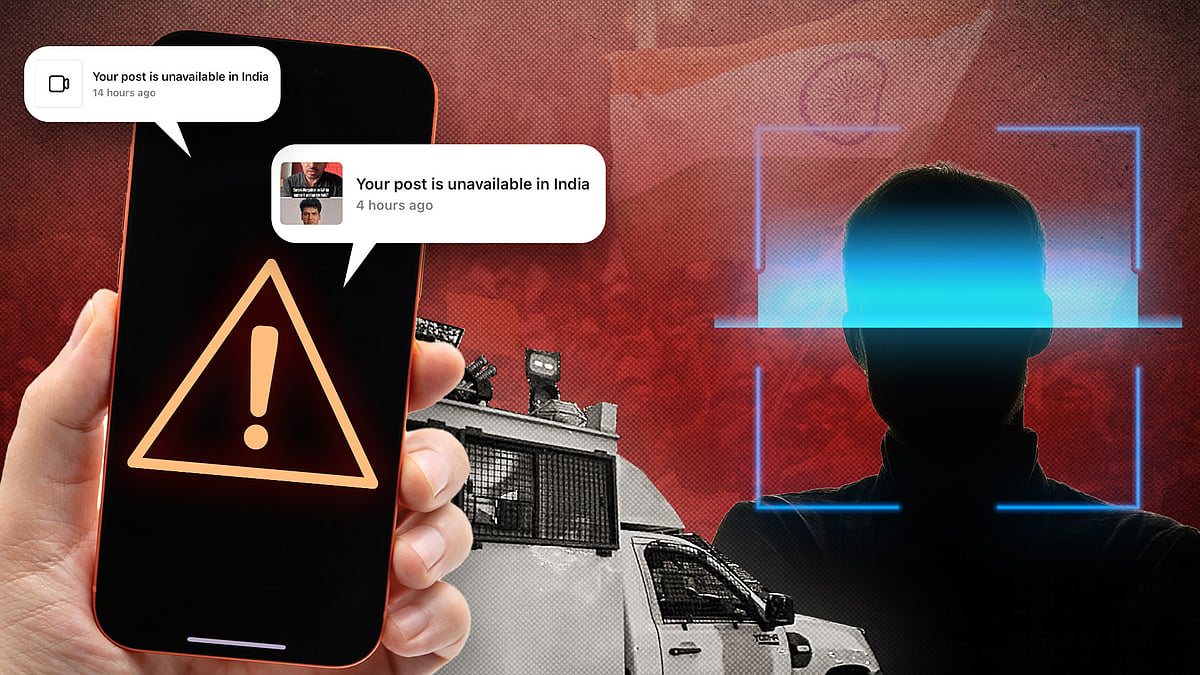
Within minutes, the video could no longer be seen in India.
Ali reposted it from a second handle, Notyaqut, linking it to his main account through an Instagram collaboration. That copy was blocked too. He tried a third time without hashtags. It survived seven or eight hours before it went the same way. The notice told him the post was unavailable in India under the Information Technology Act.
This came amid a Delhi Police operation in which social media platforms are being told to remove posts carrying purportedly objectionable content about the prime minister. Its social media team, police say, is scanning platforms and has so far flagged 450 posts containing deepfake or AI-generated material.
The operation follows a wider contest over the protest’s online narrative. For weeks, the CJP had outmanoeuvred the BJP on Instagram with decentralised, creator-driven content, forcing the government to respond in the same idiom. By the end, even Prime Minister Narendra Modi addressed young audiences through a selfie-style video.
The PM posted more selfie videos, one of which was briefly blocked by Meta on Facebook. Meta has apologised to the government, with the company attributing the removal to a technical glitch, suggest media reports.
The clamour around the PM’s video has at the moment drowned out restrictions faced in India by several other posts which contained nothing crude or abusive, with little clarity on the process followed.
What was restricted
Jyoti Yadav, another creator, saw videos blocked across three weeks. On July 5, a conversation with an AISA member about the hunger strike. On July 23, an interview with AAP’s Sanjay Singh on the paper leak. On July 25, a discussion with Bhim Army members, again on the paper leak. Each of the three revisited claims made during earlier agitations, including the farmers' protest. In one, a Bhim Army member called Hindutva activist Pinki Chaudhary, who faces over 30 FIRs, “nalayak”, and spoke of confronting him on Independence Day.
All three were made unavailable in India but they remain up on Facebook. The notice did not specify the department or agency that requested the action.
“I work as a freelancer and also upload content for my own personal account,” Yadav said. “I really want to upload good content other than anything agenda-driven, but I am afraid that any time this page can also be suspended.”
Gajendra Singh, who has run his page since September 2022 and also posts on his portal News Diggy, uploaded footage on July 20 of a protester injured in a police beating during the Parliament march that day. It was restricted in India the next day, with the notice citing Section 79(3)(b) of the IT Act.
“Another video, where I took an interview of Swara Bhaskar, was also taken down,” Singh said. “It’s not available in India. Why is this wrong if we are uploading videos which are not even fabricated?”
Journalist and creator Raghav Trivedi posted a video on Sunday about an incident in Ghaziabad, where a man named Satyam Pandit attacked protesters returning from the CJP demonstration after asking them their religion. Trivedi asked why a police force willing to lathi-charge students was not acting against men who assault protesters. This video was an Instagram collaboration with news outlet Molitics.
His post was not restricted but removed. The notice said it “may show children being abused, even as memes, as a joke or to express outrage”.
Another video by Molitics, featuring Naveen Kumar of Article 19 and discussing pro-government media, was posted on Instagram on Saturday. It was taken down but has now been restored.
Abhinav Bisht, whose Instagram account followers surged from a few thousands to over 6 lakh as he posted reels linked to the CJP protest, saw his account suspended. It was restored hours later. Bisht claimed he had no idea why the action was taken. After he created a new account, thousands of followers rallied behind him, urging Instagram to restore his original profile.
View this post on Instagram
Meanwhile, in West Bengal’s Barasat, one Soumik Chatterji was arrested after a complaint lodged by a BJP leader after he posted a video showing him lighting a cigarette with a burning picture of PM Modi.
‘Creators reporting collapse in reach’
The Internet Freedom Foundation earlier raised questions for Meta and said that users “across India are reporting that reels and videos documenting the ongoing student protests in Delhi are being marked as ‘sensitive content’ on Instagram. This includes stories being shared by the CJP official account and for Anish Gawande. Story shares of these reels display an interstitial warning, and in several instances the ‘See reel’ option does not function at all. Creators are also reporting a sudden and unexplained collapse in reach, consistent with what is commonly described as, ‘shadowbanning’.”
It is not clear what legal power the police are exercising to take down posts. A police source quoted by PTI said: “After review of content uploaded during and after the protest, police will issue notices to remove such posts which are abusive in nature. An exercise to identify such content across different social media platforms is already underway.”
It’s not clear yet how many of these restrictions and takedowns mentioned in this report were carried out at the request of Delhi Police alone. Newslaundry sent questions to Delhi Police and Meta. This report will be updated if a response is received.
Apar Gupta, founding director of the Internet Freedom Foundation, said the actions should be made public. “This is how a digital-native generation, raised online, speaks about accountability. We demand that Delhi Police must publish every notice issued, and the legal provision invoked.”
It’s not clear yet how many of these restrictions and takedowns mentioned in this report were carried out at the request of Delhi Police alone. Newslaundry sent questions to Delhi Police and Meta. This report will be updated if a response is received.
The surveillance question
The restrictions come amid the Delhi High Court’s refusal to entertain a petition challenging intrusive surveillance at the Jantar Mantar protest. The court asked the petitioner to instead seek general guidelines.
Demonstrators had earlier photographed Ikshana, a mobile police surveillance van fitted with cameras on a telescopic mast, giving a 360-degree view of the crowd. This was apart from drone cameras and police personnel filming those who visited the spot.
A report from police commissioner Anurag Kumar to the government now says 2,873 people were examined over attacks on police and vandalism of vehicles, of whom 989 had antecedents in heinous offences, according to a Times of India report. They were identified using facial recognition cameras, CCTV, and video shot by police and the public. Permission, the report notes, had been granted only for a protest at Jantar Mantar, not a march to Parliament. The police said its investigation found that 101 people facing murder charges, 284 booked for dacoity and robbery, and 92 accused of sexual assault and other offences against women and children took part in violence during the July 20 march to Parliament.
The Internet Freedom Foundation has written to Delhi Police and filed RTIs on that use of facial recognition.
“The Delhi Police’s own replies to our RTIs, extracted after a second appeal before the Central Information Commission, establish that there is no rule governing its use of facial recognition technology (‘FRT’), that no privacy impact assessment was ever conducted, and that a similarity score of just 80% is treated as a positive match,” the foundation said. It had sent a legal representation to the Commissioner of Police seeking an immediate halt to live FRT at peaceful assemblies, deletion of protesters’ biometric data, and publication of any rules that exist. It has filed four fresh RTI applications, including one on the private vendor arrangement behind the Ikshana van.
In times of misinformation, you need news you can trust. We’ve got you covered. Subscribe to Newslaundry and power our work.
Newslaundry is a reader-supported, ad-free, independent news outlet based out of New Delhi. Support their journalism, here.