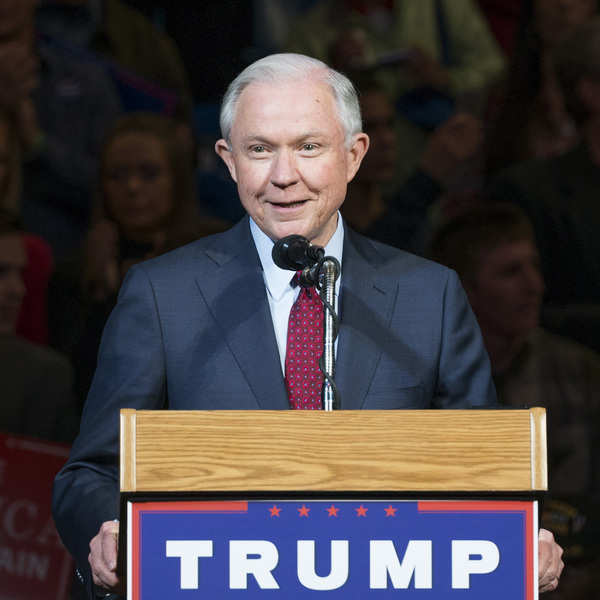
WASHINGTON _ If confirmed as U.S. attorney general, Sen. Jeff Sessions can make major changes to the nation's immigration system by boosting prosecutions of low-level violations, hiring tough immigration judges and cutting law enforcement funds to cities that don't cooperate.
While the Department of Homeland Security vets visas and enforces immigration laws, a handful of obscure offices in the Department of Justice hold vast sway over how immigration cases are heard in court and how quickly migrants can be deported.
Sessions, a four-term Republican senator from Alabama, successfully led efforts to kill immigration reform bills in Congress and is considered a fierce opponent of any pathway to legal status for the estimated 11 million people in the U.S. illegally.
Those legislative battles, and his background as a former federal prosecutor, give him a mechanic's knowledge of the inner workings of immigration policy.
"He can have a tremendous impact," said John Sandweg, who was acting director of Immigration and Customs Enforcement in 2014.
The attorney general "has complete control over the immigration courts and whether to use criminal prosecutions against immigrants," he said.
Immigration judges are chosen by the Justice Department's Executive Office for Immigration Review. The office sets standards for hiring and vetting judges, and for the training and instructions they receive on how to interpret immigration law.
"Most people don't realize we are not technically judges," Dana Leigh Marks, president of the National Association of Immigration Judges, said from San Francisco, where she has presided over immigration cases since the 1980s.
"In terms of our technical employment status, we are attorney employees of the Department of Justice, which we believe does make us much more vulnerable to political influence than we would be in an independent court structure," Marks said.
When immigration judges are hired, they can be fired for any reason during a two-year probationary period. After that, they are protected from dismissal by the same rules that shield other civil servants.
Immigration courts have been understaffed for more than a decade, creating a huge backlog of cases in Los Angeles, San Francisco, Houston and New York.
In all, 522,000 deportation cases are pending in immigration courts, and cases may take three or four years to resolve in the most backed-up jurisdictions.
The Obama administration recently hired 61 immigration judges, Marks said, bringing the total to 294. But that is far below the 374 judges Congress has authorized.
Many judges are expected to retire in the next few years. That could allow Sessions to hire dozens of new judges who agree with his hard-line views.
Former aides to Sessions were instrumental in adding tough immigration proposals to the GOP platform at the Republican National Convention in July, including cutting federal funding to cities that don't cooperate with immigration agents, and increasing penalties for migrants convicted of illegally reentering the U.S. after being deported.
As the nation's top law enforcement officer, Sessions could implement those policies.
He would oversee the Bureau of Justice Assistance, which reimburses local jails for holding federal prisoners under the State Criminal Alien Assistance Program.
In Senate speeches, Sessions has repeatedly called for cutting those funds to push local authorities to identify migrants in the country illegally and hand them over to federal agents.
Trump's transition policy team has drawn up plans to pressure so-called sanctuary cities _ including Los Angeles and Chicago _ to help immigration agents identify those here illegally.
"The issue of sanctuary cities is substantially in the hands of the attorney general," said Mark Krikorian, executive director of the Center for Immigration Studies, a think tank in Washington that advocates for lower immigration levels.
Under Sessions, Justice Department lawyers could try to get federal court orders for local officials to cooperate with federal immigration agents.
"First thing you do is you file suit, then you get a judge to issue an injunction" to force cities to stop their policies, said Krikorian, who has submitted policy proposals to Trump's advisers.
"The nuclear option is you criminally prosecute city council members and supervisors for illegally harboring illegal aliens, which they are," Krikorian said.
Under Sessions, the Justice Department is likely to support states that give local police authority to enforce immigration laws. In 2012, after the Obama administration objected, the Supreme Court struck down Arizona's so-called "papers, please" law on the grounds that the state was trying to enforce federal immigration laws.
Sessions also can instruct federal prosecutors to be more aggressive in filing criminal charges against migrants for illegal entry and reentry after deportation, convictions that can speed up deportation orders.
In recent years, the Obama administration eased such prosecutions and focused instead chiefly on deporting individuals believed to be involved in human smuggling, gang activities and other crimes.
Prosecutions of immigration violations dropped by 6 percent this year, according to an analysis by the Transactional Records Access Clearinghouse at Syracuse University.
On Sunday, another anti-immigration advocate, Kansas Secretary of State Kris Kobach, met with the president-elect at a Trump golf club in Bedminster, N.J., carrying a document called "Department of Homeland Security, Kobach Strategic Plan for First 365 days."
Trump's transition team has floated Kobach's name as a possible Homeland Security chief. In 2002, Kobach helped implement more-restrictive immigration policies at the Justice Department as an advisor to then-Attorney General John Ashcroft.
Cameras that zoomed in on the top page of Kobach's document revealed proposals for a crackdown on several fronts.
The first item was titled "Bar the Entry of Potential Terrorists," and it called for blocking entry to all Syrian war refugees.
It also called for updating a screening system used after the Sept. 11, 2001, terrorist attacks to track migrants from "high-risk areas," and for instructing border officers to ask visitors from designated countries questions about support for jihadism, the Islamic system of laws known as sharia, equality for men and women, and the U.S. Constitution.
Kobach's document also proposed a "rapid build" along the border with Mexico to expand the 386 miles of existing walls and other barriers to the entire 2,000-mile land border.