Traditional artisans are putting their skills to good use by producing masks as local specialty goods. These are fast becoming popular in each locality.
To overcome the hardships caused by the novel coronavirus, a succession of companies in local industries such as fabric dyeing have joined in the production of these masks. In some cases, masks are made with fabric set to be used to make attire for summer festivals that were canceled.
Producers are creating various original designs hoping to send forth the energy they put into making the masks to encourage wearers.
Kitaichi Shikkiten Co., a Kaga, Ishikawa Prefecture-based company established in 1891 that sells traditional handicrafts, has jointly developed masks with Okuda Senshoku, a Kanazawa-based company specializing in dyeing techniques.
Their Kaga Yuzen masks are made of hand-dyed Japanese resist-dyeing fabric peculiar to the prefecture. Cotton cloth dyed in blue and red colors in traditional patterns called komon and thread made of synthetic fibers produced in Kahoku, Ishikawa Prefecture, combine to make the masks. Each of the masks is carefully produced in a sewing factory.
Ishikawa Prefecture had been designated until May 14 as one of the prefectures on special alert amid the outbreak of the new coronavirus.
With a desire that people would have positive feelings, even if only a little, when they wear masks, Hiroyuki Kitaichi, the president of Kitaichi Shikkiten, began selling the masks on April 1. As of May 15, the company has received orders for about 13,000 masks.
"There were people who wept for joy when they received the masks," Kitaichi said. "I hope we can ease people's anxiety, even by a bit."
Yamakuchi Orimono Yozando Co., based in Yonezawa, Yamagata Prefecture, sells masks made with textiles produced using a traditional technique called Yonezawa-ori. The technique has been passed down since the Edo period.
Orders to textile makers have fallen partly because events at department stores have continued to be canceled. Souvenir shops the company deals with were also negatively affected by the virus.
Since April, the company switched its production lines to those for making masks. Its artisans are making use of their skills in manufacturing stoles and handkerchiefs. The masks are popular for their lightness and soft texture.
There are four designs: Yonezawa-ori komon pattern, small dot pattern called mameshibori, Japanese check pattern called ichimatsu and sakura patterns.
"We hope the attractiveness of the Yonezawa-ori technique will be widely known through these masks," a company official said.
The Yosakoi Soran Festival is a famous event held in Sapporo every June. With the virus situation, however, it was decided in April that this year's event would be canceled. This was the first cancellation since the festival began in 1992, disappointing many Sapporo residents.
Eight Products, a Sapporo-based company, had produced costumes and other items for the festival. In April and May, the company's sales plummeted to below 10% of those in usual years. Fabric intended for festival products piled up.
Chie Haga, the president of the company, had masks made on a trial basis and posted information about them on social media. They soon became widely known through word of mouth. From mid-April, the company began full-fledged production of masks.
"There are a large number of people who wanted to join or see the festival," Haga said. "I hope people will feel the atmosphere [with these masks]."
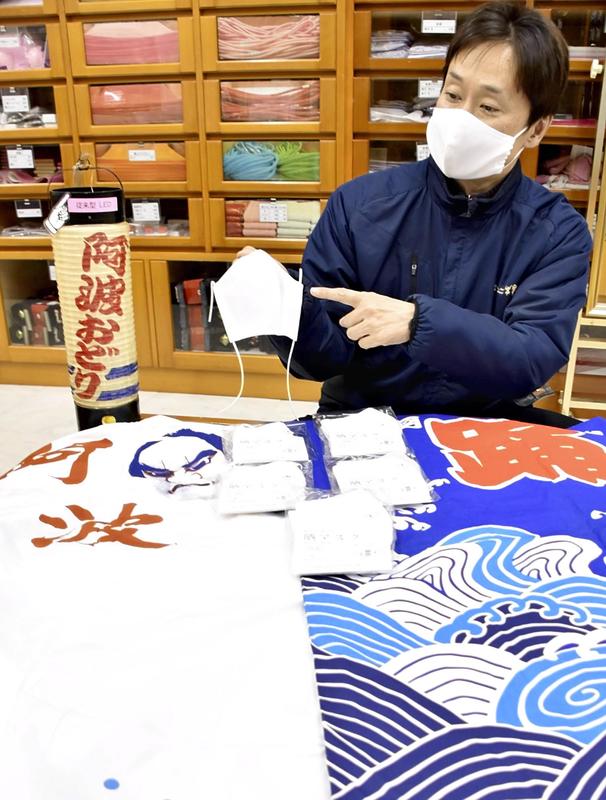
Okachu, a company specializing in items for the Awa Odori dance festival in Tokushima, began making masks because this year's festival was canceled.
Shinji Okamoto, the president of the company, recommended that his artisans make masks. The company's masks use sarashi-momen, bleached cotton fabric usually used for making outfits for the Awa Odori. The company began selling the masks online on April 13 and all 200 masks sold out within the day.
About 10 of the company's artisans now concentrate on making masks, producing up to 200 masks per day.
"The artisans are highly motivated," Okamoto said. "I hope the masks in which we've poured the spirit of the festival will save people's lives."
Read more from The Japan News at https://japannews.yomiuri.co.jp/