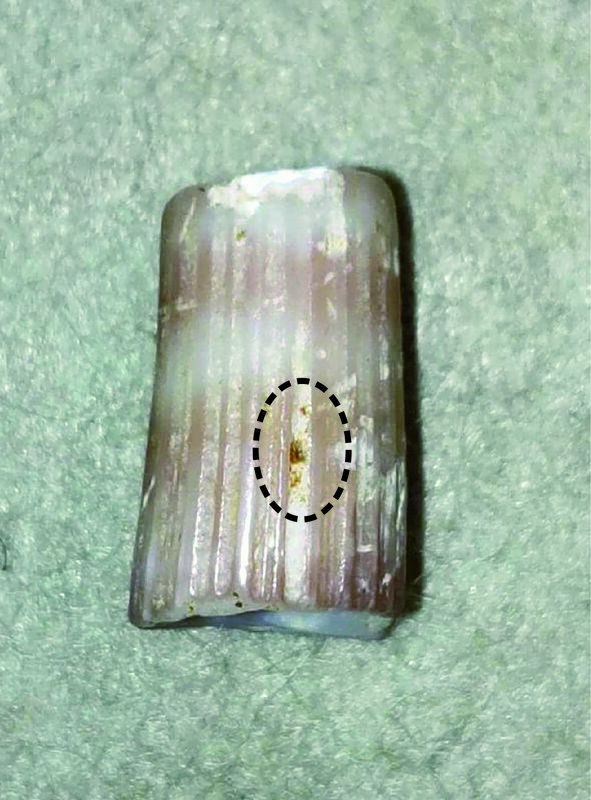
NAHA -- Researchers have found traces of red pigment on a 23,000-year-old bead unearthed in Okinawa Prefecture, making the artifact the oldest-known, artificially colored accessory discovered in Japan.
The shell bead, which was found at the Sakitari-do cave site in Nanjo in 2013, had red color applied to it during the Paleolithic period, according to an announcement Thursday by researchers at the Okinawa Prefectural Museum and Art Museum in Naha.
It had been thought that pigments were used in the Japanese archipelago during the period, but the discovery is the first verification of an artificially colored Paleolithic artifact.
At the cave site where the bead was found, researchers have also unearthed human remains and tools made from shells among other items from the Paleolithic period.
When the researchers reexamined the 12.8 millimeter-long shell bead unearthed in 2013, they identified coloring in a groove on its surface that was found to be a red pigment containing iron through X-ray fluorescence analysis.
Lumps of pigment from about 35,000 years ago and polished stones with pigment attached have been found at other archaeological sites in Japan, but the oldest artificially colored artifacts had been pottery from the early Jomon period (about 15,000 years ago)
The latest discovery proves that pigments were used for decorative purposes in the Paleolithic age.
"It is believed that the people of Okinawa in the Paleolithic period had a rich spirituality and a certain amount of latitude," said Shinji Yamasaki, chief curator at the museum.
Read more from The Japan News at https://japannews.yomiuri.co.jp/