NASA's Artemis II Moon mission successfully launched from Florida's John F. Kennedy Space Center on Wednesday afternoon at 6:35pm ET.
Why it matters: Artemis II's planned crewed lunar flyby is set to mark the closest humanity has come to the Moon since the Apollo days.
- It's also a key step towards NASA's grand ambition to return human boots to lunar soil, and the Trump administration's dreams of a permanent Moon base.
The latest: President Trump congratulated NASA and the astronauts on the successful launch during his address to the nation on Wednesday night.
- "These are brave people," Trump said. "God bless those four unbelievable astronauts."
Driving the news: NASA astronauts Reid Wiseman, Victor Glover and Christina Koch, plus Canada's Jeremy Hansen, are just beginning what's expected to be a 10-day mission around the Moon and back.
- Artemis II is designed as a "dress rehearsal" before a lunar landing planned for later this decade. (Apollo 8 and 10 served similar roles before Apollo 11 and Neil Armstrong's "one giant leap.")
- It marks the second launch of NASA's Space Launch System (SLS) rocket, and the first crewed mission for the Lockheed Martin/Airbus Orion spacecraft.
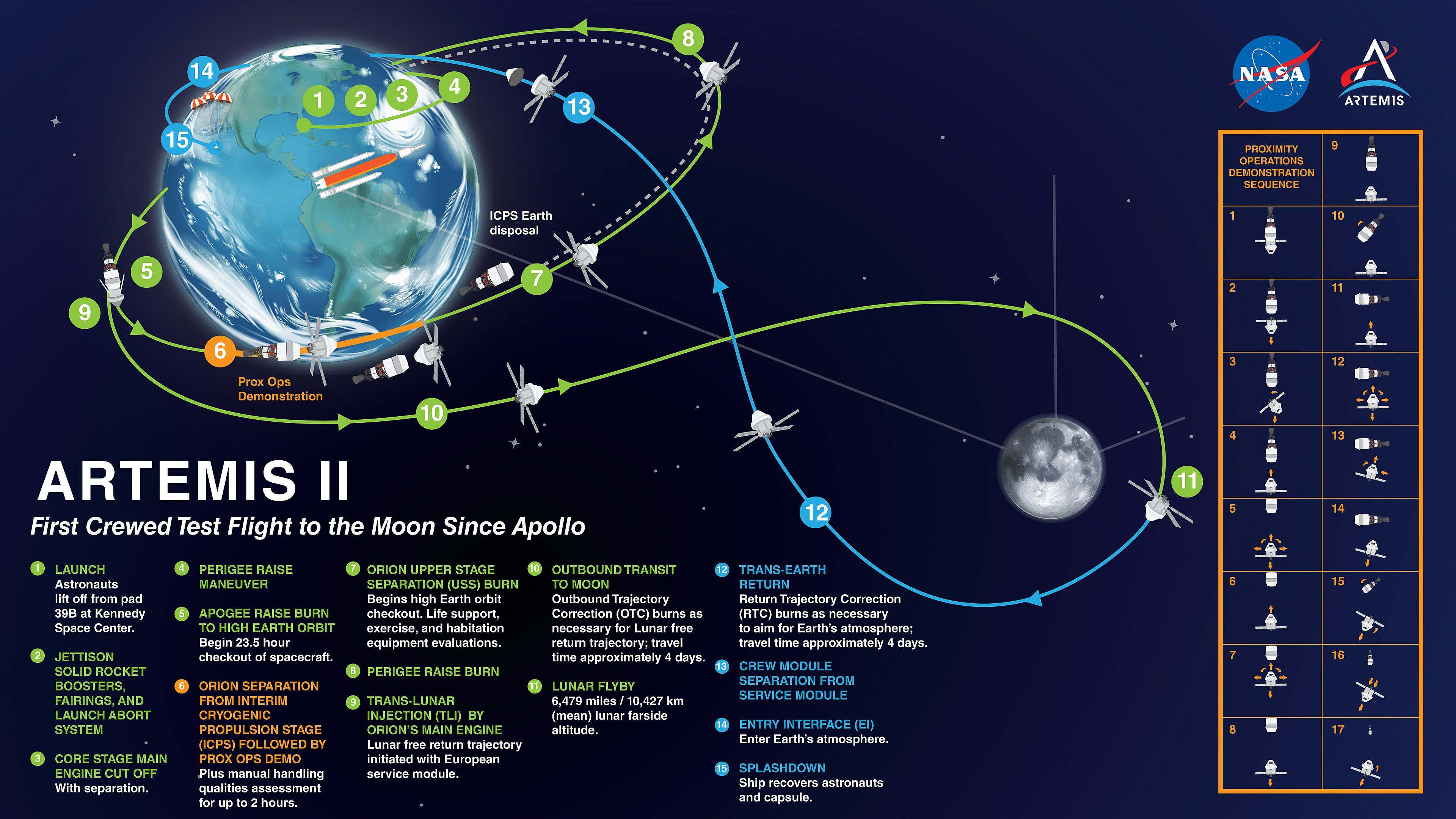
Between the lines: Artemis II is expected to make several bits of space history.
- Glover and Koch will become the first person of color and woman to travel beyond low Earth orbit, respectively.
- Hansen will become the first non-American to voyage beyond that mark.
Yes, but: NASA Administrator Jared Isaacman recently rejiggered the Artemis schedule, shifting Artemis III from a lunar landing to a test flight of one or both of SpaceX and Blue Origin's lunar landers in low Earth orbit.
- The next crewed Moon landing is now planned for Artemis IV in 2028.
What's next: The agency plans to follow that up with yearly Moon visits to build a permanent lunar base.
Editor's note: This article has been updated with President Trump's comments.