
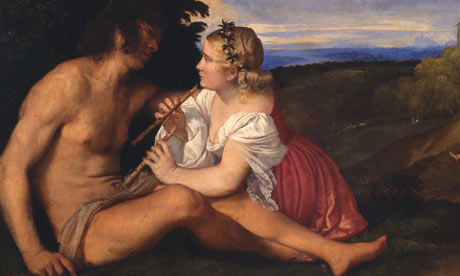
Titian and Henri Matisse, it seems, were right about the origin of music: in their paintings they imagine a pastoral era of history when shepherds played the pan pipes.
Wind instruments often seem to form part of pastoral scenes in art. In Titian's allegorical The Three Ages of Man in the National Galleries of Scotland, a young woman holds two flutes as she sits in the countryside with a naked young man; in Music by Matisse, the same flutes make the first, wild tune. Both artists are working in a tradition that goes back to ancient Greek vases and the myth of Pan and his pipes.
Now a fascinating piece of archaeological news gives this tradition a new twist: pieces of bone and ivory, found in the Hohle Fels cave near Ulm, have been identified by German archaeologists as musical instruments. The best-preserved is a flute made from a vulture's wing bone. The finds have been dated to 35,000 years ago – a bit older than the oldest-known European cave paintings.
This raises a question about art and memory. Throughout the history of western art, classical antiquity has been preserved via a series of revivals. Pastoral flautists in European paintings look back, consciously, at Greek imagery. But what if that imagery contained a real memory of even earlier times? Greece was the first "historical" culture, proud of its own written past. But behind it are millennia of prehistory. What if the flutes of the satyrs are unwitting records of the first humans? If they are, then in a painting like Music, that past still lives.
It raises another question, about the "classical" in art. When we speak of our classical heritage, we see it through a dim filter of 19th-century academic art, but when we look at how Renaissance paintings revived antiquity, we see that it is savage – all wild dances, sacrifices and ecstasies. Titian's Bacchus and Ariadne, for instance. In Renaissance art, the ancient world is a time of caves as well as temples. Perhaps it's this connection with the primitive that makes high art in Europe so innately visceral.













