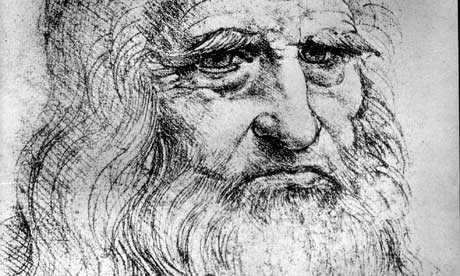
Recently I wrote about art and astronomy, and the other day I wrote about art and mathematics. The sometimes creative, sometimes antagonistic relationship between art and science fascinates me – and I am not alone. You'd be lucky to visit a science museum without seeing an installation by an artist; at the Natural History Museum, a wooden "evolutionary" ceiling by Tania Kovats hangs above the copy of a controversial fossil of what some call a primate missing link.
And yet, the results are so often frustrating when art and science meet. I've been sceptical about contemporary art's ability to engage science, in an intelligent way, ever since I gawped in horror at a giant statue of a "quantum" man by Antony Gormley outside the Millennium Dome a decade ago. Periodic table paintings by He Who Cannot Be Named Here are just as silly.
What we need is an artist who is also a scientist; or a scientist who thinks like an artist. And at last I can unveil that missing link of art and science!
The fact that he died in 1519 is no hindrance to this man's power in contemporary culture. No modern artist expresses so perfectly today's dream of a scientific culture, where knowledge and imagination are one. No artist seems so made for the digital age, so attuned to the civilisation of research, communication, and democracy that it promises.
I'm talking – of course – about Leonardo da Vinci, whose mind straddles science and art and remakes them both, as better, bigger things. For Leonardo, art is science. It is research. When he paints the lucid sphere of an eyeball in a portrait, you know he is also trying to understand how images are formed in that intricate orb and how they reach the brain. His anatomical observations anticipate much of the medical science that has evolved since, and appeal not just to art critics but to heart surgeons.
The opportunities that I have had to get closer to his science while researching my book The Lost Battles, about him and Michelangelo, have deepened my awe and ultimately my mystification in the face of his genius. But this I know: he is an inspiration for this millennium and our technological civilisation is right to adopt him as our hero, our contemporary.