Jason writes:Thelma Golden, the director of the Studio Museum in Harlem, tried to express the dissonance of being in louche Miami while New York was erupting in protest:
It's Thursday of Miami art week
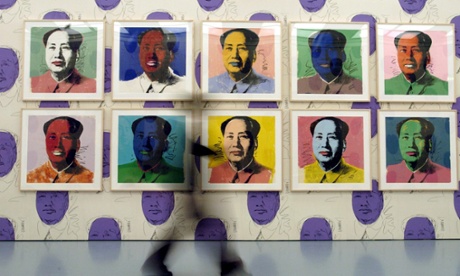
Good morning – Alex here. Art Basel Miami Beach is now offically open to the public – although it’s hard to imagine that it could be much busier than it was yesterday, when the collectors swooped in. At close of play yesterday I was sent a succession of emails that detailed some of the sales. Among others, Andy Warhol’s 1973 portrait of Mao went for $4.5m, and Mark Bradford’s White Girl was sold for $1.8m. It’s hard not to feel disquiet about such gigantic sums, but as the artist Ryan Gander told me yesterday, this is the reality of the way artists make their money. Although not Warhol, obviously - what with being dead.
Last night Jason and I hit some of the parties. Thanks to friends at V magazine, I got into arguably the week’s hottest ticket, a party hosted by V, Tommy Hilfiger and gallerist Jeffrey Deitch. The main attraction was a performance by Miley Cyrus, who performed mainly rock classics backed by the Flaming Lips as confetti and bubbles rained down. My review will be up very soon - in the meantime, here’s what it looked like.
Signing off for the day now, but the night offers a private Miley Cyrus gig among other delights. Do come back tomorrow and in the meantime tweet us @alexneedham74 and @jsf.
It’s Alex: I’ve now left the fair for the day. I had a chat with the British artist Ryan Gander, who has two projects here, who had a lot of interesting things to say about the state of the art world – I’ll post that conversation as soon as possible. I also had a wander around the various booths and saw a couple of works that seemed to sum up the extremes of the work you can see here. The first is Robert Wilson’s video portrait of Lady Gaga, posing as Jacques Louis-Davis’s The Death of Marat:
Art Basel 1 pic.twitter.com/uPaIbLEQVB
— Alex Needham (@alexneedham74) December 3, 2014
The second was a fantastic sculpture called Untitled (pig skull) by the late artist and activist David Wojnarowicz, whose work was still causing controversy as recently as 2010.
Art Basel 2 pic.twitter.com/NjPRW0yuAT
— Alex Needham (@alexneedham74) December 3, 2014
On the way out I spoke to Pedro LeRoux, the president of NJASAP (NetJets Association of Shared Aircraft Pilots). NJASAP is are suing NetJets, the private jet company owned by Warren Buffett’s company Berkshire Hathaway, for which its members are pilots. The union says that NetJets, who have a glitzy booth inside the Art Basel VIP lounge, want to impose a five per cent pay cut over five years, reduce work rules that restrict their hours, and have the power to force pilots to cross a picket line if flight attendants or mechanics - who are also in negotiations with the company - went on strike.
“Our CEO Jordan Hansell is saying that Buffett is demanding a 4 to 6% return so they want a greater profit from NetJets,” said LeRoux. “We fly some of the wealthiest people on the planet and Hansell is also telling us that the owners are demanding lower prices and he is planning on passing the savings that he gets from labour, if he gets concessions, onto our customers/owners and to Berkshire Hathaway.”
The pilots stressed that they weren’t on strike, just picketing to inform their clients, many of whom were inside, of the situation. NetJets have been contacted for comment.
As day turns to night here at the convention center, one refrain comes up again and again: where are you going to dinner? Or actually, since this is Miami Basel, the question is a little different: “Which dinner are you going to?” You see, the big-time parties and popup concerts are only the surface activity of Art Basel nightlife. The real action is at the private dinners galleries throw for their artists, collectors and employees, mostly at the garish restaurants of Miami’s beachfront hotels. It’s a funny sort of courtship: the galleries, asset-rich and cash-poor, invite their loaded collectors to dinner—the better to entice them to spend the next day.
Take it from me, though: if you are in Miami there is only one place to eat. Joe’s Stone Crab, down at the extreme tip of Miami Beach, has the best crustaceans in South Florida, plus key lime pie to convert even the hardiest no-carb dieter. Unless you’ve got a party of 20 it’s no reservations, so be prepared to idle.
Who says print is dead? One peculiarity of Miami Basel, and of the art world more generally, is that iPad-toting collectors still look to paper as a sign of importance and credibility. Here at the fair there’s a whole section of print magazines on display, from Artforum all the way to Leap, a very strong title published in Beijing (on very glossy paper). And the fair has multiple in-house bookshops — print goes a long way to justifying high prices.
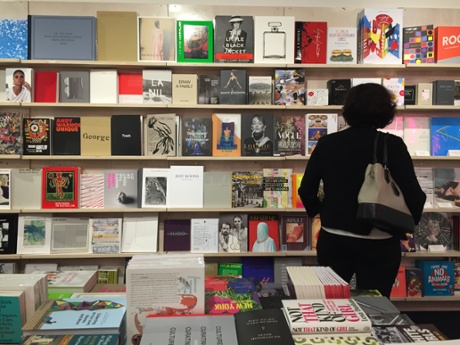
That hasn’t stopped UBS, the Swiss bank that sponsors Art Basel, from trying to drag eyeballs from paper to screen. This week they launched an app that scrapes cultural coverage from the best sources worldwide (including, cough, us), supposedly to let bigwig collectors gather the kind of informational advantages that they get from market intelligence newsletters. The website Artnet wonders, Can this UBS art app be the Bloomberg terminal for the art world?” (We remind you that when a headline is in the form of a question, the answer is always no.)
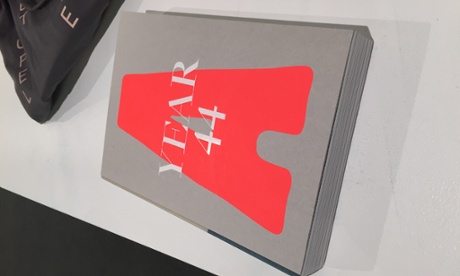
Meanwhile, the fair’s catalogue is the size of a cinder block. And weighs about as much.
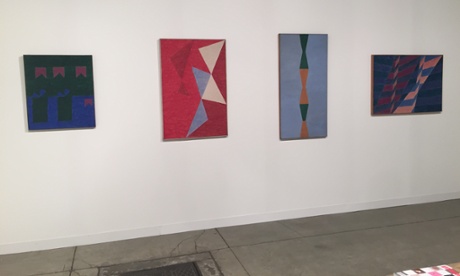
Jason writes: for all the chaos of the fair, for all the obscenity of the money and the marketing, there is still one excellent reason to come to Basel: it offers a critical opportunity to see art from off the US-western Europe axis. Art Basel Miami Beach is especially strong on Latin American art (and you hear a lot of Spanish and Portuguese being spoken in the aisles.) No fewer than 10 Brazilian galleries are here, among them São Paulo’s Galeria Bergamin. They are exhibiting very fine geometric abstractions from the 1950s to 1970s by Alfredo Volpi, a painter too little known outside Brazil.
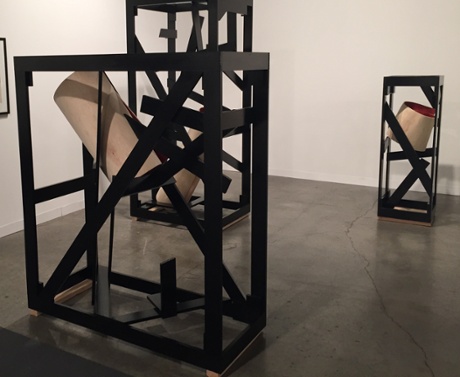
And one of the best booths in the fair comes from Cape Town. The dependably strong Stevenson Gallery has produced a thematic installation of African sculptors working with fractured, roughly fashioned wood. This work, by the Burundian artist Serge Alain Nitegeka, was a particular favorite.
Very cheered to see German “living artworks” EVA & ADELE turn up. They are now drawing an impressed crowd of onlookers. Here’s a great piece about them by my colleague Helen Pidd.
Just when I was flagging, Eva and Adele turned up at Art Basel pic.twitter.com/N2oJJh2kD6
— Alex Needham (@alexneedham74) December 3, 2014
Amidst the gilded mania of the Art Basel Miami Beach VIP room, I am very much enjoying the tweets by legendary New York magazine art critic Jerry Saltz, who has decided to skip the whole thing ... or has he?
Arriving in the beautiful modern Miami Beach airport ready for wonderful Art Basel Miami Beach! Fun here I come! pic.twitter.com/kQMLdE8Igq
— Jerry Saltz (@jerrysaltz) December 3, 2014
Hi Miami! A long line of VIP limos waiting to get into ABMB. Yay! pic.twitter.com/9bcgI7p9Fe
— Jerry Saltz (@jerrysaltz) December 3, 2014
First booth I see inside miraculous Art Basel Miami Beach art fair is none other than Larry Gagosian. Great stuff. pic.twitter.com/kiZzerAegi
— Jerry Saltz (@jerrysaltz) December 3, 2014
This Rosemarie Trockel head sculpture seems to be freaking out a few people:
An eerie #RosemarieTrockel piece on view at @SpruethMagers @ArtBasel #ABMB2014 pic.twitter.com/tWm3N0JfLn
— Art Observed (@ArtObserved) December 3, 2014
Updated
An art fan’s crie de coeur:
Art basel tryna kill me with all these events giving free alcohol. The event im going to tonight got free Hennessy... Where they do that at
— J u í c e (@PimpxJuice) December 3, 2014
The New York Times’s style supplement T magazine have presented Art Basel Miami Beach in numbers - as elegantly presented and no doubt meticulously researched as you’d expect. I’m sorry I missed these pearls of wisdom from Kanye West when he was interviewed here last year:
Anything that we promote as a celebrity, we sacrifice ourselves ... If you put your name on the side of a water bottle, when people are done with the water, they throw it in the trash. Now your name’s in the trash.”
I (Alex) agree with him, in a funny kind of way.
Also, T reminds us that Jay Z namechecked the fair in Picasso Baby.
Updated
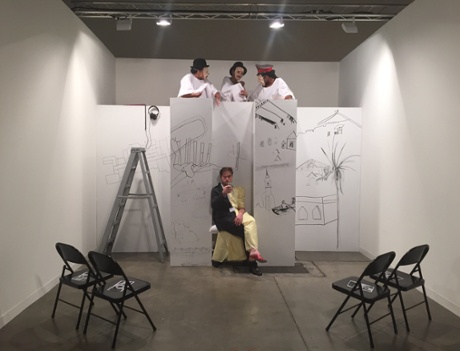
With 267 galleries, Art Basel Miami Beach can be a slog for even the hardest hustlers. The fair organizers do try to lighten the burden by dividing the show into thematic sections - but they have cryptic, unhelpful names, whether in English (Survey) or Swiss German (Kabinett) or Latin (Nova). I’m currently in the section called Positions, which turns out to be for young galleries showing work by a single artist. The tone here is a little rougher and freer than in the main fair, and on the booth of Berlin dealer Dan Gunn there’s an ongoing dumb-show staged by the artist Tracey Rose.
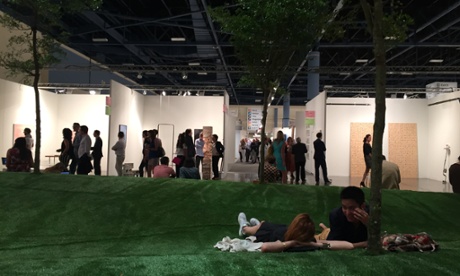
Mysteriously, Positions has at its center an expansive, undulating green patch. I am typing these words while sprawled out on artificial grass in the middle of a convention center whose air conditioning is on blast. In Miami, even the ground beneath your feet is fake.
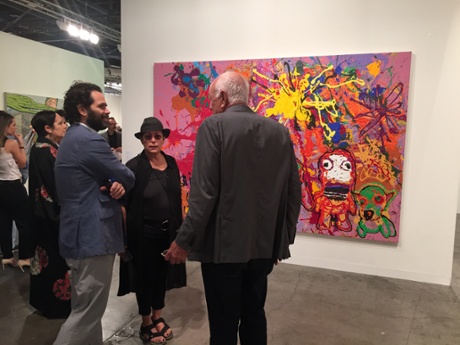
Fergus McCaffrey—a gallery whose booth signage enviably lists its hometowns as “New York and St. Barths”—has mounted an unmissable solo display by Jack Early, a painter and poet who won wide acclaim in the 1980s, only to go into exile from art making after a notorious 1992 exhibition that made use of rap music and portraits of iconic black Americans. (Early is white.)
Slowly, carefully, he has reemerged in recent years, and he’s a very good painter. The subject matter of these works should appeal to those with other concerns than the ethics of representation:
Jack Early on Fergus McCaffrey's booth, rather a must for jockstrap connoisseurs. #ABMB pic.twitter.com/VK2IiBc5xo
— Jason Farago (@jsf) December 3, 2014
Speaking of Tom Wolfe, he took aim at Art Basel Miami Beach in his book Back to Blood (according to Fusion’s timeline). The relevant quote, from the Cuban-American character Magdalene:
Just take a look at them! … the billionaires! They look like shoppers mobbed outside Macy’s at midnight for the 40-percent-off After Christmas Sale. No, they don’t look that good. They look older and grubbier and more washed out.
Meanwhile, in a scene from a Tom Wolfe novel, private jet pilots are picketing the event.
NetJets pilots picket Art Basel Miami Beach, where their employer is a 12-yr sponsor and clients VIPs. pic.twitter.com/Yg0QMyzCEO
— Mostafa Heddaya (@mheddaya) December 3, 2014
Jason writes: While running around Basel in search of the new-new-new and v-v-hot, it’s too easy to forget that the fair also contains some exemplary art from the first half of the 20th century. Hammer, a New York gallery, has brought an exquisite little painting by Fernand Léger, one of the four artists in the Met’s major Cubism show:
A lovely little Léger, "Femme au cordage," from 1930 (on the Hammer booth) #ABMB pic.twitter.com/qlWhSVrtHd
— Jason Farago (@jsf) December 3, 2014
And Galerie 1900–2000, a reliably strong Paris outfit, has a whole wall of works by Francis Picabia, stretching from his early Dada provocations to his late pinups.
Picabia, je n'écris que pour toi. (On Galerie 1900–2000.) #ABMB pic.twitter.com/dQ6qUfDV6X
— Jason Farago (@jsf) December 3, 2014
Right next to the VIP area, which currently looks like this:
Lunchtime at Art Basel pic.twitter.com/QmqPUYSCpE
— Alex Needham (@alexneedham74) December 3, 2014
Some people are gamely trying to do this:
Marina Abramovitz performance piece at #ArtBasel2014 pic.twitter.com/S21yAOBbkZ
— Mark Ghuneim (@MarkGhuneim) December 3, 2014
Fusion have done a timeline called How Art Basel Miami Beach became one big party. Miley’s appearance tonight is the penultimate staging post. Meanwhile, I (Alex) am starving. Not sure I’ll be ordering the $250 truffle pizza, mind.
Jason writes:
Over on the booth of Gavin Brown, the charmingly misanthropic New York dealer, we bumped into some Miami fixtures: Don and Mera Rubell, the latter rocking Yoko Ono shades inside the convention center. The Rubells are two of the principal catalysts for the Miami art boom, and the insane wealth and endless partying that have accompanied it. (You might know Don’s brother Steve Rubell, of Studio 54 fame.) When the Rubells arrived from New York in the early 1990s, Miami was still a pretty rough place, gripped by a crime wave; and culturally it was not exactly barren, but certainly not on the map of the international art world. But Don — a former gynecologist turned accidental property magnate — and Mera soon acquired the most Miami property imaginable: a warehouse used by the Feds to store seized cocaine and guns. It became the first of a specific kind of Miami institution: a private collection publicly displayed, presenting global contemporary art for free. Miami’s museums, though maturing, remain a bit off the top of the game. But the Rubells and a number of other collectors, among them Rosa de la Cruz and Martin Margulies, have built an arts district in Miami all on their own.
Soon after, a prestigious but staid Swiss art fair decided to spin off to the beach. The collector base in Miami, even more than public institutions, was critical to convincing Art Basel that it could thrive in a location that, until recently, was more a market for drugs than for painting and sculpture. The rest is luxury-sponsored history.
A rather droll report by the New York Observer headlined is titled BREAKING: Sean Combs “Delighted” to Meet Observer Reporter at Art Basel!
In other news, film director Baz Luhrmann has come dressed as Picasso.
@ArtBasel #ABMB2014 Great Gatsby supremo Baz Luhrmann with a Picasso at Galerie Gmurzynska. pic.twitter.com/9x9mF3FmEM
— Gareth Harris (@garethharr) December 3, 2014
Updated
Here’s another while we’re at it:
#weirdartbasel Collectors about to drown in a Roni Horn sculpture pic.twitter.com/ZaN6OAmIxC
— Alex Needham (@alexneedham74) December 3, 2014
It is absolutely mobbed in here at the moment. The throng appears to include P Diddy:
Leonardo DiCaprio is also supposed to be here, along with Miley Cyrus, who’s playing a party tonight thrown by Tommy Hilfiger, Jeffrey Deitch gallery and V magazine. The Guardian is on the list so expect a report of that action tomorrow morning.
Updated
If you’re at the fair, why not tweet the strangest thing you’ve seen with the hashtag #weirdartbasel?
Here are a couple of mine:
#weirdartbasel Mendes Wood stall from Sao Paulo pic.twitter.com/TWTOT1P4kC
— Alex Needham (@alexneedham74) December 3, 2014
#weirdartbasel Beyoncé art by Jonothan Horowitz pic.twitter.com/p6fO6A0yHJ
— Alex Needham (@alexneedham74) December 3, 2014
Updated
That Warhol portrait of Mao in full, apparently the most expensive work here at $15-$18m.
Meanwhile Jenny Holzer, the veteran American artist know for terse, politically incisive adages reproduced on billboards or LED displays, has a psychedelic light work on the booth of Cheim & Read:
Updated
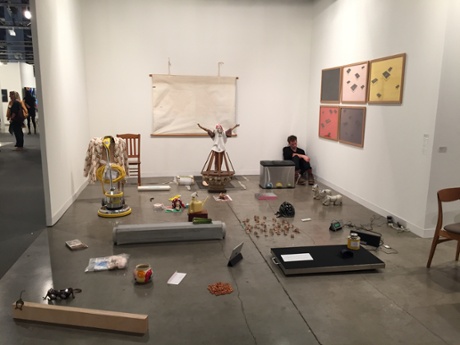
Jason writes: The booth of Andrew Kreps, a New York gallery just on the edge of blue-chip and scrappy, has got one of the weirdest installations at the fair: a mutable, head-scratching affair by Darren Bader, whose art privileges digressions, mistakes, serendipitous encounters, and pretty much anything but clarity. Here he has scattered the floor with dozens of random objects, some everyday—a pile of almonds, an old newspaper, a broken iPad — and others more obscure: antique aviator goggles, a tube of Japanese superglue. In the corner, no explanation, is a rather cute boy sitting on the floor, reading at times, texting at others. (He returned my lecherous smile but didn’t get up.) There’s also a ghetto blaster playing SexyBack by (Florida native!) Justin Timberlake on endless repeat. Go ’head, be gone with it, go ’head, be gone with it ...
A head-scratcher, but all intelligible enough until the dealer tells you the kicker: the work is in an edition of three. The first buyer ($38,000, by the way, and no takers yet) gets to take the present work home, though not the boy. The other two buyers have to then reconstitute the work, somehow, with the same objects or different ones, who knows ... A puzzle, but amid endless blue-chip take away shops a necessary one.
It’s ingenious:
Art Basel Miami Beach: there’s art, and there’s also Andre 3000 exhibiting his jumpsuits:
André 3000 shares the 47 jumpsuits he wore during the Outkast festival tour at #ArtBasel Miami Beach. Photos here: http://t.co/Po4E4ADb4a
— Complex (@ComplexMag) December 3, 2014
The booth of Sadie Coles, one of the best galleries in London, has been occupied by a fantastic ceramic installation by Swiss artist Urs Fischer: 1,080 lime-green ceramic raindrops, suspended on vanishingly thin strings. From an artist whose rough-hewn sculptures tend to look much more abject, this is a much cheerier, much more Miami intervention. Prime selfie territory, naturally.
Sadie Coles chatting in Urs Fischer's lime green ceramic rainstorm #ABMB pic.twitter.com/hksM8DWz98
— Jason Farago (@jsf) December 3, 2014
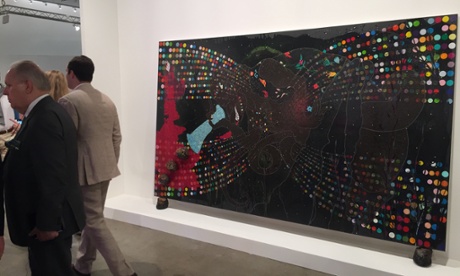
Jason, who is on the shop floor as it were, writes: Art Basel Miami Beach is enormous, and over the next hours we’ll be looking at young artists’ new work, curated historical presentations, major contributions from Latin America, and more besides. But ultimate this fair is, like its Swiss older sister, a shopping mall for the super rich. Assuming you can write a check for seven figures, you can take home (from David Zwirner’s booth) a fine Chris Ofili, subject of a killer retrospective up now at New York’s New Museum:
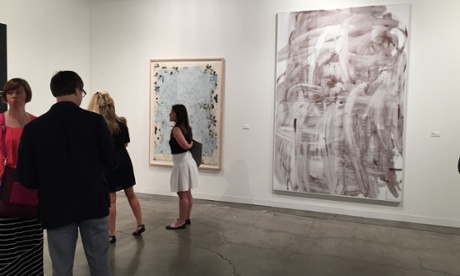
Or, if you liked Christopher Wool’s recent shows at the Guggenheim and the Art Institute of Chicago, these newer paintings could be yours (and for a fraction of the $25m someone paid at Christie’s last year.)
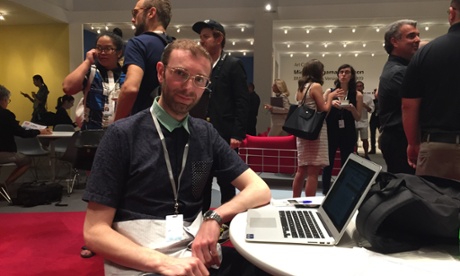
OK, so owing to the fact that it’s the only bit in Miami convention centre that appears to have wifi, this blog is coming to you live from the obscene luxury of Art Basel Miami Beach’s VIP area. Behind me (Alex) is a pop-up store devoted to Davidoff cigars, to my right is a bar for Absolut Elyx, whatever that is, and ahead there’s a wall of Audermars Piguet watches displayed in a gloomy booth decorated with fake rocks. At my right elbow there’s a waiter being berated over a tannoy for dropping a glass of champagne. I haven’t tried to get into the UBS lounge (the main sponsors) but I can see a gigantic Christopher Wool painting hanging there. Until I get chucked out of here, I am right in the midst of the 1%.
The fair opened with speeches from the Art Basel chair Norman Brand; the mayor of Miami Beach, Philip Levine; John Matthews, head of private wealth management at UBS; and Marc Spiegler, the former journalist who is now head of Art Basel Miami Beach. The main takeaways were that 100% of galleries who attended last year reapplied for a stall this time; that Miami will soon be bristling with new galleries, including the HQ of Fairholme Capital, designed to accommodate a 200-foot-long Richard Serra sculpture and a gigantic work by James Turrell. That the convention centre we’re in is being redeveloped at a cost of $500,000. Coming from the UK, I am squeamish about the way art seems to intersect, or even be part of, naked celebration of wealth here. But with next to no public funding for art in the States, I guess this is the way it has to be. Do feel free to contradict me in the comments ...
Updated
Jason: Last night we were at the opening of the Institute for Contemporary Art, the newest museum in the Miami ferment. Its new building, scheduled to open in 2016, is being spearheaded by kingpin Norman Braman, the mastermind of Art Basel’s importation from Switzerland to Florida. Elsewhere in the city there have been openings at the Bass museum (a disaster, but worth seeing for car-crash fans) and the newish Pérez Art Museum Miami, in a foliage-bedecked waterfront home designed by Herzog & de Meuron (architects based in, where else, Basel, Switzerland).
But can Miami, even with all its wealth, even with its growing Latin American collector base, sustain as much contemporary art as this? The Art Newspaper – a monthly professional publication which puts out a consistently impressive daily edition at this fair and others – suggests otherwise:
Miami finally has a flagship public museum capable of staging its own major shows and hosting important travelling exhibitions—above and beyond what the city’s numerous private museums are able to offer. But an ongoing debate about public funding for the institution has laid bare the single biggest challenge for museums and galleries in the city: fundraising in an increasingly competitive climate. Despite the new museum’s success in attracting visitors, it struggled to secure an increase in public funding which it said it needed to deliver its programme this year.
Alex: last night Jason and I went to see one of Art Basel’s headline events. A piece of performance art masterminded by Ryan McNamara, it’s called ME3M (ie meme) and bills itself as a ballet about the internet. I thought it was great and have posted my review here.
But does the work really express how the internet feels? There is something about the accretion of images, the endless distraction and the way that one thing segues into another in a logic-warping style that certainly seems like a living Tumblr or late-night YouTube session. The way we’re constantly moved on before we’ve had the chance to get bored with one performance – but at the same time can’t really dig into it deeply – also seems familiar, as does the slippage of categories between high art and popular culture.
It’s also intriguing to watch the responses of your fellow viewers as you’re deposited in different configurations around the performers. Most of them film the action through their phones, or simply send emails in the case of a woman next to me. I found this grossly disrespectful to the performers, who in most cases were mere feet away, but maybe this inability to concentrate on what’s actually in front of your face is embedded in the work itself, if not the whole point of the piece. I also started to think of the other audience members as commenters on Twitter or indeed the Guardian – members of a community who may be either annoying or enlightening, but with whom we now coexist inescapably.
You can see an excerpt from the New York version, which was much less expansive apparently, here:
Jason: It’s 11am in Miami, compañeros, and the doors have swung open for Art Basel Miami Beach, the largest (and priciest) art fair in the United States. Actually, they haven’t really swung open. Basel lets the public in only tomorrow, after an endless succession of graduated high-net-worth-individuals, their private wealth managers, celebrities, chancers, and a few people who actually love art. We turned down the champagne for coffee, lots of it, and I’ll be running around the Miami Beach Convention Center for the rest of the day, where 267 galleries are presenting art from all over the world.
Art Basel Miami Beach, where they ply you with free champagne at 10am (uncharacteristically, I declined) pic.twitter.com/4L36NO4UUn
— Alex Needham (@alexneedham74) December 3, 2014
Updated
Art Basel Miami Beach opens today
Good morning. After a day spent wandering around Design Miami; looking at architect Peter Marino’s preposterous exhibition; pondering the relationship between Marina Abramovic and Tumblr; and watching a ballet about the internet, Jason Farago and I, Alex Needham, are back for the main event, the opening of Art Basel Miami Beach. Inside the Miami Beach convention centre is apparently $3bn worth of art looking for a good home.
But first, some tweets from yesterday which, er, got stuck in my spam filter. Jason says:
Peter Marino himself made his way from the Bass to Design Miami, where a booth honoring him with a “Design Visionary Award” (don’t ask, don’t ask) has been decked out in style.
Peter Marino live and in the leather-clad flesh at #DesignMiami pic.twitter.com/C7WcvFgpGv
— Eleni (@rubyvrooooom) December 2, 2014
And also from Jason: Alain Servais, a shrewd and thoughtful Belgian collector who’s active on Twitter, went to Scope, one of the less sexy peripheral fairs. The verdict is as predicted.
WTF did i do at Scope? Save urself the embarassment. Even repetitive one year on other #abmb pic.twitter.com/HF3E9UmU1Q
— alain servais (@aservais1) December 2, 2014
We’re signing off for today to go to one of the fair’s hot tickets – Ryan McNamara’s “ballet about the internet” ME3M, followed by a party thrown by Interview magazine. Stand by for the sordid details tomorrow – and, slightly more importantly, the opening of Art Basel itself.
Kicking off Art Basel with an @ArtProductionNY picnic #StandardABMB pic.twitter.com/x4fdCJ0IFu
— The Standard (@standardmiami) December 2, 2014
The other inaugural show at ICA Miami is a lot less ponderous - downright fun, in fact. Pedro Reyes, a Mexican artist, is presenting a show called Sanatorium: a series of consulting chambers, staffed by “therapists” (i.e., volunteer performers) in lab coats.
The therapies are rather unorthodox, though this being Miami I suppose the patients are too. There is a room for “couples therapy,” featuring fresh fruit and knives, or a “museum of hypothetical lifetimes,” where visitors can play with children’s toys and act out the futures they never had.
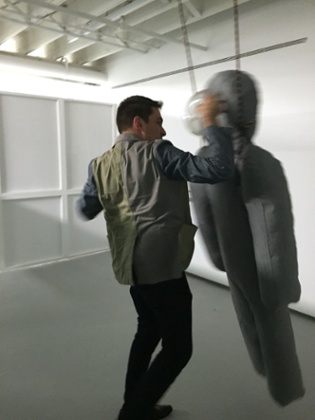
Given my perpetual New Yorker agita, I went into the consulting room marked “vaccine for violence.” God knows I could use one. The friendly therapist, a woman named Susan, smiled and instructed me to blow up a balloon. “Now draw the face of someone you really hate, I mean really hate,” she told me. I picked David Koch, and tried to capture his thinning hair and billionaire’s jowls with my marker.
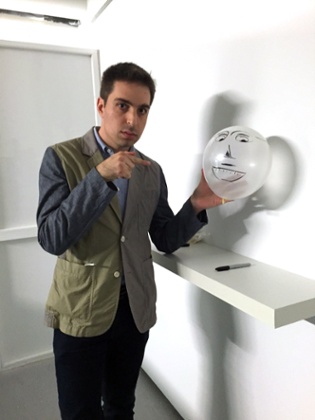
Susan then inserted the David Koch balloon in the cavity of a human-shaped punching bag, and told me, all sweetness and light, to unleash my rage. I kicked David Koch in the testicles, I punched him over and over in his chest, I boxed his ears. “Tell him what you really feel!” Susan instructed. “Your antisocial greed and anti-government dogma is condemning the planet to apocalyptic climate change!” I screamed. There might have been some ruder words too, but I was worked up.
It was over. Susan told me to put the balloon on the floor and pop David Koch’s face, which I did with the finality of a groom at a Jewish wedding. I felt great. But now came the vaccine: a white breath mint, which I was instructed to swallow to enter my new violence-free life. “It’s just a placebo,” Susan told me, “but placebos work.” I must hope so.
Updated
Jason writes: I’ve left the beach, crossed Biscayne Bay, and come to Miami proper for the opening of the Institute of Contemporary Art — the brand-new museum that’s resulted from a very ugly dispute. As we reported earlier, the ICA has been established by former board members of the Museum of Contemporary Art in North Miami, who broke from that institution in an acrimonious, lawsuit-beset showdown with local officials. The new ICA is far from MoCA NoMi, in Miami’s design district, not far from the warehouse showcasing the private collections of Miami’s oligarch aesthetes.
It’s too soon to say whether the outcome is good for all involved, and so far this place is pretty sedate. But this week it was announced that the ICA is building a permanent home here in the design district, designed by the Spanish firm Aranguren & Gallegos Arquitectos and opening around Art Basel 2016. It’s being spearheaded by Irma Braman, one of the former chairs of MoCA NoMi, and her husband Norman—the car dealership king of Miami, who first spearheaded the unlikely importation of the very Swiss, very sedate Art Basel to garish Miami Beach back in 2000.
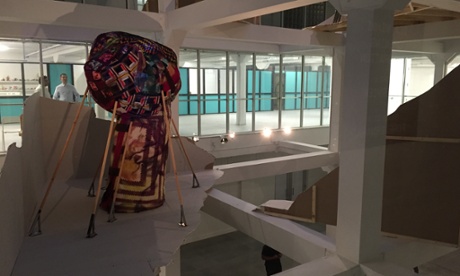
For now, though, ICA Miami is housed in a converted commercial building, complete with frosted glass offices and a big old atrium. The Romanian artist Andra Ursuta, one of the two artists in these inaugural exhibitions, has played with the history and the architecture of the space in a sculptural installation rising four stories. On rough, uneven slabs of drywall, Ursuta has placed melancholy, wordless sculptures that suggest absent bodies, or fading memories. A long wood column, recalling her fellow Romanian Constantin Brancusi, lies in a bird’s nest; a bunch of grandmotherly quilts sits on an air pump, inflating and deflating; coloured stools are soaked in paint, signs of artists no longer here.
In a sentence you could definitely take two ways, Artnet are asking “What are top dealers bringing to Art Basel in Miami Beach and why?”
Meanwhile, Vulture have an article on “the people who get to Art Basel one night early”. Yes, that was .
Meanwhile, here’s a sneak preview of what the fair itself looks like, the evening before the official opening.
Day before the fair pic.twitter.com/jtgAjlKoFs
— Alex Needham (@alexneedham74) December 2, 2014
Updated
While Jason was hard at it at the design fair, I (Alex) went on the trail of performance art legend Marina Abramović. I eventually found her having lunch with two trestle tables of people who work at Tumblr at the Standard hotel – not a shabby location.
Marina Abramovic and folk from Tumblr pic.twitter.com/ZYuiIMuj97
— Alex Needham (@alexneedham74) December 2, 2014
In fact, looking from the other direction it was even nicer.
Slaving away as usual pic.twitter.com/p6fwCsP5DI
— Alex Needham (@alexneedham74) December 2, 2014
What connects Abramović and Tumblr? According to one of her assistants, she turns over her own official Tumblr once a month to emerging artists, who are free to curate and post as they see fit. Tumblr, he said, is increasingly used by artists as a way of showing their process and inspirations, in the manner of an old-school “mood board”.
I was keen to speak to Abramović, but before the fish tacos arrived she had to go to Design Miami, where she was giving a press conference, so I dashed over there. She’s participating in a series of performances there, in the vein of her durational performances this year in New York and at London’s Serpentine gallery.
This will entail a slow motion walk with Miami’s YoungArts foundation, a booth where you can go to sleep amidst the chaos at Art Basel, and two performances where participants count grains of rice for no less than six hours, on top of a table designed by Daniel Libeskind.
But why? Abramović told the conference:
I think it’s important to know that technology is great, but it’s also a dangerous thing, because it takes up all our free time, and we need to learn how we can get this free time back for ourselves. And the only way to do this is to really immerse in some long, duration activities ...
It might seem ridiculous, but you need to make time for ourselves, so if you can’t count the rice for three hours, you can’t do your life any good either.
She’s also on a funding drive for her Marina Abramovic Institute, which has already been the subject of a Kickstarter. To be housed in New York in a building designed by Rem Koolhaus, its aims are:
... dedicated to the presentation and preservation of long durational work, including that of performance art, dance, theater, film, music, opera, and other forms that may develop in the future. MAI will foster collaboration between art, science, technology, and spirituality, bringing these fields into conversation with long durational work.
It will be interesting to see what effect such forays in the worlds of commerce and celebrity, in the service of her foundation, have on her artistic credibility. Or is that an outmoded concept in a world where Cindy Sherman designs handbags for Louis Vuitton?
Not everything at the fair is so tasteful—this is Miami, amigos y amigas. There is a swanky car spinning on a turntable, and showgirls with gift bags. (I declined. Professional duty.)

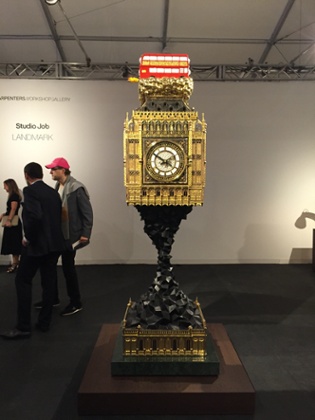
And, if you have no taste, perhaps you’d like to take home a gold statue of a half-destroyed Big Ben, topped by a fire-belching Routemaster?
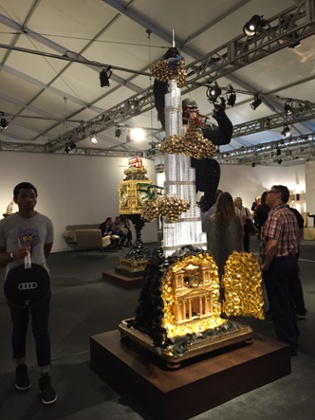
Or perhaps you would prefer a crystal-eyed King Kong climbing the Burj Khalifa ... Yours if you want it. Doesn’t match my couch, I’m afraid.
Updated
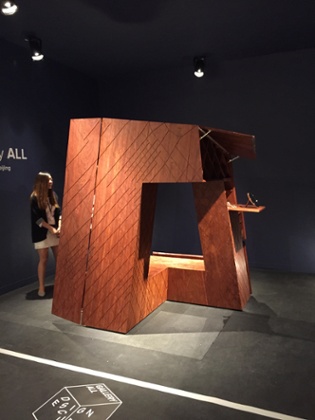
One of the more piquant works on display at Design Miami: a dresser/wine rack/bookshelf in the shape of one of the most famous buildings of our time, Rem Koolhaas’s tower in Beijing for CCTV (that is, the Chinese state television broadcaster and propaganda centre). The armoire, by Chinese designer Naihan Li, is made of Brazilian rosewood, and even copies Koolhaas’s cracked and striated glass with its surface incisions. Welcome to the art world circa 2014, when even the mouthpiece of the Chinese Communist Party can be transmuted guilt-free into a luxury good.
It’s on the booth of Beijing’s Gallery All and it’s in an edition of only three. Get yours now, comrades!
Updated
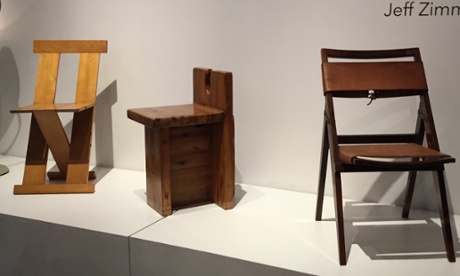
On the booth of R & Company, a New York furniture gallery, are three chairs by my favorite architect of the 20th century: Lina Bo Bardi, the Italian-born Brazilian who turned away from International Style utopianism to produce radically blunt buildings for everyday use, often using concrete. Bo Bardi — the subject of a fantastic show this summer at Zurich’s Johann Jacobs Museum — was a polymath. She got her start as a critic, actually (hope for us all!), and also designed theatre productions, directed a museum of anthropology, and made furniture. The folding chair on the right, with a leather seat and a jacaranda body, dates from the 1950s, when she was completing her work on the Museu de Arte de São Paulo; the others are from the end of her career, in the 80s, and made of solid pine.
Galerie Patrick Seguin, from Paris, has mounted a fantastic display – a proper exhibition, nearly – of furniture for university housing, designed by three leading figures of French applied arts: Le Corbusier, Charlotte Perriand, and Jean Prouvé. The earliest work comes from a college in Nancy, where in 1932 Prouvé designed mass-produced furniture for 70 student dormitories, built in response to a housing crisis. There’s a simple but elegant armchair, bluntly functional metal bookcases, and a bed made of bent sheet steel, painted a bold red.
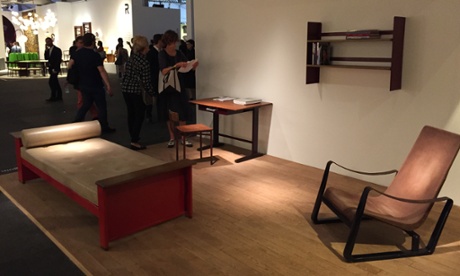
After the war, the Cité Universitaire in Paris — a collection of dormitories for international students — entrusted Le Corbusier and Perriand to furnish new housing for Brazilian students. Amid severe budget constraints, the pair produced multifunctional furniture (a room divider with a bookshelf and wardrobe, for instance) that articulate Corb’s passion to build “machines-à-habiter”: architecture and furniture with the rationality of a modern machine. They’re glorious works — though given the booming market for these designers, even the mass-produced objects are certain to furnish rooms far less spartan than student digs by the end of this week.

Jason writes: Art Basel doesn’t open until tomorrow, but across the street from the main event is Design Miami, the applied arts fair that’s celebrating its tenth anniversary this year. Along with NADA, the young dealers’ event (opening Thursday), it’s the most legit of the peripheral fairs that have multiplied like kudzu around Miami Beach.
I’ve been swanning around the VIP preview this afternoon, and it’s looking good. In this first December of the post-Piketty era, it’s hard not to see how the furniture here (and the art across the street) reflects the growing wealth of a small elite, and goodness knows there are some shiny gold things here to decorate your fifth house in Aspen or the Turks and Caicos. Yet under its new director Rodman Primack — a practicing designer who took the reins earlier this year — the fair has tightened considerably, with lots of important postwar French design and a good showing from Latin America. I’ll post some highlights now.
Alex is now going to attempt to get into an event which brings together Tumblr and performance art doyenne Marina Abramović over a fancy lunch. More news soon ...
Jason writes: the Bass Museum, we should point out, is one of the players in a big shake-up of Miami’s museums over the last 18 months.
During last year’s Basel week, all the talk was about the chaos up the road at the Museum of Contemporary Art North Miami — MoCA NoMi, to friends — whose board was in full rebellion against city hall. The board members, mostly big-hitting members of the international collecting class, wanted the museum to merge with the wealthier Bass, whose more glamorous location seemed more appealing to them than grittier North Miami. The local government was furious, and insisted that MoCA belonged to the local community, not wealthy collectors who fly in for a week a year; one official called the mooted merger “a modern-day art heist.” (FYI, Miami, North Miami, and Miami Beach are all independent cities with their own local governments.) There were lawsuits. There were accusations of racism. It was ugly. At one point MoCA had two duelling directors: one appointed by the board, the other by the city.
It’s all shaken out: MoCA remains in North Miami with a new director and will retain the majority of its collection. The board members, having abandoned the plans to merge with the Bass, have founded a new institution, the Institute for Contemporary Art, which opens tonight. (Alex and I will be there later and, I’m sure, will have more to say then.) And the Bass, like almost everywhere else in this cash-flush moment for contemporary art, is now looking to expand on its own.
We’ve just posted Jason’s take on One Way, the exhibition of architect Peter Marino’s art collection, which juxtaposes some heavyweight works by the likes of Anselm Keifer with footage of fashion shows. Jason writes:
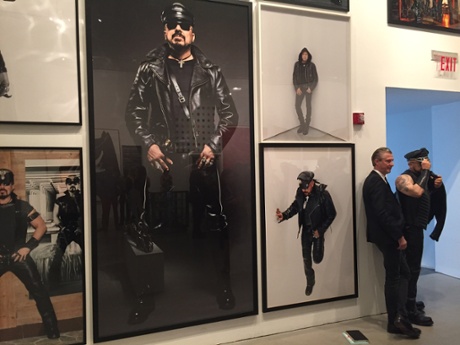
It is, in a word, obscene. And yet there is something almost perversely admirable about the overtness of its obscenity – the show’s unconcerned commingling of art and commerce, its total indifference to history and scholarship, its assurance that art’s recession into fashion and luxury is not just inevitable but something to be celebrated. Philanthropy is marketing, alas, but this show takes it to new heights. Too many luxury brands to count have stumped up to support the show, and here’s something I’ve never seen before: individual galleries bear the names of luxury sponsors. “This gallery is sponsored by Chanel.” “This gallery is sponsored by Louis Vuitton.”
The funny thing is that he actually owns some truly major works of art. Along with numerous Stingels, you’ll see some important photographs by Thomas Struth, a totemic Baselitz sculpture I liked more than I thought I would, and there’s even a Robert Ryman white monochrome if you can find it shunted near the emergency exit. (Women artists are not his thing; I counted just three – Paola Pivi, Claude Lalanne, and Michal Rovner – alongside more than 40 men, though Marino’s wife Jane Trapnell collaborated on the opera.) If a private collector wants to hang such important works in such decadent circumstances, that’s no concern of mine. Whether a nonprofit museum should be the forum for this, though, is a thornier matter.
The Wall Street Journal has a good titbit:
Even the catalogue has the Marino touch. It is bolted with real leather straps that Mr. Marino fabricated in-house and paid for out of his own pocket.
(Jason didn’t see it.)
Bloomberg have run down the finances of Art Basel Miami Beach here:
They think that there will be $3bn worth of art for sale when the fair opens tomorrow, with works including a Warhol portrait of Mao Zedong princed at $18m, a Roni Horn sculpture at $3.5m and David Hockney’s iPad drawings at $28,000 a time.
You probably don’t want to know that 1,000 private jets are set to swoop into Miami to scoop up such shiny baubles.
By the way, if you’ve got any tips on things we should be covering, do feel free to tweet @alexneedham74 or @jsf.
In the mean time, I (Alex) have been perusing the web for tips on how to approach Art Basel Miami Beach.
Black Book have recommended a party-centric bunch of events. I think I’ll give the one where Paris Hilton DJs a miss - although PS1’s Zero Tolerance exhibition, with work by Joseph Bueys, Pussy Riot and Doug Aitken, sounds like a must-see.
ArtNet have a (presumably) tongue-in-cheek “10 ridiculous but true rules for navigating Art Basel in Miami Beach” which include “Buy artworks before you get to the fair. If you’re making an appearance, do it only to be seen” and “Skip all museum shows, openings, performances, and other satellite events. Boring! Waste of time.” (Incidentally I would take issue with their rule not to turn up to something if you’re not on the list. Most parties here seem highly crashable to me.)
This looks highly useful if you don’t want to get financially rinsed:
Art Basel on a budget: free events and free art fairs this week @ArtBasel http://t.co/wyr7xLFkYI pic.twitter.com/BGS5iJU9xy
— Miami on the Cheap (@miamicheap) December 2, 2014
Huffpo have also rounded up 11 Instagram accounts worth following over Art Basel, with Serpentine gallery co-curator Hans Ulbrich Obrist at no 1. Here’s an example of Hans’s Instagram action:
Instagram has really become a force in the artworld over the past few years, with some commentators wondering whether it’s actually now influencing artworks and exhibitions – that all onlookers are now mentally perusing galleries for images that will look good on the social networking site, rather than looking at the work unmediated. It’s another thing to ponder over the coming few days.
He writes:
For [real estate company CEO Craig] Robins and others, bringing art to the city appears to have paid off. It’s got its own name: the Miami Effect. The city is going through a construction boom. There’s a feeling that the influx of wealth will support the development of an indigenous art scene, rather than have one imported for a week every December.
That’s certainly collector Mera Rubell’s hope. This year, on their 50th wedding anniversary, she and husband Don are showing highlights from their collection, including Cindy Sherman, Richard Prince and Charles Ray. Founding pillars of Miami’s art establishment, the Rubells moved to the city in the early 1990s. When they first suggested bringing Art Basel to Miami, the mayor imagined a flea market. So the Rubells flew him to Switzerland. “Money, visibility – he saw what a huge scene it was. You have to remember that art is now global and art fairs are the only way to connect.”
Rubell and John Baldessari sometimes talk about the time when there was no money in art. “It’s interesting,” she says, “that all these brands can’t live without artists. Their marketing depends on creativity and they need artists to define them.”
As Edesio points out in the comments on Edward’s piece, on the same day the New York Times posted an article giving an almost diametrically opposite view.
The writer, Brett Sokol, speaks to local artists and gallerists, who say they get little to no benefit from Art Basel. though he identifies hope in the thriving nonprofit organisation the ArtCenter South Florida, where artists have taken refuge from the familiar story of gentrification and rising rents.
Sokol writes:
The buying power represented by Art Basel Miami Beach should be obvious. After all, money continues to pour into the art economy, with more than $2 billion exchanging hands in New York’s November auctions alone. The Miami Beach fair remains one of the art world’s most conspicuous showcases, drawing more than 75,000 attendees in 2013, organizers said. The fair itself is only one part of Miami Art Week, which now includes two dozen satellite fairs hoping to pull in the moneyed spillover, as well as a dizzying array of brunches, dinners and luxury-steeped parties.
Yet only a small percentage of out-of-town visitors will venture out to explore Miami’s homegrown art scene. Once a prime attraction for Basel-ites, the local terrain increasingly seems to them to be merely a traffic-clogged backdrop. The New York collector Beth Rudin DeWoody said that the events surrounding Art Basel have become so frenetic, many of the collectors she knows fly into Miami for only two days, solely to hit the main fair.
“Then there are some people who come just for the parties,” she added with a laugh, “and the hell with the art.”
Later on, Jason and I went to a couple of parties; the first for public art organisation Los Angeles Nomadic Division (LAND), which was celebrating its fifth anniversary with an auction, and the second for the biannual independent architecture magazine Pin-Up, where the attractions included cakes designed by luminaries including fashion designers Viktor and Rolf.
Cakes at Pin-Up pic.twitter.com/WFXGPDmVBF
— Alex Needham (@alexneedham74) December 2, 2014
Amidst all this frivolity I got chatting to an artist (who I shouldn’t name) who seemed pretty disquieted by the prices his work was commanding, which he described as “illogical”, and the general decadent hoopla of the fair itself (he would have skipped it, he said, but he had to be there for meetings). I got the impression that he was far from atypical in this. He’d just opened an artists’ foundation in Mexico City to give back something to emerging artists out of his windfall.
Here’s an artist’s impression of the pavillion by the way:
MT @ARTnewsmag A concise guide to Miami art fairs #UNTITLED2014 http://t.co/3NzHudQYL4 pic.twitter.com/6O6m8X6Pdc
— UNTITLED. (@UNTITLEDmiami) November 28, 2014
And a coffin-themed installation inside:
Untitled art fair, Miami pic.twitter.com/Q2ORQ6rXsf
— Alex Needham (@alexneedham74) December 2, 2014
Another slightly odd thing about Untitled - the Sotheby’s Institute of Art stand, which an unkind onlooker described as a finishing school/interns’ clearing house, was showing the work of the avowedly anti-capitalist Alfredo Jaar, whose work This is Not America caused controversy when shown in Times Square. The work consisted of two piles of printouts – which passers by were free to take – saying “for sale” and “not for sale”.
Sotheby's stand at Untitled pic.twitter.com/8kQOCEd4qy
— Alex Needham (@alexneedham74) December 2, 2014
Alex: Last night Jason and I got our first taste of the artworld madness with a visit to the Untitled art fair, situated in a gigantic white tent here on South Beach, Miami. It concentrates on emerging artists: here’s what it looked like inside.
The scene at Untitled pic.twitter.com/DadE1L0KKQ
— Alex Needham (@alexneedham74) December 2, 2014
Plenty of people impatient to get in on the action were milling around drinking cocktails and eating surprising canapes – pots of houmous and pretzels. As for the work itself, a polite description would be eclectic, although I was put right by a chat from Artforum’s publisher Knight Landesman, resplendent in canary-yellow trousers and tie.
He said, and I am paraphrasing from memory, that he makes sure to visit every art fair and unearth the one thing that’s great - that while some work might seem naive, or unsophisticated, or just not very good to the eyes of artworld sophisticates, one should always bear in mind that it’s been made by someone because they loved it, and that they had something to say. At that point some Finnish performance art struck up.
Finnish performance art about to happen pic.twitter.com/gQXXpyvWEE
— Alex Needham (@alexneedham74) December 2, 2014
Updated
We’re at art week in Miami
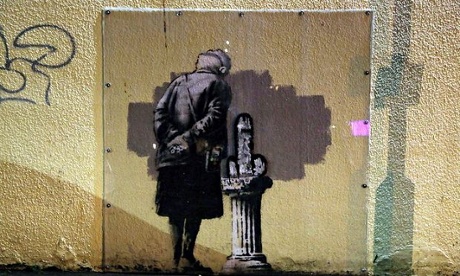
Morning from a cloudy Miami. Guardian US’s art critic Jason Farago and I are here to bring you the news and reviews from the city’s art week. As well as the famous art fair Art Basel, there’s a bewildering range of art-related events taking in a design fair, rival art fairs, many parties (here’s Vanity Fair’s list of the latter) and, among other things, the possible unveiling of a Wu-Tang Clan album of which only one copy has been made, a private gig by Miley Cyrus and the flogging of a Banksy which first appeared in Folkestone, but which was removed by the council after it was vandalised.
Jason: Art Basel Miami Beach, the largest art fair in the United States, gets underway Wednesday – and it’s the centre of this week’s action. But the great and good (and not so good) of the international art world have already descended on Miami, and on Tuesday a whole host of museum openings, exhibition unveilings, and artists’ performances are getting started.
Over the course of the day we’ll be visiting the new Institute for Contemporary Art, which opens its doors after an awkward split from its parent institution; viewing the private collection of Peter Marino, the leather-clad New York architect; and taking in a major performance from Ryan McNamara, whose work explores how digital media and human bodies intersect and transform each other (read a Guardian interview with him here). As for the parties, they’ve been going since Sunday, but with a few cafés con leche in us we’re ready to go.
Updated