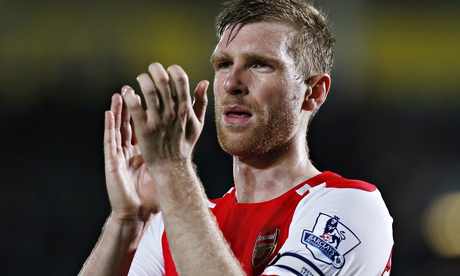
After spending the last four years living in England and embracing the culture, Per Mertesacker and his wife are considering scrapping their plans to return to Germany when his career is over. Mertesacker has reached the stage where he dreams in English, his two sons have been brought up speaking the language and there is something about the Arsenal defender’s adopted home that makes the grass seem greener here. “How you maintain your gardens, we don’t have that in Germany,” he says.
The only downside – and Mertesacker is reluctant to say anything negative – concerns bricks and mortar. “We’ve moved house twice already because we were not happy with the building and how the wind blew into the house. During the summer everything was OK but during the winter we had some big problems. That’s different to Germany – single-glazed windows ... small things that we have an eye on in Germany, and everything needs to be fixed and sorted in a good manner.”
Mertesacker is smiling but serious. The man Arsenal fans have taken to their hearts and affectionately nicknamed the BFG – Big Friendly German is how Mertesacker intends to get round the middle part of that acronym with his children – has been talking with refreshing candour for more than an hour, discussing everything from Arsenal’s title aspirations to his own limitations as a young footballer.
“I was lucky to get a professional contract. I wasn’t that sort of talent that is considered to be a professional player,” Mertesacker says. “I’ve never had that dream in my head: ‘I want to play Bundesliga or Premier League.’ I was a fan, but it was never the dream that one day I was going to make it, because a lot of people had told me already that I wouldn’t.”
One of the most fascinating aspects of Mertesacker’s story is that he spent 12 months working in an institute for the mentally ill before breaking into the first-team at Hannover 96. A youth player at the time, Mertesacker chose community rather than military service when a decision had to be made and he could hardly have taken on a tougher assignment. “It was challenging – much more so than I thought – but a great experience,” he says.
“You trained in the morning and went to the mental hospital in the afternoon. I did that every day for a year. You had your own key because everything was locked. You went in and had to help them get up, change their clothes, go to the toilet, make their daily routine, their food, everything. It was a different world. Some were just in the room on their own, someone had socks on his ears but played chess really well. How do you cope with these people, how can you deal with that?
“Some of the guys just went at you, screaming because there was something in their mind. But you realised they are people who are ill, who need your help. When I went in I thought: ‘They need me.’ You can’t turn up and think: ‘I don’t care.’ It was something to put things in perspective. That privileged life we live is good but you have to respect what happens on the other side as well. When you have a high sometimes, just look back and think about that.”
Mertesacker wishes he had more time to reflect but he knows that moment will only come when he retires. A natural leader, intelligent and a great reader of the game, the 30-year-old seems like ideal management material, yet he has no intention of spending the next chapter of his life on a training pitch or in the dugout and instead talks about trying to “get respected in a different way, not in football”.
“I don’t see myself coaching because the intensity of that is massive, and the intensity as a manager, for example Arsène Wenger, is even more. Maybe you will want to have that intensity and you can’t live without it, then I come back for sure. I’ve had some great managers and they gave me some experience, great managing skills as well, but right now I would say I do not fancy it.”
Family life is important to Mertesacker and after retiring from international football in the wake of Germany’s World Cup triumph last summer, he relished the chance to enjoy a proper break at the end of last season. As well as taking several holidays, he returned to Hanover to spend some time with his foundation, which was set up in 2006 and helps disadvantaged young children, and he also got stuck into a few books, including Twelve Yards: The Art and Psychology of the Perfect Penalty. Did a German really need to read up on that subject? “No,” says Mertesacker, laughing. “We are well prepared.”
The previous summer had passed by in a blur. Oskar, Mertesacker’s youngest son, was born three days after Arsenal beat Hull to win the FA Cup and end their nine-year trophy drought. Within 48 hours Mertesacker was off to Austria for a pre-World Cup training camp. He went back to Germany for three days to see his family before heading to Brazil with a simple message ringing in his ears. “My wife said you can only come back with the World Cup,” says Mertesacker, smiling at the memory.
Brazil was a magical experience for Mertesacker and it will live with him forever, yet it was also mentally and physically draining, and if there was one moment that came to define him at those finals, it was the television interview he gave shortly after Germany’s 2-1 extra-time victory over Algeria to reach the quarter-finals.
So often the go-to man for the media after matches because of his courteous manner and willingness to front up, Mertesacker reacted with a mixture of anger and incredulity to a line of questioning that immediately focused on Germany’s poor performance rather than their place in the last eight. “What do you want from me? What do you want from us?” Mertesacker said, dripping with sweat and staring with indignation.
The footage caused quite a storm in Germany and Mertesacker smiles as soon as it is mentioned. “I’ve seen it a lot,” he says. “Normally I wouldn’t. But I had to because there were lots of reviews of the year in Germany of the success and they always reviewed the interview and wanted to know what I thought. I did an interview with the guy who did that interview after the match – we have a good relationship.
“But at that moment I was honest and emotional. He criticised the way we played and [asked] if that was really a German side, I was upset straight away. It was after 120 minutes and I thought: ‘No, you’re not right.’ And then I just let it go, there was no holding back and that was important for us as a team. We were winning and that is what counts at the end. We don’t want to play really good football and lose, as we did in the World Cups we played in before.”
While not everyone in Germany agreed with Mertesacker’s response, the majority took his side. “‘Great World Cup win, and great interview’, that was the two things that everyone mentioned when I got back. Even when I was in Spain on holiday, I remember on the beach people coming up and saying that.”
The warm glow Mertesacker felt when he first returned to Germany after the World Cup has now started to fade and he almost chokes on his glass of water when asked whether he has been given the freedom of Hanover. “My home town called me a citizen of honour. So I’m a special citizen now. It’s more responsibility,” says Mertesacker, chuckling at the realisation that he has almost been burdened rather than liberated.
Mertesacker’s responsibilities at Arsenal have extended to leading the team in the absence of Mikel Arteta. Scoring in the FA Cup final victory over Aston Villa in May was a highlight but Mertesacker wants more. The league title is top of his list but Arsenal have never showed the consistency to mount a legitimate challenge during his time at the club.
“If you compare us to Chelsea, the reigning champions, I think they lost only three games last season. That’s something we haven’t been able to do. We lost six, seven or eight games per season, that’s not good enough to win a championship,” he says.
His own form has come under the microscope at times, with Martin Keown and Jamie Carragher singling Mertesacker out on occasions last season. Mertesacker accepts that “there will always be doubters” but says that the only way to respond is on the pitch “because there are so many people who trust me at the club and count on me every week”.
At the same time, it is a safe bet that we will not see Mertesacker in a TV studio critiquing players when he hangs up his boots. “In modern football there will be more and more demand for former players who want to have an opinion and still feel they are part of the football system,” he says. “Maybe I can avoid that when I finish my career. That’s my target.”
As for Arsenal’s prospects this season, Mertesacker points to the 2-0 defeat at home against West Ham in the opening game as evidence that they cannot afford to play at anything other than 100% and he goes on to say that Liverpool’s visit on Monday will serve as a reasonable barometer for what they are capable of achieving. “It’s the first test against a title contender, so it’s a chance to see how good we are. We need to turn up, especially at home, with the right intensity and a kind of aggressive nature we maybe lacked in the first home game.”
With that it is time for Mertesacker to head off, comfortable in the knowledge that he has found a country and a club that make him and his family feel totally at home. There is even the possibility that Oskar, who was born in London, could end up representing England one day.
“That’s what I heard,” Mertesacker says, smiling. “I can’t decide that on my own, my wife has a big part to play in that as well. But you never know. Do we stay here, do we go back to Germany? Those questions will be asked because when we came we said we would go back for sure. But it slowly starts ... my wife enjoys it, speaks English fluently and considers that she could stay here.”