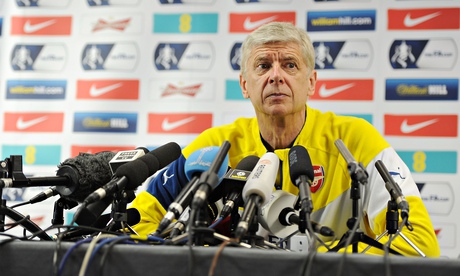
Arsène Wenger is aiming to win a sixth FA Cup on Saturday and a 12th major honour as a manager but he has no idea where his medals are. Asked about what he had done with the medals accrued with Monaco, Japan’s Nagoya Grampus and Arsenal, Wenger looked completely blank. “I don’t know where they are,” he said. “If you ask me now: ‘Show me a medal of anything’, I don’t know where they are.” But surely they are in a safe place? “No … I think the guys who come and clean the house, they come and take them,” he said, jokingly.
This suggestion was not, it must be stressed, put in any kind of accusatory way, more as if he was thinking aloud. Apart from the medals he cannot put his fingers on, Wenger can recall giving some away. But the general conclusion is that the Arsenal manager does not particularly care for reminders of past successes. He has always been more fixated by what is in front of him than what went before. “I am not a collection man,” he said. “I am always focused on what’s next.”
He has the chance to become the most successful postwar manager in the FA Cup and also equal the all-time record holder, George Ramsey, who collected his six medals over a 33-year period with Aston Villa between 1887 and 1920. “I don’t look at it in a personal way,” said Wenger of a place in the history books. “Maybe I will if we win.”
When he reflects on his own FA Cup final story, it is telling in a way that the one that sticks out was the defeat, in 2001 against Liverpool. Arsenal led and should have had a penalty with their opponents reduced to 10 men, when Stéphane Henchoz saved a certain goal with a hand, but the offence went unpunished and Michael Owen pounced later. “It’s quite strange because I have played six finals and the one we deserved to win most was the one we lost,” he said. Does it still hurt? “Of course.”
Wenger’s affection for the FA Cup dates back to his boyhood and paying some francs to watch the final on the black and white television in the village school. “That was in 1955, 56. The first television I got at home was when I was 15. Before that we had no television at home.”