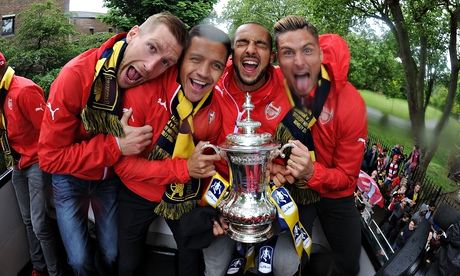
As Arsenal’s players took turns to lift the FA Cup in watery late-evening sunshine at Wembley the in-house PA avoided the temptation to serenade the trophy winners with We Are the Champions or some other cheese‑encrusted hymn to ultimate sporting triumph. Instead Arsenal lifted the Cup to Curtis Mayfield’s Move on Up, a familiar Gunners anthem but also a suitably halfway-there song about hopeful starts, aspiration and, basically, going on somewhere better after this.
Arsenal were excellent, pressing Aston Villa high up the pitch, feeling their opponents buckle under the pressure and earning the space to exert their greater class and movement in attack.
The end result was among the more one-sided FA Cup finals, a 4-0 victory that was never at any stage in the slightest doubt. Not only were Villa outclassed in midfield by the A-list craft of Santi Cazorla and Mesut Özil, frankly they looked dazzled by the occasion from the first whistle. Those of a more sceptical bent will point out that, as last year, Arsenal beat a Premier League back-marker at Wembley, the culmination of a cup run in which they also edged past Reading, Middlesbrough, Manchester United, Brighton and Hull. And yet, watching Alexis Sánchez – signing of the season and scorer here of a truly memorable Wembley Cup final goal – hoist the trophy, it felt entirely correct that Arsenal’s rare run of form from New Year’s Day into spring should result in some tangible end-of-season reward.
Which is where attention must focus now. After last year’s final, Arsène Wenger came swaying a little giddily into his press conference in a borrowed shirt, having stripped to his champagne-drenched waist on the Wembley turf. Here Wenger was not only fully dressed but quietly reflective in the face of questions that were all about what next and what now. “I think, of course, we can push on. Why not?” Wenger said, as indeed he must.
And, really, this time there is no excuse for anything less. Arsenal are in a good place. Money has been spent. The squad is well-stocked but also glitzy in many of the right places. A Champions League play-off has been avoided. It will instead be Manchester United steeling themselves for an early-season pinch point Arsenal have often dropped points either side of in the past.
For Arsenal it is time, as Curtis himself might have put it, to take nothing less than the supreme best. Which in this case means a gear change up into a genuine Premier League title challenge, with the conviction that coming third or second next season should be seen as a falling short of this team’s potential. The Manchester clubs will spend big this summer but really only Chelsea can claim to be in a more settled state. For Wenger’s stable, painstakingly refined Arsenal 2.0, it really does feel like now or never.
Victory at Wembley provided plenty of evidence of the qualities already there, and also of where Arsenal may look to strengthen and focus even further.
As they have since the midfield was rejigged following Francis Coquelin’s emergence, Arsenal pressed high up the pitch and looked a more gristly, physically robust team than at times in the recent past. With Theo Walcott starting in place of Olivier Giroud, there was real pace throughout, with a player such as Héctor Bellerín able to use his energy as a defensive weapon too, a way of hustling and pushing back his opposite number. In the first half Villa were simply unable to settle, with Tom Cleverley, Fabian Delph and Jack Grealish all hustled into giving the ball away.
The opening goal on 40 minutes was an extension of what had gone before, only this time with a finish, Walcott producing a supreme first-time shot on the run that whiffled the corner of the net. Villa will no doubt regret their unusual timidity. Perhaps Tim Sherwood had looked at the stats, as some suggested he should, that indicated the way to beat Arsenal is to be compact in the first half and make them sweat as the game goes on. If so, this was a mistake. A better approach was always to consider their own strengths first of all, which are to start quickly and to play with risk-taking aggression.
Sánchez’s goal seemed to capture Villa’s sleepiness. The defence failed to attack a loose ball. Sánchez picked it up, looked up to check his spot and whipped the most beautifully executed right-foot shot over Shay Given, the ball zinging in off the underside of the bar. After which there was time for Per Mertesacker to add a Sunday League-ish third, shouldered in from an unmarked position direct from a corner, and then for Giroud to tap in the fourth in stoppage time.
For Villa there is still the basis of a fine, energetic team here if Christian Benteke, who was morose and a little isolated at Wembley, can be retained and if Grealish, who fought gamely in the second half, can maintain his fine progress. For Arsenal, meanwhile, the question is whether the team’s strengths can be sharpened into title-winning weapons. At Wembley their two most notable players were Walcott and Cazorla, but these two positions – striker and central midfield – are still among those they need to strengthen. Giroud has some fine qualities but in a title-challenging team he looks more like an excellent variation than a spearhead at the level of Diego Costa, Sergio Agüero or the Robin van Persie of two years ago.
In preferring Walcott, Wenger acknowledged the allure of a fast, genuinely mobile centre-forward in this pass-and-move team, but Walcott is more the right style than the right man, with more precision required, and more natural striking presence. Against Villa Walcott had six shots at goal but he also attempted just eight passes in 76 minutes on the pitch.
Similarly Cazorla must and should be retained this summer. His ball-playing take on central midfield has been wonderful to watch. But his success also points to an area of weaknesses that would still benefit from further strengthening and Wenger is in the market for a another powerful, disciplined central midfielder.
At the end of which, and with all due apologies to the old trophy, it is hard not to conclude that for Arsenal a truly successful summer will involve not just winning the FA Cup but managing to recruit, say, Alexandre Lacazette, Geoffrey Kondogbia and Petr Cech. Either way, Wenger’s record sixth FA Cup victory provides both a moment of release and a building of necessary expectation. It has been a quiet, carefully costed, ultimately successful revolution. But from here Arsenal must now surely move to the next stage.