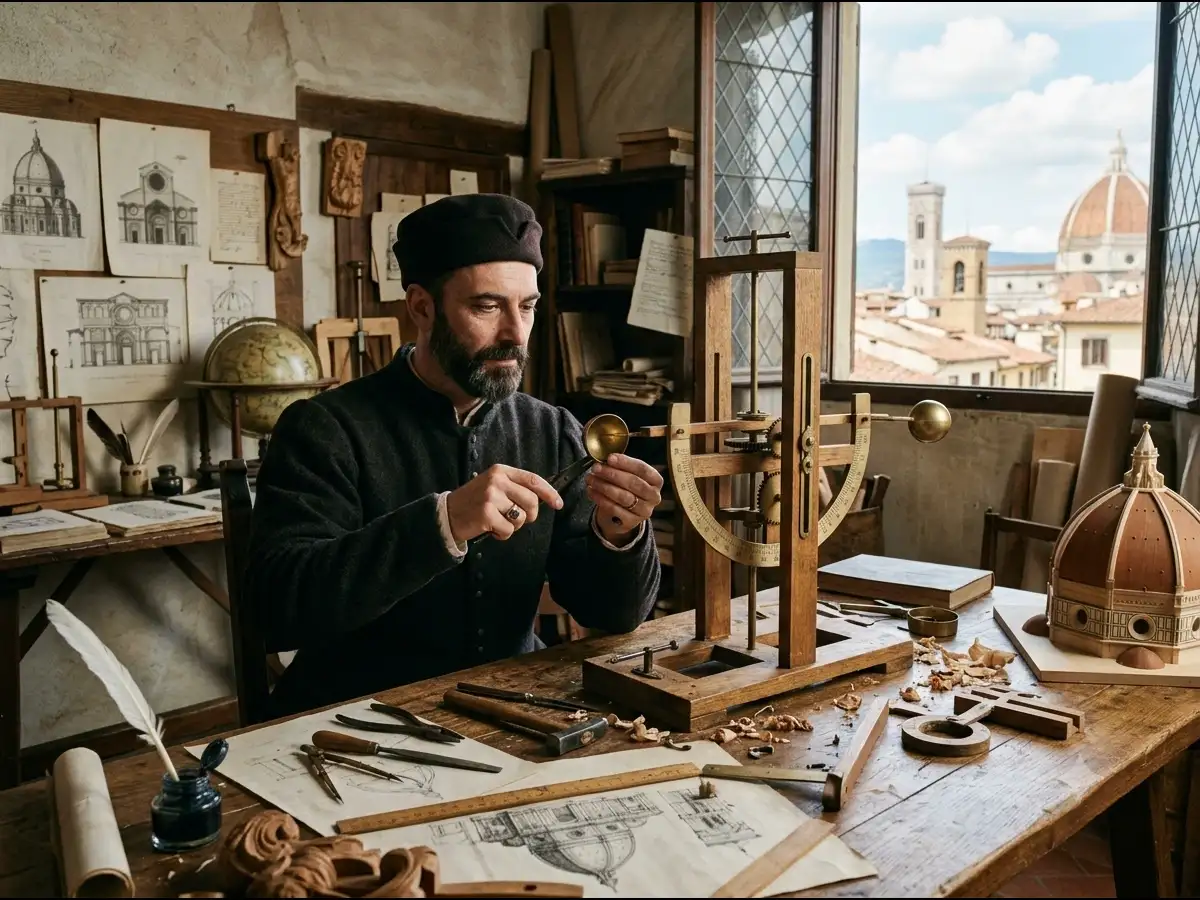
Around 1450, Leon Battista Alberti created a device that helped turn wind observation into measurement . The Italian Renaissance humanist, architect, writer and mathematician used a movable plate to observe the effect of wind. The plate was placed in the path of the wind. When air pushed against it, the plate moved. The amount of movement showed the relative force of the wind. This device is recognised as the first known mechanical anemometer. Historical research describes Alberti's instrument as a swinging-plate anemometer in which a disk was attached to a vertical shaft and placed perpendicular to the wind.
Around 1450, Alberti introduced a new way to measure wind
Before instruments were used to measure wind, people could observe its effects without assigning a numerical measurement. Trees moved, flags changed position and smoke showed the direction of moving air. These observations could indicate that wind was present, but they did not provide a mechanical reading of its force. Alberti's device introduced another approach. It used the physical reaction of a plate to moving air.
The instrument is generally described as a swinging-plate or pressure-plate anemometer. A disk was attached to a vertical shaft and positioned so that its face was perpendicular to the wind. When the wind struck the disk, it caused the disk to move away from its original position. The angle of this movement could then be observed as an indication of wind speed or force. This principle was simple. Wind produced pressure. Pressure caused movement. Movement could then be observed and compared.
How did Leon Battista Alberti's invention work?
The working principle of Alberti's anemometer can be explained through four parts:
- Disk placement: A thin plate or disk was positioned perpendicular to the wind.
- Wind pressure: Moving air struck the surface of the disk.
- Movement: The pressure caused the disk to swing or tilt from its original position.
- Angle reading: The angle of the disk's movement provided an indication of the force and speed of the wind.
The instrument did not work like a modern digital anemometer. It did not provide a digital number in metres per second. Instead, it provided a physical indication of the effect of wind on the plate. The relationship between the angle and wind force made it possible to compare different wind conditions. A stronger wind could produce greater movement, while a weaker wind could produce less movement.
Why Alberti needed information about wind?
Alberti was not only interested in wind as a natural phenomenon. His work connected mathematics, architecture and observation. He was an architect and architectural theorist. His work included studies of proportion, perspective, construction and the relationship between buildings and their surroundings. His architectural treatise De re aedificatoria was presented to Pope Nicholas V in 1452 and dealt with different parts of architecture and building.
Understanding wind could be useful for architecture because buildings are exposed to moving air. Wind can place pressure on walls, roofs and other structures. Alberti's effort to observe wind through a mechanical device reflected the broader Renaissance interest in studying the physical world through measurement and mathematics. His mathematical training also influenced his approach to practical problems. Historical accounts describe mathematics as an important part of Alberti's work in areas such as perspective and architecture.
Who was Leon Battista Alberti?
Leon Battista Alberti was born in Genoa in 1404 and died in Rome in 1472. He was an Italian humanist, architect, writer, mathematician, philosopher, linguist, priest and cryptographer. His range of interests made him one of the figures associated with the Renaissance idea of the polymath.
His family came from Florence and had interests in banking and commerce. His father, Lorenzo Alberti, was connected with the Florentine merchant and banking family. Because the family was in exile, Alberti was born in Genoa and later spent part of his childhood in Venice. His education included Latin and classical studies. He attended school in Padua and later studied law at the University of Bologna. He received a degree in canon law in 1428. He later entered the papal administration and worked in Rome.
Alberti did not limit himself to one field. His writings covered painting, architecture, mathematics, language, philosophy and other subjects. His 1435 work De pictura, also known as On Painting, discussed the mathematical basis of perspective. His architectural work later became part of the development of Renaissance architectural theory.
His education helped shape his practical thinking
Alberti's early education included mathematics and classical literature. His father provided mathematical training, while his formal education introduced him to Latin and classical texts. He later studied law at Bologna. Although law became part of his formal education, his interests extended into mathematics, architecture, literature and science.
This broad education mattered because Renaissance scholars often studied several fields at the same time. Alberti used mathematical ideas in areas that included painting and architecture. His approach to the physical world also appears in his interest in geography, surveying and mapping. Historical references describe his work on geographical measurement and mapping alongside his other studies.
The historical importance of the anemometer
The importance of Alberti's device lies in its method. Wind had always been visible through its effects. But a mechanical instrument allowed the effect of wind to be connected with the movement of an object. This represented a step toward measured observation.
The known history of wind measurement identifies Alberti's 1450 device as the first known anemometer. Research on wind-gust measurement describes it as a swinging plate attached to a vertical shaft. The device therefore occupies a place in the history of instruments that measure atmospheric conditions. Its basic principle also remained relevant. Pressure-based anemometers continued to be developed after Alberti.
Robert Hooke developed a similar device
The idea did not end with Alberti. In the 17th century, Robert Hooke developed a similar pressure-plate instrument. Historical accounts identify Hooke's version as a later development of the plate anemometer. One research review dates his similar instrument to 1667.
The continued development of the pressure-plate design shows that the basic idea had practical value. Later versions introduced changes to the mechanism and methods used to record wind pressure.
John Thomas Romney Robinson changed the design
A different approach appeared in the 19th century. John Thomas Romney Robinson invented the four-cup rotating horizontal anemometer in 1846. Instead of relying on the movement of a single plate, this design used cups that rotated when exposed to moving air.
The rotation could be connected to wind speed. This became a major stage in the development of mechanical wind measurement. Cup anemometers remain associated with the measurement of wind speed. The change from a swinging plate to rotating cups shows how the same basic problem led to different mechanical solutions.
Modern anemometers use other methods
Modern wind measurement no longer depends only on mechanical plates.
Several types of anemometers are now used.
- Cup anemometers: Cups rotate when wind passes over them.
- Sonic anemometers: Sound waves are used to measure air movement.
- Laser-based systems: Laser techniques can measure air movement without relying on a moving mechanical part.
- Pressure instruments: Pressure differences can be used to determine wind conditions.
These instruments can provide measurements with a level of precision that was not possible with Alberti's device.
Alberti's wider contribution to architecture and science
The anemometer was only one part of Alberti's wider work. He contributed to architectural theory through De re aedificatoria. The work discussed architecture, proportion, construction and planning. It was presented in 1452 and later printed in 1485.
He also wrote about painting and perspective. His work helped explain the mathematical principles behind the representation of three-dimensional space on a flat surface. His architectural projects included the Palazzo Rucellai in Florence and the churches of San Sebastiano and Sant'Andrea in Mantua. He also worked in areas such as cryptography, geography and language. This range of work explains why Alberti is often discussed as a Renaissance polymath.
From observing wind to measuring wind
Alberti's anemometer shows how an ordinary natural phenomenon could become the subject of mechanical measurement. The device did not require complex machinery. Its main parts were a plate, a support and a mechanism that allowed movement to be observed. Its importance came from the relationship between wind and motion.
- The wind pushed the plate.
- The plate moved.
- The movement provided information about the wind.
That process created a method for comparing wind conditions instead of relying only on visual observation.
Why Alberti's invention still matters?
The history of the anemometer shows how measurement developed through simple mechanical ideas. Alberti's device came from a period when mathematics, architecture and observations of nature were increasingly connected. His work demonstrates how a question about buildings could lead to an instrument for studying wind.
Later inventors changed the design. Robert Hooke developed another pressure-plate instrument. John Thomas Romney Robinson introduced the four-cup rotating anemometer in 1846. Modern instruments now use mechanical, sonic and laser-based methods.
The technology changed, but the purpose remained the same: to determine how fast and how strongly air is moving. Alberti's contribution is therefore part of the early history of turning wind from something people could see into something they could measure.
Leon Battista Alberti's Anemometer
Alberti's mechanical anemometer dates to around 1450.
- It is described as the first known anemometer.
- The device used a swinging plate or disk.
- The disk was positioned perpendicular to the wind.
- Wind pressure moved the disk.
- The angle of movement indicated the relative force of the wind.
- Alberti's work connected mathematics, architecture and observation.
- Robert Hooke later developed a similar pressure-plate device.
- John Thomas Romney Robinson invented the four-cup rotating anemometer in 1846.
- Modern anemometers use mechanical cups, sound waves, pressure systems and laser-based methods.