Nothing like a narrow mountain road in a remote district of Jammu and Kashmir to test India’s civil-military relations. Reams have been written on why the supremacy of civilian institutions in India makes it so different from – and need it be said, so much better than – Pakistan. But allegations from a recent episode suggest that all it takes is asking a soldier to give way to a convoy of civilian officials for it all to come unravelling.
On June 25, a convoy of about 40 vehicles transporting Kishtwar district administration officials was snaking its way up through the hilly region to Padder for a “block diwas” or public “durbar”. The practice, in vogue in J&K for a few years, takes officials to citizens at the block level instead of citizens making the rounds of district offices, enabling spot redressal of grievances. In the convoy were the deputy commissioner of Kishtwar, the district additional superintendent of police, the assistant regional transport officer, and a host of other officials from all departments of the administration. What happened next has been detailed in several reports like this, this and this.
A pilot vehicle led the way, clearing the road for the convoy. At a point where two vehicles could not pass at the same time, the pilot stopped oncoming traffic, and asked some vehicles to reverse so the convoy could pass. One car refused. It was a private car, with a male driver and a male passenger in the front, both in civilian clothes, and a small boy at the back. When the pilot insisted on the car reversing, the two men in the car identified themselves as soldiers and demanded right of way.
As the other cars in the convoy drew closer, hot words were exchanged between the pilot and the men in the car. After more officers from the convoy got involved in the slanging match, with the car still blocking the convoy, the police ordered the car to proceed to the police station for investigation.
In J&K, the army uses civilian vehicles with ordinary registration plates for security or operational reasons. District authorities keep a list of such cars. At the station, it was determined this was an army vehicle. The driver was from 11 Rashtriya Rifles. The second man was an army major, attached to 17 RR. After a call from the CO of 11 RR, the car and its occupants were let go.
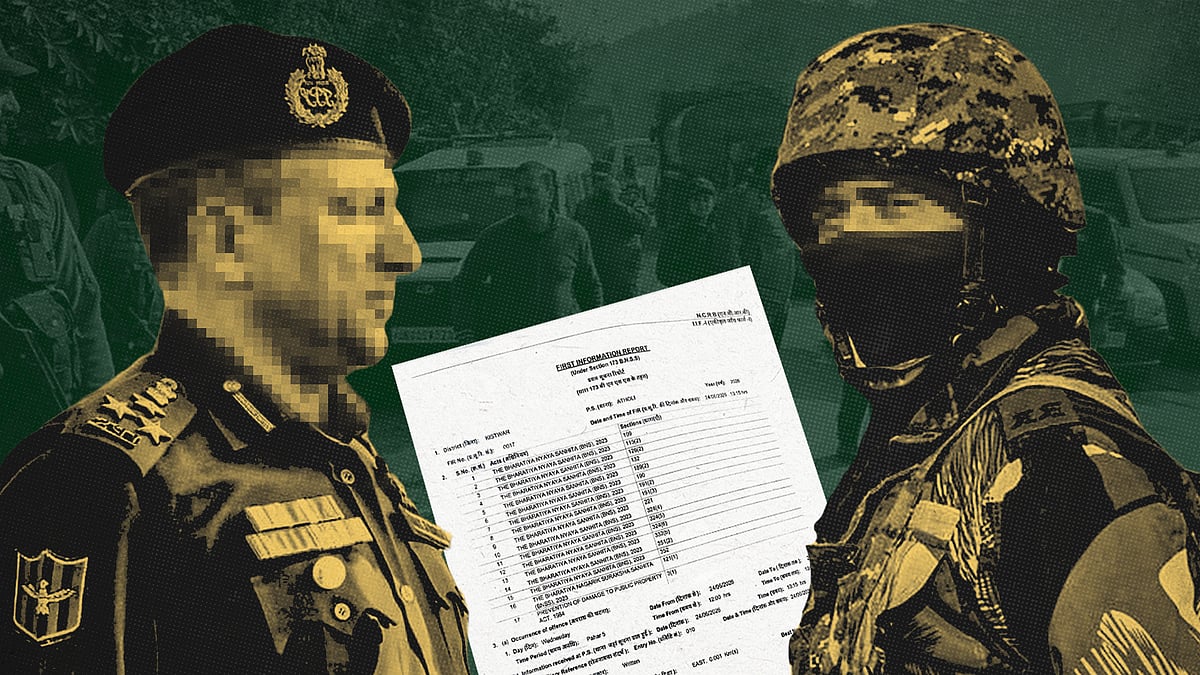
Some time after noon, a group of 30 to 40 soldiers arrived at the Atholi police station where the car had been taken.
The FIR names the CO of 17 RR Colonel Arun Gandhi as having sent the men, who were led by Major Vikas Sharma, the passenger in the car, and a naib subedar. The FIR alleged the men, armed with firearms besides iron rods and lathis, launched a “pre-meditated attack” on the police station with “the intention to cause fatal injuries and kill police personnel on duty”.
According to the FIR, this group of soldiers, most of them trained in lethal counter-terrorist operations, allegedly roughed up the Atholi SHO and tore his uniform, assaulted the sub-divisional police officer and a special police officer, who had an injury from a rifle butt, and beat up the assistant road transport officer too. They damaged vehicles and other property. A source in the police claimed the soldiers withdrew only when a police officer drew his gun.
Among the charges against the soldiers are attempt to murder, criminal intimidation, unlawful assembly, rioting, trespass, assaulting public servants on duty, and damage to public property. In response to the incident, the army stated that the matter was “under examination through institutional mechanisms.” An army spokesman in Jammu said the army would fully cooperate with the legal process and that “appropriate action would be taken after a joint investigation”.
The allegations levelled by the police are yet to be proven in court, but the sequence of events raises important questions on civil-military balance in our country.
‘National interest’ chorus drowns out concerns
Meanwhile, a proxy army of social media warriors has declared war on the deputy commissioner and police officers, demanding his suspension, transfer or arrest for daring to question the supremacy and authority of the army in a “conflict area”.
One post claimed the private car should have been given the right of way over the civilian administration’s convoy because it was out on operational duties. Another asserted it was carrying sensitive communication equipment and alleged it had been illegally seized. Voices pointing out that the J&K police have been equal participants in the fight against militancy and terror in the Valley, and neither could do without the other, have been drowned out by the use of that old familiar trope, “national interest”, and defamatory statements alleging police collusion with terrorists.
The relationship between the army and the J&K police have always been fraught, but they appear to have sunk to new depths.
At a time that the Union Territory is preparing for the Amarnath Yatra, for which both police and army work jointly to secure the route and ensure the safety of pilgrims, the violence at the police station and the subsequent war playing out on social media justifying those acts should give no joy to anyone genuinely interested in the “national interest”. A full statement from the army would clear the air, but none is forthcoming.
The narrative that the army is above the law is not new in J&K, and in the Northeast.
In both regions, the state uses the armed forces to quell secessionist insurgencies, giving them legal protection through the draconian Armed Forces (Special Powers) Act for actions “even to the extent of causing deaths” in the discharge of duties. This controversial law also lays down that prosecution of any armed force personnel for alleged excesses committed while on duty needs “prior sanction” from the central government. It is well documented that AFSPA has been misused in both regions and that the sanction for prosecution is rare.
Arising from this is a culture of impunity, an “army rules here” atmosphere, and the treatment of the civilian administration in the area as inferior. How would the army have responded had it been a civilian officer blocking an army convoy?
This was not the first time that such an incident has taken place. In May this year, a large group of Territorial Army personnel, led by three army officers, stormed a police station in Kupwara because it investigated a member of the TA in connection with an alleged crime.
The government’s use of the military in the service of the governing party’s political and ideological objectives, and the conflation of Hindutva with national sovereignty and patriotism is not helping.
From invoking the sacrifice of soldiers killed in action during election speeches, to using the armed forces to set up “selfie points” (with a cutout of Prime Minister Narendra Modi) at war memorials and other defence locations, and getting the Air Force to do a flypast over the Ayodhya temple at its inauguration, the government’s striking use of the forces can fuel the sense of superiority in the armed forces over the civilian administration, and not just in “disturbed areas”.
The latest was getting the Air Force to fly out question papers for the NEET re-exam, conveying that the government has zero confidence in its own administration to plug the leaks and conduct the exam.
The first sign that the civilian-defence balance is wobbly is when a nation, pumped up on hyper-nationalism, is ready to exempt its soldiers from the rule of law and starts believing the civilian administration is rubbish.
That’s how it began in Pakistan.
Small teams can do great things. All it takes is a subscription. Subscribe now and power Newslaundry’s work.
Newslaundry is a reader-supported, ad-free, independent news outlet based out of New Delhi. Support their journalism, here.