The face of protest is changing. In the years immediately after the 2008 financial crisis, mass rallies took over the streets of Athens and Madrid. Anger was aggressive. At some moments, it seemed societies might break down. But as that master of comedy Karl Marx pointed out, the philosopher Hegel missed a trick when he said history always repeats itself. Hegel forget to add, said Marx, that it tends to do so the first time as tragedy, the second as farce.
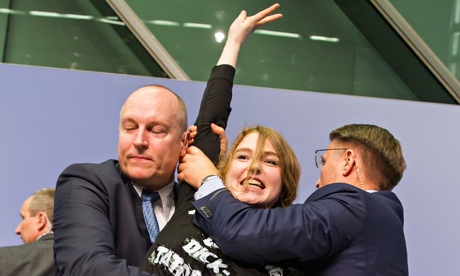
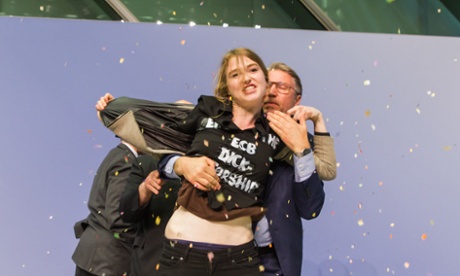
There was a vivid farcical quality to Josephine Witt’s one-woman protest at the European Central Bank press conference this week. As the bank’s president, Mario Draghi, tried to speak about the endless process of nursing the EU economy and keeping Greece within it, she suddenly leapt on to his desk, showered him with gold glitter, and threw around flyers condemning the bank’s “undemocratic” policies. As the security men grabbed her she managed to show the cameras a T-shirt which had a slogan saying “End the ECB dick-tatorship”.
The visual effectiveness of Witt’s protest owes everything to the antiseptic ambience of the ECB’s bland press conference room. The setting and space where Draghi was speaking have, in pictures, a muted smoothness that contrasts comically with Witt’s ecstatic performance. She seems to be enjoying herself. Her use of gold glitter defuses any hint of violence. It looks from the images as if, in the absence of security guards, she would have danced triumphantly in front of Draghi rather than attacking him.
But is her quirky protest likely to have any effect other than increasing scrutiny of press credentials? Witt made her harmless protest after claiming to be a reporter. They won’t fall for that one again – and you could argue that the ease with which she got into Draghi’s press conference undermines her claim that the ECB is an undemocratic dick-tatorship.
Yet her protest will make people smile and agree with her. It is no coincidence that it resembles a stunt from some vaguely radical TV sketch show. The BBC programme The Revolution Will Be Televised is evidence that a “radical” message plus cheeky confrontations with real politicians can disguise totally mediocre comedy. A well-staged protest can similarly sell any politics you like, however crude.
Protest works, and in this age of democratic communication it does not matter how few people are protesting – a single individual can get her case across with a bit of glittery performance art that can be seen across the world on the internet. Images count for more than words. Protest itself impresses and attracts us because we all have one thing in common – we hate authority.
The rise and – hopefully – fall of Nigel Farage illustrates the power of protest in these times of universal disdain for establishments and elites. Farage and Ukip won acclaim as a protest movement attacking the Westminster insiders, yet seem to be failing in the general election as they try to turn protest into power. One reason for their recent fall in polls is surely the well-staged protests against them. Protesters who barricaded Farage into a pub, prevented him speaking, or turned up at the Ukip conference dressed as a Nazi chorus line may have been accused of bullying, but they seem to have been remarkably effective in helping to brand Ukip as an ugly, extremist party.
That would never have been the case 30 years ago. Students protested against the Thatcher government, as did trade unionists, but it was easy for the ascendent right in those days to brand demonstrators as “enemies within”. There was a fear of social anarchy. Today, the public mood has changed. We’re all armchair anarchists. We instinctively admire acts of protest – even if we’d never contemplate committing them ourselves. Farage did lose out by being protested against, and Josephine Witt has made her voice heard.
There’s a deep and universal sympathy for protest in our culture now. It is seen as creative and alive. To protest is to be young. To jump on the table of power is the only channel permitted to the generation betrayed by the financial crisis. And that same mood accompanies the UK general election, where the only party with a surge is the one channelling the anger of the young – the SNP has harnessed the spirit of revolt.
“Protest and survive”, as the Marxist historian EP Thompson urged – or protest and be alive, for acts like Witt’s are a basic affirmation of liberty and engagement. Nowadays it is not the lone protesters who seem out of touch, but the business as usual functionaries who can’t seem to grasp how widely the order of things is loathed.