The Arizona State Legislature approved seven ballot measures for the Nov. 2026 ballot before adjourning in the early morning hours on June 13, 2026.
To place a measure on the statewide ballot, both chambers of the state legislature must approve the bill by a simple majority vote. The bill does not need to be signed by the governor to certify a measure for the ballot.
Constitutional amendments
Four of the measures are constitutional amendments:
- Prohibit Race- or Ethnicity-Based Preferential Treatment, Public Education Offices, and Disciplinary Policies Amendment – The amendment would prohibit government agencies, including public education systems, from requiring an applicant, student, or employee to endorse "promoting preferential treatment toward or discrimination against an individual or group on the basis of race or ethnicity." It specifically prohibits requiring support of a theory or practice of race-based diversity, equity, and inclusion. The amendment would also prohibit the use of state funds for training or offices that aim to promote preferential treatment toward or discrimination against an individual or group due to their race or ethnicity.
-
Voter Identification and Citizenship Voting Requirements Amendment
– The amendment would make a number of changes to election laws in the state, including:
- specify that only citizens may vote in any election in Arizona;
- prohibit a foreign national from making contributions in an effort to influence an Arizona election, and prohibit others from knowingly accepting such contributions;
- require voters to provide government-issued identification to cast a ballot; and
- grant voters the right to have their vote tabulated at their voting location.
-
Prohibit School District Payroll Deductions for Labor Organization Dues and Collective Bargaining Agreements Amendment
– The amendment would prohibit school districts and their employees from:
- using public resources and money to support a labor organization and its operations;
- deducting payment from an employee's paycheck to be used for membership dues for a labor organization;
- providing access to the school's communication systems to distribute labor organization materials;
- distributing communications on behalf of a labor organization if it consumes public resources; and
- using public resources and money to perform labor organization activities during working hours.
- Prohibit State Confiscation of Military Family Empowerment Scholarship Account Funds and Void Conflicting Laws Amendment – The amendment would prohibit the state from confiscating money from the scholarship account of a student in a military family if the scholarship account is maintained by a program for which military family students are eligible, and the account can be used to pay for postsecondary education. Additionally, it would provide that any law enacted or measure approved by voters on or after November 1, 2026, that violates this prohibition would be entirely void and could not be severed by a court. This would include each of the citizen initiatives proposed for the 2026 ballot that would amend the state's Empowerment Scholarship Account program.
State statutes
Three of the measures are state statutes:
- Require Schools and Athletic Associations to Restrict Use of Restrooms, Locker Rooms, and Other Private Spaces Based on Sex Measure – The measure would prohibit schools and athletic associations from authorizing a student, athlete, employee, or other individual from using a restroom, locker room, shower room, or other private space that is not designated for their sex, as recorded on their original birth certificate. It would also remove a provision allowing any student, including females, to participate in any interscholastic or intramural athletic team or sport designated for males.
- Prohibit New Photo Traffic Enforcement Systems Measure – The measure would prohibit the government from installing and using new photo enforcement systems to identify people who violate certain traffic ordinances, including traffic signs, markings, signals, and speed restrictions. It would require local governments to receive voter approval to continue using existing photo enforcement systems.
- Arizona Require Certain School Districts to Spend 60% of Operational Spending on Direct Instruction Measure – The measure would require large school districts—those with more than 7,500 students or located in counties with populations greater than 500,000—to spend at least 60% of their budgets on direct instructional expenses. The auditor general would be responsible for defining direct instructional expenses .
Other measures on the 2026 ballot
The seven measures approved by the state legislature in June bring the total to ten measures on the Arizona ballot in November. The state legislature certified three ballot measures, one constitutional amendment and two state statutes, in the 2025 legislative session:
- Prohibit Taxes or Fees on Miles Traveled in Motor Vehicle Amendment
- Limit Local Tax Rate on Groceries to 2% of Base Price and Require Voter Approval to Increase Tax Rate Measure
- Designate Drug Cartels as Terrorist Organizations and Require State DHS to Address Threats Measure
Citizen initiated measures slated for the 2026 ballot
In Arizona, citizens can initiate state statutes and constitutional amendments. Three state statutes and two constitutional amendments have been filed with the Arizona secretary of state and are gathering signatures to be placed on the 2026 ballot.
To place a measure on the ballot, signatures for the initiative must be submitted by July 3. In Arizona, the number of required signatures is based on the number of votes cast for governor in the most recent gubernatorial election. To place a state statute on the ballot, supporters must submit a number of signatures equal to 10% of the votes cast for governor. For 2026, that amounts to 255,949 valid signatures. To place a constitutional amendment on the ballot, supporters must submit a number of signatures equal to 15% of the votes cast for governor. For 2026, that amounts to 383,923 valid signatures.
Sponsors of three of the filed initiatives are actively gathering signatures to place the measures on the ballot. Two of the initiatives concern Arizona's school choice policy. Both measures are proposed state statutes that would amend the state's Empowerment Scholarship Account (ESA) program. The ESA program provides scholarships that students can use to purchase educational services and curriculum for private schooling and homeschooling.
One initiative would require the Arizona Department of Education to establish an online payment marketplace system through which all Empowerment Scholarship Account (ESA) purchases must be made. It would also require students who are not enrolled full-time at a qualified school to take an approved examination.
The second initiative would limit eligibility for the program to families earning less than $150,000 per year, beginning in the 2027-2028 school year, with the threshold adjusted by 2% annually. Under the measure, families would not be able to use ESAs to purchase luxury items, including out-of-state travel, dining, amusement park tickets, home appliances, or home improvements. The measure would prohibit paying family members from ESAs, except for students with disabilities.
The other initiative would create a constitutional right to early voting and voting by mail without requiring a reason or excuse. It would prohibit the legislature from shortening the early voting period. The amendment would allow voters to request to be placed on a list to automatically receive a mail-in ballot for every election they are voting in. Additionally, the amendment would put the state's voter ID requirement, currently in state statute, into the state constitution. The initiative would conflict with the Voter Identification and Citizenship Voting Requirements Amendment because it would implement different voter ID policies. In Arizona, if two conflicting measures are approved by voters, the one that received the most votes is ratified as law.
PDI of the ballot measures
Ballotpedia uses a Partisan Direction Index (PDI) to illustrate the level of partisan support behind each legislatively referred ballot measure. The PDI measures the difference between the percentages of Democratic and Republican legislators who voted in favor of a measure. Scores range from –100% to +100%. The table below shows how percentage ranges translate into PDI classifications. The classifications are based on dividing the full –100% to +100% scale into five equal parts.
All ten of the legislatively referred measures on the ballot in 2026 are classified as Republican. Of those ten measures, eight had unanimous Republican support and no Democratic support. Only two were supported by any Democrats. Six Democrats voted in favor of the measure to prohibit the use of photo traffic enforcement systems, and 12 Democrats voted in favor of the measure to prohibit local governments from imposing or increasing the sales tax on groceries without voter approval.
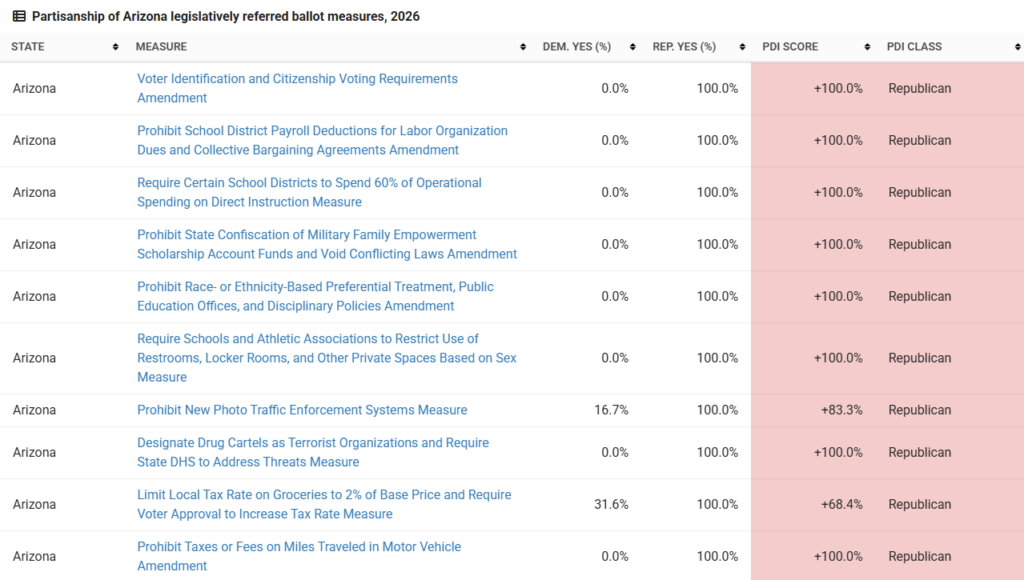
Between 2014 and 2024, 25 legislative referrals were on the Arizona ballot. In that time, the average PDI for a referral was 68.89%, classified as Republican. On average, 24.2% of Democrats and 93.11% of Republicans supported the referral.
Of the 25 legislative referrals in that ten-year period:
- Two were classified as Bipartisan;
- One was classified as Democratic;
- One was classified as Lean Democratic;
- Two were classified as Lean Republican; and
- 19 were classified as Republican.
Historical context
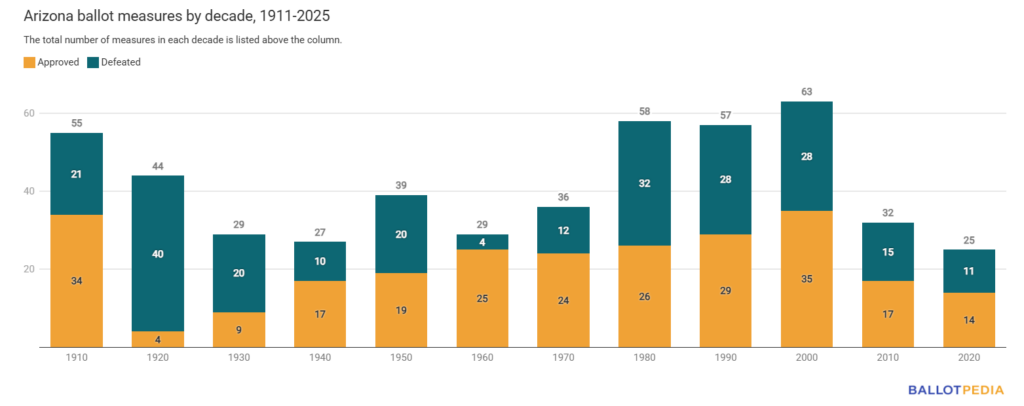
Between 1911 and 2025, Arizona voters have decided 494 ballot measures, averaging more than 4 per year. The average number of measures per decade was 41, and the average number of measures approved per decade was 21. The decade with the most ballot measures was the 2000s, with 63. The decade with the least was the 1940s, which featured 27 ballot measures.
Additional reading: