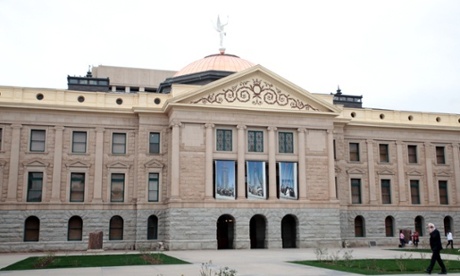
The governor of Arizona has vetoed legislation that would have required law enforcement agencies to keep the names of officers involved in shootings secret for two months.
Doug Ducey said in a lengthy veto letter that he sympathized with backers who sought to protect officers. But he said he listened most to police chiefs who told him that an arbitrary hold on releasing the names of officers would limit their ability to manage complex community-police relations.
Legislatures around the nation are taking up various pieces of police shooting legislation, including proposals requiring police to wear body cameras or mandating that shooting investigations be done by outside agencies. But Arizona was apparently the only state considering new rules for releasing the names of officers, said Ezekiel Edwards, director of the Criminal Law Reform Project at the American Civil Liberties Union.
Ducey, a Republican, faced pressure to veto the measure from police chiefs, who worried they couldn’t manage community relations or stop unfounded rumors about an involved officer.
Police unions, however, supported the bill, saying the required two-month delay would give time for investigations to play out. They called it a common-sense measure to ensure officer safety.
The death of Michael Brown in Ferguson, Missouri, drew intense criticism and widespread protests. State legislatures have been looking at police transparency laws since Brown’s shooting in August 2014 by Darren Wilson, whose name was released a week later.
The Tucson police chief, Roberto Villasenor, wrote to Ducey last week in his role as president of the Arizona Association of Chiefs of Police urging the veto.
In an interview he said it would be wrong to ignore “the elephant in the room” of poor police-community relations that has been the highlight of much law enforcement news coverage in the past year.
“Enacting legislation that would hamper that trust by not allowing officers’ names to be released is not in my opinion the best way to improve or repair that level of trust,” Villasenor said.
Republican lawmakers who backed the proposal said it was designed to protect officers. “The simple fact remains that we live in a world where misinformation can put everybody in jeopardy, especially police officers,” said state Senator John Kavanagh last week. “And until we get those facts straight we need to shield those cops and their families from being assassinated by lunatics or political zealots.”
Arizona public records laws currently require the release of an officer’s name as soon as possible, unless the agency cites specific reasons for a temporary delay. In practice agencies typically have released the name within several days but can hold off indefinitely if the officer’s safety is in jeopardy.
Ducey pointed to the existing option of withholding an officer’s name when necessary as a determining factor in his decision.