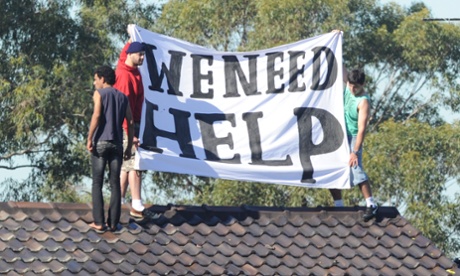
Ariak wanted to fly. Hallucinating and disorientated, he climbed on to the roof of Villawood detention centre in Sydney. But 24 hours later Ariak couldn’t even see the sky. Instead he spent the next six months of his life in one of Villawood’s isolation rooms; a place called the Annexe.
“I saw two guys on top of the roof,” Ariak says. “I thought they were going to fly. I was making aeroplanes with paper, and I wanted to join them. I went up there as well. The next thing I knew I was in the Annexe for six months.”
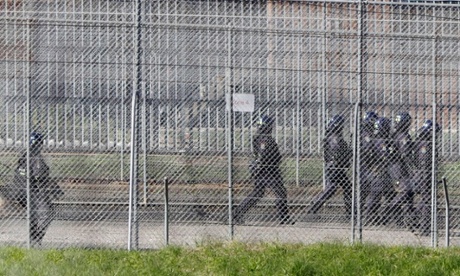
Behind the mesh fences and steel wires of Australia’s immigration detention centres there are many different ways to be held in detention.
In a prison, the place Ariak was held might be called solitary confinement. In mental health facilities it’s often described as seclusion. The phrase the immigration department uses is “restrictive detention”. The name changes but the condition is the same; placing a person in isolation away from others.
But while mental health facilities have dramatically reduced the use of seclusion and have strong safeguards in place, immigration detention facilities have not followed suit.
What emerges from Guardian Australia’s analysis of the immigration department’s own records on the use of its isolation rooms are lengthy periods of restrictive detention, approved by staff without medical training, and with patchy reporting of when and for how long the rooms have been used.
Life in the Annexe
The room is a cramped space with bare white walls. It’s the kind of room you might find in a hospital, but there are no windows. The bed is a hard surface, with a thin mattress that gives little comfort at night.
Ariak’s belongings are scattered around the room. Two small video cameras near the ceiling are a constant reminder that he is always being watched. A guard is stationed outside the room, which Ariak is unable to leave freely.
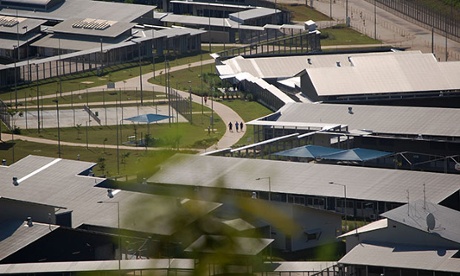
This is the Annexe. It’s a self-contained part of the Villawood centre in the high-security Blaxland compound, cut off from the rest of the facility. Within it are several tiny observation rooms, where Ariak spent six months of his life in 2011. The rooms can fit two people, although they are often used to hold an asylum seeker in solitary confinement.
“It was a very hard place, we don’t have any backyards or anything there,” says Ariak, who is from Iran. “We couldn’t see the sun during the day. The only time we could go out was the time that people could come and visit us.”
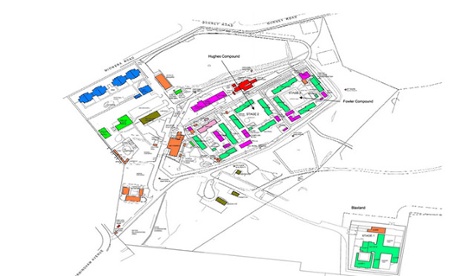
April 2011 was an uneasy month at Villawood detention centre. The facility was running at high capacity, with 392 detainees crammed into it. There had been dozens of self-harm cases in the past month and scuffles would break out daily as the detainee population continued to grow. Processing times were slow. Many detainees spent more than a year held in the centre. Events boiled over when a group of detainees rioted. Some decided to take to the roof.
Ariak was struggling. He had spent nine months on Christmas Island and was moved to Villawood in early 2011. A reserved man with dark, slicked-back hair, he slowly rolls up the sleeves of his blue checked shirt to show the scissor marks on his arm where he cut himself. After his time in the Annexe he was released into community detention and now lives in a small Lakemba apartment. He asked that his full name not be used to protect his identity and his family in Iran.
“I came to this country to get a life and be free but in that place that I was in it was taking my life and my time,” he says. “The reason I came here was to stay alive for my son and for my family but it was the opposite way because the place that I was in was taking my life and myself away.”
He falters and his face begins to twitch. Ariak also has epilepsy, a condition that made his time in detention all the more difficult.
“Seclusion involves keeping somebody in a cell-like room, with constant video surveillance for many days and even weeks at a time with very limited access to the outside world, so it might be half an hour a day of time outside the room,” says Jon Jureidini, a professor of psychiatry at the University of Adelaide who became familiar with seclusion practices in detention centres at Baxter detention facility and gave evidence at the Australian Human Rights Commission inquiry into children in detention.
“Often they would be deprived of reading material and light in quite austere conditions.”
But the technique is used sparingly and is widely regarded as an ineffective and dangerous way to hold people in restrictive environments. Excessive use can often increase the mental risks posed to detainees.
The United Nations special rapporteur on torture, Juan Mendez, has said of seclusion: “There can be no therapeutic justification for the use of solitary confinement and prolonged restraint of persons with disabilities in psychiatric institutions.”
In an environment like immigration detention, where many asylum seekers have experienced trauma, the risks are high of developing mental illness. The immigration department’s own statistics show that about 15% of detainees at Villawood have a mental health condition or have been prescribed psychotropic medication.
Ariak was one of these detainees. One former detention official, familiar with his case, says Ariak was a difficult client: “He would wander around the centre naked, he didn’t know what was happening. Something needed to be done, but placing him in that room for so long was just crazy.”
What remains unclear is just why Ariak was placed for so long in such a restrictive form of detention.
Who needs to know about solitary confinement?
For the first 24 hours the immigration department doesn’t need to know if someone has been put in the Annexe. The private contractor, Serco, which runs Australia’s mainland detention centres, only needs to inform the department of the use of an observation room if it’s longer than a day. Jureidini says this falls far below the standards set in mental health facilities.
“The time should be closer to five minutes because seclusion should be an exceptional activity,” he says. “The act of putting somebody into that environment is something that the system should be anxious about, anxious enough to want to be reporting every time it happens from the first minute it happens and having review mechanisms in place.”
This gives Serco staff, who aren’t required to have any medical training or experience, a high level of discretion to use rooms that can have a serious impact on detainees’ mental health.
The process for when the seclusion exceeds 24 hours is slightly different. Serco’s management support unit policy says detainees can’t be taken out of the regular detention compound for more than 24 hours, but a “further order” can be made by the immigration department’s regional manager.
But regional managers are not required to have medical training. These decisions are made by immigration and Serco staff, not health practitioners.
Professor Louise Newman, director of the Centre for Developmental Psychiatry and Psychology, says the process is of serious concern. Newman was previously the chair of the Detention Health Advisory Group, an oversight body made up of health professionals which advised the federal government on health in immigration detention until it was disbanded by Scott Morrison in December 2013.
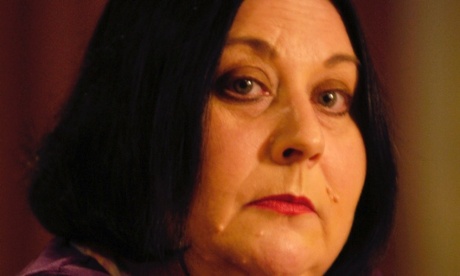
“They don’t have any medical qualifications; you’re talking about bureaucrats making decisions about restrictive seclusion of people, which is very different,” she says. “It’s a political process, it’s not a process of a health professional being asked if it’s in the persons best interests or safe to use those sorts of practices.”
Compared with the stringent checks on seclusion used in mental health facilities, the absence of similar protections leaves detainees vulnerable and without recourse.
But who in the immigration department approved Ariak’s lengthy stay in the Annexe? And were they monitoring his progress? The minister’s office did not respond to questions about his detention.
The data the department receives on seclusion from Serco is sporadic. If the use of a room in the Annexe exceeds 24 hours then it needs to be reported in writing to the department.
But the reports from 2009 to the present day make no reference to a period of seclusion for more than seven days. Where are Ariak’s incident reports? What these records show is that there are no clear guidelines for when a detainee has to be entered into the system, and whether the department is even aware of the continued presence of a detainee in the Annexe. Staff working at the detention centre in 2011 have confirmed that Ariak was held there for six months.
The department did not even follow the terms set out in its policy documents. While its policy is to tell detainees in writing why they were placed in seclusion, the department says this has not been put into practice.
“The business area has confirmed that it is not the department’s practice to provide such notices,” the department’s freedom of information officer wrote. “Although I am aware this had been viewed as a possible policy position, namely that such notices be provided to detainees, this policy has not been endorsed and implemented across the detention network.”
The department has been repeatedly criticised for the way it keeps records and its relationship with Serco and other providers. In the 2012-13 Australian National Audit Office report of the department, the auditor general delivered this assessment of its systems:
“DIAC [the Department of Immigration and Citizenship, as it was then] has not established a strategy for communicating and sharing information between DIAC staff at national and local levels and with key service providers. Inconsistent practices and decisions across the detention network have been, in part, a consequence of poor communication networks and contract management.”
Seclusion rates declining in mental health facilities across Australia
While the seclusion rate in mental health facilities around Australia has been falling, detention centres have not made the same progress. Data compiled by Australian Institute of Health and Welfare from 181 hospitals in 2013 indicated that there had been an overall decrease in seclusion use of 25% to 30% over the past three years.
The approach is consistent with a UN special rapporteur on torture report that said it was “essential that an absolute ban” on all coercive measures in detention, including restraint and solitary confinement of people with psychological disabilities, should apply “in all places of deprivation of liberty”.
But the vision for seclusion reduction outlined by the health and welfare institute for mental health facilities does not appear to exist in the immigration detention network. What the department’s records show is that the number of detainees being kept for more than 24 hours in confinement is high. In Villawood alone from May 2010 to February 2014 there were more than 700 recorded uses of the observation rooms for more than 24 hours.
“The questions that need to be asked are, if there are different practices within the immigration department, why is that the case, and why are they not benchmarked against what would be current contemporary psychiatric practice,” says Newman.
She adds: “In general psychological practice and in psychiatric facilities, seclusion is only used as a matter of last resort. There are very strict regulations around the use of seclusion and seclusion is not used long-term.”
In 2011 the Human Rights Commission also criticised the use of the Annexe and the absence of clear policy guidelines about it. “It is troubling that there is no clear written policy governing the placement of people in Blaxland annexe, given the additional restrictions placed on a person’s liberty,” a report said.
In its response to the report, the department made no clear commitment to reducing seclusion. It justified the use of the observation rooms, saying: “As a general rule, unless the degree of risk necessitates accommodating an individual in a highly safe and secure environment, every effort is made to accommodate the person in their regular living environment.”
Guardian Australia also asked the immigration minister’s office whether it could provide specific goals or targets aimed at reducing the use of seclusion, but it did not respond.
The Detention Health Advisory Group consistently flagged problems with the use of restrictive detention before it was axed.
Serco’s chief operating officer for immigration services, Tony Hassall, was asked about the use of restrictive detention on Christmas Island at a meeting of the group in February 2012. According to the minutes, he said: “The process for placing a person in restrictive detention has a number of checks and balances involving the initial referral, followed by an operational and health assessment and then a decision by the regional manager regarding the placement.”
The minutes also list an action item in relation to Christmas Island: “Staff appeared not to have a consistent understanding of the intent and length of restrictive detention nor of the processes involved in restrictive detention, including their roles in the decision-making process for the transfer of clients into restrictive detention.”
Reducing seclusion in detention
There have been numerous calls over the years to explain why the department and Serco have not brought their policies more closely into line with practices in mental health facilities.
A submission by the Uniting Church in 2010 outlines the need for a more aligned response to seclusion use in detention centres: “In state and territory jurisdictions such facilities are legislated under mental health acts and such acts have strict guidelines for people being held in seclusion.
“People held in such areas are regularly reviewed by independent advisers and include such people as the chief psychiatrist or equivalent in the reviewing and oversight process,” the submission says. “Nothing less than that is appropriate for equivalent facilities in immigration detention centres.”
And Newman suggests there also needs to be far more data made available on the use of seclusion: “We need to have public scrutiny of data related to the prevalence of seclusion practices, the duration of seclusion, the reviews of people who are in those environments.”
She adds: “Whether there’s been adequate consultation with mental health teams and mental health staff and who actually makes the decisions about restrictive practices, whether that’s health or security or the providers of detention such as Serco or whether that might even be immigration officials.”
But despite these repeated calls, it is difficult to see what action has been taken. Guardian Australia asked the immigration minister’s office whether it could provide some evidence to indicate that the policies, procedures and oversight of seclusion use had been advanced since Ariak was held in detention in 2011.
Once again, it chose not to respond to the question.
The Annexe will always be with Ariak. On the wall of his Lakemba unit there is a picture of a Sydney beach and a map of the city’s train routes. It’s a map that he rarely uses.
“I go out maybe once a month, I think that everyone is going to hurt me,” he says. “I don’t like to go out because I feel like people are going to hurt me. I don’t like to leave the house because I think this is where I am going to be safe.”
Ariak doesn’t have many friends. He prefers to spend most of his time in the cramped apartment. The brown couch has a distinctly worn shape.
He walks to the kitchen and brings back two bags that hold the medication he now takes on a daily basis. There are dozens of boxes of prescription drugs; strong painkillers, epilepsy medication, mood-altering drugs. He also has puffers to treat asthma, a condition he said he did not have before his time in detention.
When Ariak was in detention all he wanted was freedom. It was all he could think about in these difficult days in the Annexe.
“I always had a dream that I could go and stand next to a tree and see the sun or see the moon. The place that we were in did not have access to the sky.”
As he spends his days now in the small, dark apartment, freedom looks very much like the Annexe.