Rarely have new year predictions been proved right so quickly. At the start of 2014, the financial gurus looked into their crystal balls and said that for the first time since the crash of 2008 they were more worried about emerging markets than the dull old west.
There was some difference of opinion about where the sell-off would start. Some said Turkey, some said Indonesia, some thought history would repeat itself with Thailand being the first domino to fall, as it was in 1997.
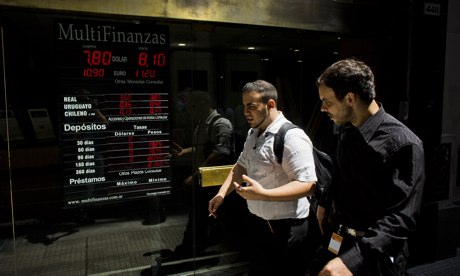
Few picked on Argentina, perhaps because the second-biggest economy in South America has appeared to be highly vulnerable for some time. Yet attention is now focused on Buenos Aires after the steepest fall in the peso since the crisis of 2002.
That was the cue for a rapid search for safe havens, such as the dollar, as investors decided to dump all the other emerging market currencies. A mood that was already jittery as a result of concern about the impact of the gradual withdrawal of tapering by the Federal Reserve turned nasty very quickly.
The trigger for the run on the peso was the decision by Argentina's central bank to stop intervening in the markets to defend the currency. The policy was proving extremely costly, draining Argentina of its foreign currency reserves.
With high inflation already a problem, Cristina Fernández de Kirchner's government has been trying to prevent a fall in the value of the peso from pushing up the cost of living by raising the cost of imports. The government even imposed restrictions on online shopping this week in response to capital flight and a ballooning balance of payments problem.
That policy is now in tatters. Just like the Bank of England in September 1992, Argentina has decided enough is enough and stopped intervening before the central bank is cleaned out completely.
So what happens now? In Argentina, there is the prospect of capital flight, a sharp fall in the peso and higher inflation. In emerging markets more generally there is the prospect of contagion. Brazil, as Argentina's neighbour and a country already identified as one of the fragile five emerging markets (India, Indonesia, Turkey and South Africa are the others), looks most vulnerable.
For the global economy, Argentina can be read one of two ways. Either it is a sign that the financial crisis of 2008 has a sting in the tail. Or it is the start of a new one.