Happy couples, whether straight or gay, strolling down the aisle or off into the sunset, do not want for cheerleaders on our cinema screens. So anyone weary of film-makers drumming home the message that two is the magic – in fact the only – number will be forgiven for looking forward to Trainwreck, a new comedy about a young woman seemingly content in her life of promiscuity.
It is written by its star, the vivacious standup comic Amy Schumer, who has also given the lead character her name. Amy’s father has inculcated in her from an early age the belief that monogamy is unrealistic. Now she’s in her twenties, her apartment would be best served by a revolving door to allow for all the male traffic to and from her bed. The movie is directed by Judd Apatow, who made Knocked Up (in which a shambolic stoner and an up-and-coming TV presenter have a child after a one-night stand) and also produced that emblem of defiant single living, Bridesmaids, which argued that romance could be a minor element in a woman’s life, far below friendship and sexual satisfaction.
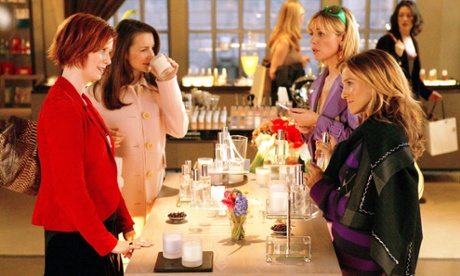
Most significantly, Apatow shepherded to the screen Lena Dunham’s HBO series Girls, which has exerted a cultural influence out of all proportion to its viewing figures. Like a kind of Sex and the City: The Next Generation, Girls has combined wit and honesty with a non-judgmental approach to promiscuity. Its characters are not punished for their choices or needs. There is a sense that they are living freely on screen without fear of any censorious editorialising hand. Despite the pioneering advances of Sex and the City, it looked increasingly as if Samantha (Kim Cattrall), the most ravenous and uninhibited of that programme’s central quartet, was paying an extravagantly high price for her freedom, first with a settling-down storyline, and then when she was hit with cancer.
For all the candour and explicitness with which it depicts and discusses sex, Trainwreck falls a long way short of being Girls: the Movie. Once Amy falls in love with a good-egg sports doctor (Bill Hader), the film throws in its lot decisively with a view of society that would not be out of place in a church sermon or Conservative manifesto. The only way for Amy to find happiness is to forgo her indiscriminate, hedonistic lifestyle and prove herself worthy of the love of this upstanding man. That’s an awful lot to ask of her when all that is demanded of him is that he make peace with her abundant sexual history.
It’s disappointing that something released in 2015 can seem so out of touch with the modern world, where desires can be catered for with the touch of a button or the swipe of a smartphone app. Kevin Smith’s 1994 debut Clerks may be no pinnacle of cinema, but in its sexual politics it feels far more sophisticated than Trainwreck. One highlight is a scene in which the shop clerk of the title, Dante, agonises over a casual confession by his girlfriend that she has performed oral sex on “something like 36” men in her lifetime. The joke is entirely on Dante for his prissiness (“Try not to suck any dick on the way to the parking lot!” he says in a huff). Trainwreck, on the other hand, suggests that any shame should attach itself to Amy alone.
Cinema has never looked kindly on the woman who is led by her desires. For any female character who fails the commitment test, a fate worse than loneliness awaits. The femme fatale, an archetype of film noir, is the most extreme example – think of Rita Hayworth in Gilda, cuckolding her husband with a former lover, and then humiliating him in turn with a taunting performance of Put the Blame on Mame as a crowd of lecherous men compete to separate her from the slinky black number she’s wearing.
Such disapproval is not restricted to romcoms or noirs. Horror is traditionally one of cinema’s most prurient areas, but it is also extreme in the punishments it doles out to the sexually available. In her groundbreaking 1992 book Men, Women and Chainsaws: Gender in the Modern Horror Film, Carol J Clover proposed the theory of the “final girl” – the surviving female character, such as Laurie (Jamie Lee Curtis) in Halloween, whose sexual inexperience preserves her uniquely from the killer’s attentions. Those reckless enough to have lost their virginity are not so lucky. This was one reason why It Follows, a recent horror film about a sexually transmitted curse, felt so innovative. As if in some warped game of tag, the carrier can only offload the curse by passing it on through intercourse. For the first time in cinema, promiscuity became a lifesaver.
The threat of death to the sexually available woman extends beyond horror. Long before Lars von Trier subjected Charlotte Gainsbourg to repeated sexual humiliation and violence in his two-part Nymphomaniac, he had directed Breaking the Waves, starring Emily Watson as a childlike young woman who undertakes demeaning sexual encounters with strangers at the behest of her hospitalised, paraplegic husband. The overtones of martyrdom and sacrifice in this religious parable sat uneasily with the images of Watson tottering around the Scottish countryside in hotpants and heels. It was a vision of degradation turned knowingly on its head when Scarlett Johansson undertook a similar odyssey, this time with a more predatory bent, as an alien prowling Glasgow luring men to their deaths in Under the Skin.
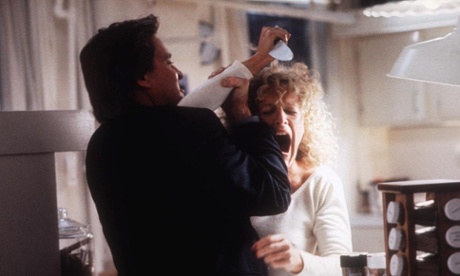
Someone always has to suffer in the cinematic view of promiscuity: on those occasions when the woman isn’t placed in jeopardy by her own libido, you can be sure a man will pay the price. For a period in the late 1980s and early 1990s, Michael Douglas was that man. In Fatal Attraction and Basic Instinct, two sensationalist thrillers that became cultural phenomena, he was placed at the mercy of a single-minded woman (Glenn Close and Sharon Stone respectively) who threatened to literally devour him. In both cases, sex driven by a woman became synonymous with violence and even murder. Whereas Sea of Love, a 1989 thriller starring Al Pacino as a cop who suspects that Ellen Barkin could be responsible for the killings of men on the singles scene, had the intelligence to subvert misogyny, those Michael Douglas vehicles couldn’t countenance the idea of a woman unable to be controlled by a man, unwilling to submit to marriage or motherhood.
That idea of desire as a force that sends women out of control is one that persists in cinema. It would be ridiculous that a wife’s admission of sexual fantasies in Eyes Wide Shut could on its own be enough to send her husband (Tom Cruise) into a tailspin, were it not for the carnivorous hunger with which Nicole Kidman plays that scene. It harks back to the moment in Strangers When We Meet, a 1960 drama about the affair between two married neighbours, played by Kirk Douglas and Kim Novak, in which Novak recalls a reckless sexual encounter she once had with a trucker. When she admits that she simply left her back door open and waited upstairs for the brute, Douglas looks utterly stricken. Perhaps, like us, he has picked up on the shocking double entendre in her words. Or maybe he is just realising that there is not much that is scarier in society than a woman who goes exactly where her desires take her.
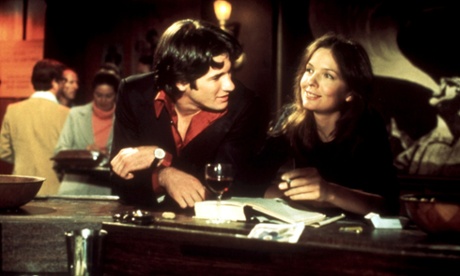
For the ultimate lesson in scaremongering, it would be hard to beat Looking For Mr Goodbar, starring Diane Keaton as a teacher of deaf children who spends her evenings cruising singles joints. Her preference is for drink, drugs and casual sex; she recoils from anyone (such as one partner played by a young Richard Gere) who attempts any deeper intimacy. It would be soft-pedalling things to say that all does not end well for her. It’s depressing anyway that the movie shaped real, tragic events into a moralising narrative designed to deter women from aspiring to freedoms that are commonplace for men. That the film opened in 1977, the same year as Woody Allen’s Annie Hall (which also starred Keaton, this time as a liberated woman comfortable with her own appetite and idiosyncrasies) only makes it feel even more alarmist.
For that brief moment, Allen and Keaton provided the sort of model for women that male viewers take so much for granted that they don’t even notice it’s there. In a world where James Bond can dispense with sexual partners with all the casualness of a man flicking through old copies of Racing Post, it doesn’t seem impertinent to wonder why a film as superficially modern as Trainwreck can’t consider other lifestyle choices for its characters.
Any decent art should be about a plurality of voices and stories, rather than a moralistic reinforcement of the status quo. Though you wouldn’t guess it from mainstream cinema, there do exist women who have sex with multiple partners and feel perfectly happy about it. Those stories should at least be heard, preferably without the accompanying wagging finger.
Trainwreck is released in the UK on 14 August
FIVE PORTRAITS OF PROMISCUITY
Shame
Portraits of promiscuity tend to be restricted to female characters, but Steve McQueen’s 2012 drama, starring Michael Fassbender as a high-flying New Yorker addicted to sex, is a notable exception. Overly sombre and self-important, it does at least attempt to explore what it would entail for a life to be defined by the joyless pursuit of emotionless sex.
Nighthawks
Gay cinema has always been more comfortable with the idea of promiscuity – like gay communities, it has had to invent its own rules. This 1978 British film about a London geography teacher who spends his nights scouring gay clubs and bars takes an unusually detailed and compassionate view of the job of looking for love that doesn’t want to be found.
In the Cut
Nicole Kidman dropped out of this erotic thriller from Jane Campion, director of The Piano, at the eleventh hour. But Meg Ryan, right, was an unexpectedly compelling replacement as the sexually adventurous woman whose voyeuristic escapades lead her to become a witness in a murder case. The sexual tension between Ryan and the shabby, smouldering Mark Ruffalo lent an extra frisson.
Crash
David Cronenberg’s controversial adaptation of JG Ballard’s novel about people who become sexually stimulated by car accidents is remembered for the furore it caused, with some critics calling for it to be banned. But it is also one of the few movies that takes an authentically sane and detached approach to promiscuity, showing its characters engaged across the boundaries of their individual relationships in the single-minded pursuit of pleasure.
Sex: The Annabel Chong Story
This documentary depicts the professional porn star Annabel Chong in her record-breaking attempt to have sex on camera with 251 men in the space of 10 hours. Linking the filming to her traumatic memories of being raped as a student, and incorporating material about her family, it strives for an analytical reading of a disturbing and complex spectacle.