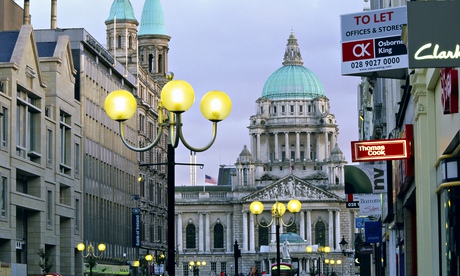
Belfast City Hall can match any of the great town halls of the Victorian and Edwardian eras. Its scale and magnificence eclipses (whisper it quietly) even the civic temples of Bradford, Leeds, Liverpool and Manchester. It was also a product of the great era of municipal enterprise. Its £369,000 construction cost – equivalent to around £40m today – was funded almost entirely from a few years’ profits made by the Belfast City Gasworks.
The Gasworks did not just pay for city hall. They also subsidised public parks, libraries and public baths. Across Britain it was a similar story. By 1870, according to Tristram Hunt’s history of the Victorian city, Building Jerusalem, “there were some 40 municipal gas undertakings”. Likewise, the Victorian water and sewerage systems were largely built and operated by municipally owned organisations. Arguably these weren’t always philanthropic, often serving the interests of local oligarchies. But is that a whole lot worse than today’s private utilities, remote, oligopolistic and funnelling their profits to institutional shareholders, mostly abroad, rather than funding local civic amenities?
Modern municipal enterprise is a patchy affair. The metropolitan confidence of the industrial era has all but evaporated, though there are relics. What was called “Luton Municipal Airport” at its opening in 1938 is still owned by the borough council today, though operated by a private consortium. Last year’s accounts showed it made a profit of £13m, as well as distributing another £13m to local charitable causes.
Hull Corporation, a municipally owned enterprise, set up the area’s first telephone system in 1902, and nearly a century later residents picked up a £1bn windfall when it floated on the stock market. A few years later it disposed of its remaining interest for around £107m.
Today we report how councils are tip-toeing back into municipal entrepreneurship. Southend and Peterborough have set up energy companies aimed at delivering what look like excellent deals for residents. What’s not to like about not-for-profit public/private partnerships keeping prices low rather than padding out the profits of the mostly foreign operators (such as RWE, Ibedrola and Electricité de France) that have snapped up UK utilities? Robin Hood Energy, owned by Nottingham city council, has gone further, creating a business where it is the administrator and supplier, with no third party involved. Meanwhile, we reported earlier this year how Sheffield city council has launched its own financial brand as a not-for-profit to fight the likes of Wonga.
Critics may argue it’s not the role of councils to engage in activities best left to the private sector, and ratepayers should not be stumping up either the capital for these ventures or being liable for any losses. There are also deep concerns about whether local authorities have the skills to run such operations. Yet they did, very successfully, 100 years ago. Tomorrow’s municipal enterprises will not be about recreating Belfast Gasworks, but could be about the opportunities presented by local waste (with power generated from incinerators) or river and tidal barrage schemes in partnership with social enterprises.
But a word of caution. There is a municipality that has benefitted enormously from its holding in what became one of the world’s greatest enterprises. Lower Saxony remains one of the largest shareholders in what until last week was the pride of the local area: Volkswagen. Unfortunately, ratepayers of places such as Wolfsburg and Hanover are rather worse off after the value of Lower Saxony’s shareholding fell by €2.5bn.
• Even if you’re dead, Virgin Media sends personalised direct mail to your address, much to the distress of one reader (see our Consumer Champions column this week). We all sympathise. One day I might crumble and actually take their service just to stop the endless tide of bumf that arrives from them almost daily.