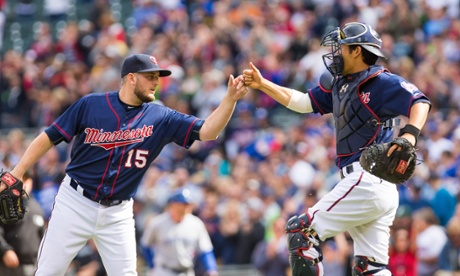
As young fans in the 1980s and 90s, baseball banter between a buddy and me included a concept we called “Twin years”. The phenomenon occurred when, seemingly out of nowhere, lowly Minnesota would suddenly shed their Twinkies moniker and do weird things, like winning the World Series. Then, not too long afterwards, Minnesota would slide back into the muck of the old American League West and Central divisions.
Of course, the biggest Twin years were in 1987 and 1991, when the franchise won its first two and only titles, beating the St Louis Cardinals and Atlanta Braves in a pair of dramatic Fall Classics. Those ball clubs had names, big ones – hall-of-famers such as Kirby Puckett, Bert Blyleven and even Steve Carlton, who pitched nine games for the Twins in 1987 but didn’t make the playoff roster (who knew?). There were all-stars like Jack Morris and Frank Viola, Joe Niekro, Kent Hrbek, Chili Davis, Chuck Knoblauch and a pair of burley bearded men closing out games inside the Homer Dome: Jeff Reardon and Rick Aguilera.
Since then there have been other successful Twins teams, but those clubs, which pumped out the likes of David Ortiz, Johan Santana, AJ Pierzynski and Torii Hunter while making the postseason six times between 2002 and 2010, were more smaller-market miracle workers than worst-to-first types.
As of right now, we are clearly back in Twin year territory, and this time Minnesota are doing it with a team made up almost entirely of no-names, a group that have helped the hometown team rocket to the top of a competitive division right out of left field. They won an astonishing 20 games last month for the first time since – you guessed it – May 1991, sending a frantic media scurrying back to read their pre-season picks to try and figure out just how they got it so wrong.
Not that anyone could possibly blame them (us), because this is a franchise that spent the past four seasons piling up losses after their once reliable supply chain of rising stars ran dry. There was little sign of a renaissance this spring and so nearly everyone is confused by these Twins, a team that has managed to eclipse the free-spending Detroit Tigers of Miguel Cabrera and David Price, and compete with a Kansas City Royals team that looks like they could boast five All-Star Game starters.
We’re talking about a group that has just two players which most fans not playing fantasy baseball would recognize immediately: Joe Mauer and Torii Hunter. A ballclub that ranks ninth in the American League in earned run average, but that has posted a win-loss mark that comes within a few ticks of the top record in the AL.
It’s a feat they’ve pulled off without their marquee free-agent signing, Ervin Santana, who flunked a drug test before throwing a single pitch for his new outfit. Two other signings, Ricky Nolasco, who joined the Twins two winters ago, and Phil Hughes, who inked a deal this offseason, both have ERAs that are downright offensive. Instead, it’s a pair of former No 1 picks, Mike Pelfrey and Kyle Gibson, who have helped keep the starting rotation from falling off a cliff. Meanwhile closer Glen Perkins, who is piling on the saves (a league-leading 19), and middle reliever Blaine Boyer are performing similar roles in the bullpen.
Even with such contributions, the overall pitching picture isn’t pretty, and yet the Twins are winning a lot of games. That’s because their offense dialed it up in May with unheralded types such as Trevor Plouffe, who sounds more like a dessert than a line drive-hitting third baseman (I’ll have the chocolate plou-ffe, please) and the anonymous Brian Dozier, who is playing like one of the best second baseman in the AL but isn’t even ranked in the top five in All-Star Game voting. At age 39, Hunter is back with the team he broke in with and has been ripping pitchers over the previous four weeks. And somehow this all has happened while franchise player Joe Mauer, earning a whopping $23m, posted a May OPS of just .618, with much of the remaining cast best described as “eh”.
Overall, the Twins bats still rank low in multiple categories, so yes, their success is baffling, and really, few know what to make of it. That suits Paul Molitor just fine – the rookie manager, who was born and bred in St Paul and finished his hall-of-fame career with the Twins, is now operating this scrambled egg of a ballclub at an elite level. Is it a new message from the third Twins manager in 29 years that’s propelling the Twins to wildly unexpected levels?
It’s just the latest skipper situation that cries out for a managerial stat to tell us exactly what kind of impact Molitor, or any manager for that matter, really has on his team. Surely there is some formula that some mad baseball sabermetric scientist can come up to provide us with just a little more insight – a WAR total consisting of in-game moves, combined with bullpen management and anonymous player surveys that paint a picture of how the skipper manages his players day-to-day. Sadly it’ll probably never happen, and so it seems that we’re all destined to remain forever blind to the true worth of a baseball manager.
What we do know is that the player once known as The Ignitor is in position to get the lion’s share of credit should the winning continue. No wonder tickets for the upcoming Paul Molitor day are the most expensive Twins seats in June.
For now, the Twins skipper will keep trying to press all the right buttons while wondering, like the rest of us, if the Twins were a one-month wonder or are the real deal, digging in for the long haul.
“If you can win 20 games in a month, you’re doing some good things,” Molitor said on Sunday. “I think we’re going to change tomorrow to May 32nd.”