The latest sport across Europe, it seems, is Premier League bashing. All that money and no teams in the Champions League quarter-finals.
David Moyes has just had a pop from across the water at his Real Sociedad base, complaining the current season of the Premier League is the worst he can remember, and Atlético Madrid’s Diego Simeone then joined in, expressing surprise that all four English teams had departed Europe early.
“English football has enormous potential with its footballers,” Simeone said. “I believe there are many great players in the Premier League and the fact there is no English team in the last eight should be a wake-up call.”
Perhaps he is right. Perhaps Moyes is right.
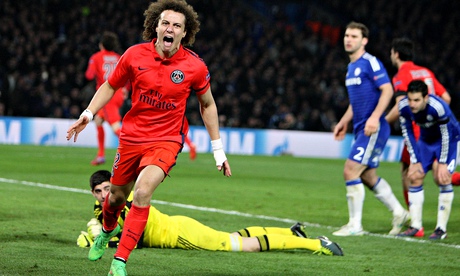
Arsenal and Chelsea should be kicking themselves after going out to Monaco and Paris Saint-Germain respectively; there is no perhaps about that. But here’s the point. Does it stand to reason that all clubs or countries represented in the last eight are doing something better than their English equivalents? Can the Champions League be regarded as an infallible barometer of footballing strength across Europe, or do some teams/countries just get a bit lucky from time to time while others suffer bad patches at inopportune moments?
Anyone who watched Bayern Munich’s scintillating demolition of Porto on Tuesday night will probably be able to guess what is coming next. Yes, the German champions were in remarkable form, particularly as they were having to play without key performers in Arjen Robben, Franck Ribéry, David Alaba and Javi Martínez. But boy were Porto terrible. Even with a 3-1 lead from the first leg they projected no self-belief whatsoever. As soon as Bayern started their high-level pressing game, they began coughing up possession in dangerous areas of their own half. Once the first goal went in, the alleged defending became so shambolic it put one in mind of Brazil’s 7-1 shocker against Germany in last year’s World Cup semi-final, another night when Thomas Müller and his pals ran riot.
Ricardo Quaresma was so lethargic in the first half – he did not come out for the second – he almost deserved credit for assists to one or two of Bayern’s goals. Casemiro was little better. There was a comical moment early in the second half when Rafinha went down near the Porto corner flag, looking for a free kick after a foul by Bruno Martins Indi. He stayed on the ground for perhaps three or four seconds, worked out that no whistle was forthcoming, so leapt to his feet and promptly helped win the ball back. Simply by applying the slightest pressure to the ball carrier, Rafinha was able to force a mistake and recover possession and position before Porto had managed to get out of their own half.
Good as Bayern were, Porto’s contribution to the evening made a mockery of the notion that the Champions League’s later stages represent the very best football has to offer. Put two teams of similar quality together and you might see why such large claims are made for the standard of football in the competition, but on the evidence of Porto’s performance in Munich it simply does not follow that all the teams in the Champions League last eight are of similarly impressive quality.
The trap to fall into here is to speculate that Chelsea, Manchester City, Arsenal or even Liverpool would have put up a better defensive show than Porto and managed to avoid such a humiliating rout. Better not to say that, though, because it sounds like sour grapes. It is certainly not safe to suggest that any of the English teams would have beaten Bayern Munich on that form, and Porto are to be congratulated for playing so well in the first leg and posting a result that would have been trumpeted from the rooftops in this country had it been achieved by a Premier League club.
Yet before Manuel Pellegrini or Brendan Rodgers is sacked, Yaya Touré or Raheem Sterling transferred, or any other English reputation sullied by the wailing and gnashing of teeth that always accompanies perceived failure in Europe, might it not be possible to at least acknowledge that luck is sometimes involved in these matters, even if it just the luck of the draw?
Porto did not come up against an English club in their run to the last eight, so direct comparison is impossible.
They found themselves in a relatively gentle group that involved Shakhtar Donetsk, Athletic Bilbao and Bate, and managed to come top, so fair play to them.
They then got lucky by drawing Basel in the round of 16, the same Basel that Liverpool really ought to have put out in the group stage. Again, Porto got past Basel and Liverpool did not, so no complaints there. But Porto’s journey to the last eight hardly compares with the difficulty City would have faced in reaching the same stage, to wit surviving a group that involved Bayern, Roma and CSKA and then overcoming Barcelona over two legs. City failed, but does that make them inferior to Porto? It is hard to see how.
Arsenal and Chelsea have less excuse for not joining Porto in the last eight. Monaco and PSG were both more daunting opponents than Basel, but ought not to have been insurmountable obstacles for the squads available to Arsène Wenger and José Mourinho.
This is not an attempt to rewrite history. English clubs all failed in Europe this season, while up to but not including their quarter-final second leg Porto could regard the campaign as a success. But they failed for different reasons. Liverpool seemed to freeze when it mattered in a manner that prefigured their performance against Aston Villa at Wembley last weekend. Manchester City had too much to do against two of the very best teams around. Arsenal and Chelsea took their eye off the ball at crucial moments. Capable of doing better, is how the Premier League headmaster would sign off his end-of-term report, though how much better is debatable.
This is clearly not a period of English dominance in Europe. As Simeone claimed, at the end of his outburst over declining English standards, the Spanish league still has the best two teams in Real Madrid and Barcelona. While the German league has at least one side seemingly capable of taking issue with that – without even mentioning Simeone’s Atlético – the Premier League at present does not.
But cheer up. We might be close to matching Porto.