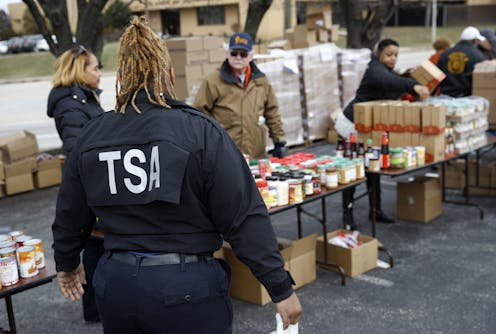
Many federal employees are being ordered by the federal government to work without pay until a spending bill is enacted.
Some workers object, arguing that they are being pressured to show up for work with no clear prospect of a payday. Some individuals have sued claiming that this violates the 13th Amendment, which abolished involuntary servitude.
Will they win?
For now, the answer is likely no. In my law review article, “Compulsory Labor in a National Emergency,” I found that legal protections against forced labor often fail to help workers.
Why most 13th Amendment lawsuits fail
Every year, a small number of workers prevail in involuntary servitude cases.
The legal standard for arguing that someone is working against their will is evidence of physical or legal coercion. The Supreme Court articulated the standard in 1988 in a case about two mentally disabled men working on a farm.
The best way to explain the standard is with an example.
In Mouloki v. Epee, a nanny named Christine Mouloki sued the husband and wife who employed her for wages and damages. She alleged that the family refused to let her leave their suburban home near Chicago.
The court concluded that a “scheme, plan, or pattern intended to convince a plaintiff (person) that serious harm or physical restraint would result if she did not continue to perform the labor and services” constitutes involuntary servitude. At trial, the nanny won her case.
But plenty of involuntary lawsuits fail. The most common are from high school students whose school districts require them to perform community service as a condition to graduate.
In one such case, students were required to provide 50 hours of community service during their four years in school. Parents sued, alleging a violation of the 13th Amendment.
The court rejected the 13th Amendment claim, stating: “Graduation from a public high school is an important opportunity, but the threat of not graduating does not rise to the level of ‘physical or legal coercion.’”
Pressure, not coercion
Federal employees working without pay fall in the gray area between the high school and nanny scenario.
So far, their situation does not present the coercion in the nanny’s home confinement case. The main impediment for the federal employees’ case is that lack of coercion, not lack of pay for their labor. In a preliminary ruling, workers lost a motion for an injunction but they are scheduled to make a similar motion soon – and as time passes, their case improves.
For now, however, these employees can call in sick, take vacation time or simply not answer the phone or emails from a supervisor. A court would likely view an order to work without being paid as unfair, or a violation of wage laws, but not coercion.

Michael H. LeRoy does not work for, consult, own shares in or receive funding from any company or organization that would benefit from this article, and has disclosed no relevant affiliations beyond their academic appointment.
This article was originally published on The Conversation. Read the original article.