Football supporters would be surprised if they turned up at Wembley to discover that the game was going to be played on a temporary five-a-side pitch raised on a platform above the turf. Lord’s ticket-holders would be equally appalled to find that an Ashes match had been moved to the grass in the middle of a roundabout outside the ground. However, such disruptions are becoming standard for theatregoers.
If you enter the Young Vic’s larger auditorium for its current adaptation of Kafka’s The Trial, you’ll find it has been transformed into a courtroom, with spectators sitting on raised banks of wooden benches, judging the inexplicable victimisation of Josef K as it takes place on a planked strip between the ranks of pseudo-jurors.
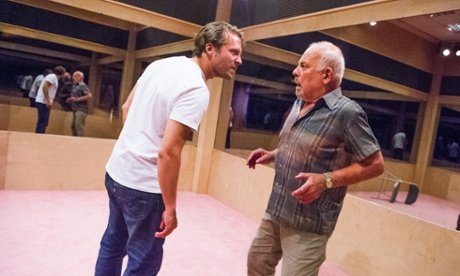
Go into the Vic’s neighbouring studio space for this summer’s sister offering – a revival of Caryl Churchill’s A Number – and you are directed to one of four small temporary viewing spaces (wooden benches again), from which you watch the actors through a two-way mirror as they perform in a glass box that multiplies their images.
As the subject of the Churchill play is cloning, this reflective set is as much a thematic redesign as the judicial timber for the Kafka play. A similar reasoning applies at the Menier Chocolate Factory where the easy listening of the sweetly enjoyable Bacharach musical What’s It All About? inspires easier seating: half of the audience are on sofas or armchairs.
In other current and recent cases, though, the unrecognisability of the venue seems to reflect not inspiration from the play but a frustration with the existing architecture of the building.
For Mike Bartlett’s Game at the Almeida in London, the auditorium was divided into a range of partitioned viewing chambers which – similar to the Young Vic’s configuration for A Number – overlooked a see-through cube where the action took place. Later, at the same theatre, spectators for Simon Stephens’ Carmen Disruption found the usual entry doors locked, and were ushered to their seats via a route taking us backstage through the dressing rooms and across the stage. Extending this inside-out approach even further, the various scenes of Who Cares, Michael Wynne’s verbatim play about the NHS at the Royal Court, were performed in back-stage offices, corridors, roof gardens and other usually unseen spaces, with viewers divided into small groups.
The same designer, Miriam Buether, transformed the Almeida for Game and the Young Vic for The Trial and, as she also put a running track around the stalls of the Hampstead Theatre for Chariots of Fire, can be seen as the pioneer of a type of design that reconstructs the building as part of constructing the set. But the fact that producers and directors are encouraging such experiments reflects a growing dissatisfaction among theatre-makers with the conventional arrangement of spectators sitting in tiered rows facing the picture-frame stage known as a proscenium arch. In all but the newest playhouses, the stage and/or auditorium often turn out to be annoyingly the wrong shape for many productions.
Andrew Lloyd Webber, despite being a lover and historian of the Victorian era and having owned several theatres, has admitted to an occasional desire to tear down buildings that are often either too small for big shows or too big for small ones and in which female theatre-goers are advised to have remarkable bladder control, late 19th-century women having apparently managed with minimal provision of lavatories.
Sharing such frustrations, the producer and Lloyd Webber’s frequent collaborator Sir Cameron Mackintosh has plans to send the bulldozers in to the 102-year-old Grade II-listed Ambassador’s theatre in London’s West End. If planning permission is given, he hopes to remove the traditional proscenium arch stage and create a new, flexible, mid-size theatre (450-475 seats), which could host transfers of productions from studio-type venues, such as the Donmar Warehouse, which struggle at the moment to find a suitable commercial home.
Sir Nicholas Hytner and Nick Starr, former artistic director and executive director of the National Theatre, will soon announce a new commercial venture. Their chosen venue is expected to be a building previously unused for performance, rather than one of the existing auditoria.
However, where Mackintosh and the two Nicks are aiming to reshape an existing space, others are thinking outside the rectangular brick box. At the Sheffield Crucible last Saturday night, for example, we were ordered out of our seats at the interval and warned that we would not be coming back for the rest of the play. Camelot: The Shining City is a modern version of the King Arthur legend – written by James Phillips and directed for the innovative Slung Low theatre company by its artistic director, Alan Lane – in which a young woman foments a revolution in a dystopian version of England.

The first act ends with a protest rally in the Crucible theatre, which is disrupted by government troops, forcing the audience into the square outside the theatre, where the second part of the drama takes place, and then, after another plot-twist, to a finale in the peace gardens in central Sheffield. With the company swelled to three figures by community volunteers, giving the riot scenes a rare, visceral realism, this revolutionary production emblemises the determination of contemporary theatre to break out of the usual spaces and take the story to the audience.
An even more extreme example of this ambition is the Home Theatre project that has just been announced by London’s Theatre Royal, Stratford East. Building on a pilot scheme two years ago, 30 addresses (which might range from hospitals to canal boats as well as houses) will be chosen to host a performance and invited to specify the type of performance they would like to see. At first glance, this project risks exacerbating a common objection to theatre: its limitation to small, self-selecting audiences. But this risk is avoided by the bespoke shows – which coincide with others around the world – being screened on the Stratford East website.
In the past, the most important questions asked by resident theatre companies were what they wanted to do and who they wanted to appear, with the matter of where it would take place already settled by the address on the letterhead. The new fluidity over location – or the shape that it should take for each show – offers artistic liberation, although theatre needs to be wary of ending up like the Church of England, with a lot of beautiful buildings standing empty while people express themselves elsewhere in different ways.