
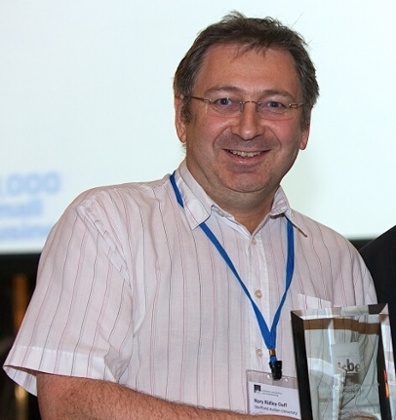
Dr Rory Ridley-Duff is a leading academic in the field of social enterprise studies, and co-authored the textbook Understanding Social Enterprise: Theory and Practice. He teaches at Sheffield Hallam University and manages the Cooperative and Social Enterprise Summer School, held this year at York St John University, to which the British Council is offering sponsored places. (See details below). We asked him about his work and the study of social enterprise in different countries.
What is the focus of your work at Sheffield Hallam University?
I focus on research and teaching on cooperatives and social enterprises, and also have management responsibility for developing Principles of Responsible Management Education (PRME). My specialist research interest is workplace democracy, particularly the management, ownership and governance systems that support a social economy.
You introduce the concept of ‘communitarian pluralism’ in your teaching. Could you explain the term and its relevance to social enterprise?
Communitarian philosophy sees individuality as a product of community life; as something that depends on collective action to facilitate and preserve. Pluralism is an outlook that there is a plurality of ways to live well, organise work, and manage people.
In the context of social enterprise, adopting a communitarian pluralist outlook leads to an emphasis on being open to learn from differences, and invites critical questioning of the impact of standardising operations and ‘normalising’ behaviour. Does standardisation create social inefficiency by inhibiting our ability to learn and adapt?
We prefer the idea of ‘best fit’ to ‘best practice’. Students explore how theories are devised to promote and protect different philosophies of organising. And we encourage a view that pluralism is desirable, that social enterprise needs to be able to adapt to each setting and context, and that constant dialogue and refinement will help it work well.
Let’s look at some examples. What do you make of the development of social enterprise in the UK?
Until the late 1990s, UK social enterprise was aligned with developments in the EU and Asia and committed to cooperative and mutual models. This aligned well with practices developing in Bangladesh, Italy and Spain, but less well with the model of Ashoka in the United States.
The consultation that led to the Community Interest Company – a legal structure allowing social enterprises to enshrine their social purpose and distribute some profits – changed the debate. After 2002, the debate was dominated by reforming philanthropy so it could support social entrepreneurs. There was a greater emphasis on market solutions driven by individuals committed to entrepreneurial action.
Employment is definitely better than unemployment. At the same time, entrepreneurship that promotes member-ownership (such as cooperatives, mutuals and employee-owned businesses) is different and preferable to the private sector model of an all-powerful entrepreneur recruiting employees.
Research makes clear that member-owned enterprises are not only more resilient and sustainable, they also promote pay and social equality more effectively.
While I favour a plurality of approaches (to meet the widest range of needs and aspirations), the marginalisation of cooperatives and mutuals in social enterprise policy concerns me, as it preserves and protects the private enterprise system by slowing down the development of a social economy.
What are the strengths of the ‘continental European’ approach focusing on social cooperatives?
The continental approach sees member-ownership and participation in governance as central – the ‘Pole Star’ for social enterprise.
EMES is a network of 200 social enterprise researchers working in 50 countries. They have found that inclusive, participative, member-controlled social enterprise models dominate where Anglo-American influence is weaker. They recognise approaches popular in Anglo-American cultures (enterprising non-profits, social businesses and public social enterprises) but find that social cooperatives create socio-economic value much more rapidly.
The logic is straightforward. Business models promoting co-ownership combined with a social purpose contribute to social value creation in two fundamental ways: through the goods and services they provide, and through enhancing the social and political skills needed in a democratic society. Other models compromise on the second type of value creation to preserve the interests of the state, voluntary, and corporate sectors.
You run the Cooperative and Social Enterprise Summer School, which draw participants from around the world. How has this informed your work?
Each year, the summer school evolves, but income inequality and sustainable development are enduring focal points. Summer school participants have contributed their ideas to books and academic papers and our deliberations have led to the creation of the FairShares Association.
This is an approach to creating solidarity enterprises that arose from one of the learning activities. By 2012, we offered a discussion paper. In 2013 we formed a network. In 2014, we held our first conference, and this year we registered the FairShares Association as a company.
Working internationally has taught me that each nation discovers that social enterprise can be pursued through associations, cooperatives, mutuals and social businesses. FairShares offers a way to integrate multi-stakeholder cooperation regardless of legal form. The individual social entrepreneur can be educated to recruit members, rather than employees.
For the next few years, developing the FairShares social enterprise framework and embedding it in responsible management education will probably be my priority. Already there are activists in Australia, the US, Croatia, Ireland and the UK who are developing projects, and my aim is to secure research funding to track their progress and support their development.
Delivered by Dr Rory Ridley-Duff and Cliff Southcombe, the managing director of Social Enterprise Europe Ltd., the Cooperative and Social Enterprise Summer School will be held from 28–30 August in York, England. The British Council is delighted to offer 15 sponsored places this year. Find more details here.
Rory Ridley-Duff is associate professor of Cooperative and Social Enterprise at Sheffield Business School, Sheffield Hallam University. He has authored three books, 35 scholarly papers and two novels. His research has been published in Human Relations, Corporate Governance: An International Review, the International Journal of Entrepreneurial Behaviour and Research, the Social Enterprise Journal and Journal of Cooperative Studies. He became a director of Social Enterprise Europe Ltd in 2012, co-founded the FairShares Association in 2013, is Chair of the PRME Working Group at Sheffield Business School, and is acting chair of the International Cooperative Business Education Consortium.
Content on this page is paid for and provided by the British Council, sponsor of the international social enterprise hub