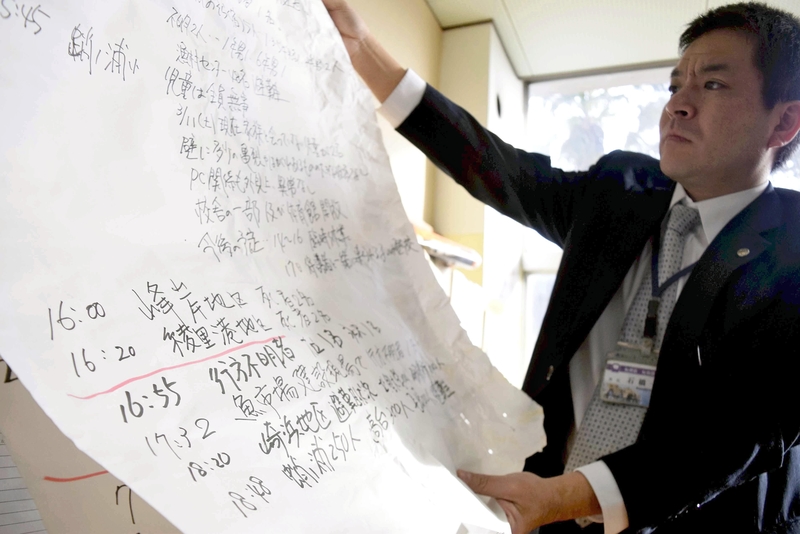
Only 11 of the local governments in the three prefectures worst hit by the Great East Japan Earthquake have established specific rules on the handling of disaster-related records, a Yomiuri Shimbun survey has found.
Some of the surveyed local governments in Iwate, Miyagi and Fukushima prefectures said they had already disposed of documents after the expiration of record retention periods under the standards set for regular public documents.
As the nation marks the ninth anniversary of the March 11, 2011, disaster, the survey results highlight the major challenge of how to preserve disaster records that can be used to examine responses at that time and draw lessons for the future.
The survey was conducted in February, covering three prefectural governments and 42 municipalities that were hit by the subsequent tsunami or were impacted by evacuation orders following the accident at Tokyo Electric Power Co. Holdings Inc.'s Fukushima No. 1 nuclear power plant.
The Public Records and Archives Management Law stipulates the retention periods for documents at central government organizations, including ministries and agencies. The length of the retention period is determined by the content of the documents.
Documents related to the Great East Japan Earthquake have been classified as "historical public documents" eligible for permanent preservation in principle because of the disaster's significant impact on society. The Cabinet Office issued an instruction to central government offices in April 2012 calling for proper preservation of such records.
However, local governments are not subject to the instruction, which means no unified standards are available for them when it comes to handling official documents related to the disaster.
Of the 45 local governments surveyed, only the cities of Ofunato and Kamaishi in Iwate Prefecture, and Shiogama and Higashi-Matsushima in Miyagi Prefecture had established special retention rules for their disaster-related records.
The Ofunato municipal government, for example, has compiled its own handling procedures, which stipulate all documents concerned be preserved even after the retention periods expire under the standards for regular public documents.
The city's rules make informal documents -- or those that are not usually regarded as official documents, such as handwritten notes by municipal government officials -- also eligible for permanent preservation.
The Kamaishi, Shiogama and Higashi-Matsushima city governments said they have also issued instructions calling for the preservation of such documents.
The Fukushima and Miyagi prefectural governments and five municipalities including Sendai have decided to treat records related to the disaster as "historical documents" eligible for permanent preservation, in line with the central government.
Thirty of the surveyed municipalities said they had established no specific rules for disaster-related records. While some of them temporarily keep such documents, the municipal government of Iwanuma, Miyagi Prefecture, for example, said it had already discarded disaster-related instructions from the central government.
"It is difficult to determine which records should be treated as documents related to the earthquake," said an official at the municipal government of Soma, Fukushima Prefecture.
The remaining four local governments -- the Iwate prefectural government and three municipalities -- said although they had issued instructions calling for preserving such documents as a tentative measure, they will consider establishing official rules in the future
The local government in Iwate Prefecture's Otsuchi -- where 39 people, including the mayor and municipal employees, were killed in the aftermath of the tsunami -- conducted interviews on 80 officials and others as part of efforts to examine the local government's response to the disaster. However, the town disposed of the interview files in 2018.
The local government has subsequently put into effect an ordinance on public records and archive management, and is now working to establish rules on how to keep such records.
Read more from The Japan News at https://japannews.yomiuri.co.jp/