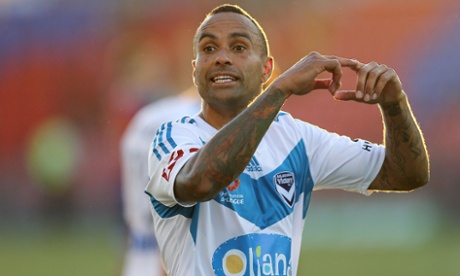
Those wide, wild Steve Irwin-esque eyes, the devil-may-care dorsal fin haircut, that infuriatingly inane grin - if ever there was an example of why footballers should be seen and not heard, it is Archibald Gerald Thompson.
There are sportsmen that are impeccably media trained, those who are able to duck and weave questions with all the skill of a politician on Q&A. Step forward Lucas Neill. Then there are those who simply bore the wits out of their audience, the flat-bat, expressionless individuals who give nothing away. Brett Emerton is one example. Mark Bridge is another.
Archie, quite assuredly, is part of neither group as he approaches his 300th domestic game in Australia. For the media class, he’s become something of a dial-a-quote, a reliable foil for journos looking to liven up their copy or create a yarn out of nothing. Responding to news that he left training early under an injury-cloud on Wednesday, Archie said he was off to watch reruns of The Bachelor. As sure as the day is long, Archie can be called upon to say something silly.
Recently, in front of the world’s media no less, he declared Neymar “overrated”. This received an embarrassingly unnecessary response - “Who?” replied the Brazilian - to which everyone shrugged their shoulders, except for the Australians, who couldn’t decide whether to laugh or cry.
Indeed there are times when Archie barely requires prompting, like when he volunteered his opposition to vaccination on Twitter. The American comic Dave Chappelle has a memorable gag about celebrities and politics. “Who gives a fuck what Ja Rule think at a time like this?” asks Chappelle. “I want some answers that Ja Rule might not have right now.” This, in theory at least, should apply for footballers. Want to know the pros and cons of vaccinating your children? There are, of course, a million people you would ask before approaching Archie Thompson. But, Twitter being what it is, Archie duly received his fair share of abuse and derision.
Herein lies the genius of Archie. His is a rare ability not only to grin happily in the face of a crowd laughing at and not with him, but also to make us ponder why the subject ever needed his input in the first place.
And yet you can’t help but instinctively like the man. Beneath the shameless swagger is a lovable larrikin untouched by false modesty, deference, or decorum. He’s a proper mongrel Australian from a different time and place thrust into a soulless modern era. A bloke who often says the wrong thing, but in exactly the right way.
In the long line of turgid, wordy and boring sports biographies, Archie’s – titled What Doesn’t Kill You Makes You Stronger – is positively Latham-esque in it’s honesty. Of the legendary ex-Socceroos boss, Frank Arok, he says “he coaches better than he drives”. About another Socceroos coach Frank Farina? “He had his favourites.” On that match against American Samoa? “My grandma probably could have bagged a hat-trick that day.”
Archie’s commendable lack of filter transfers splendidly to the page. He confesses to being convinced by his team-mates that he couldn’t fly interstate without a passport. “I must have been a naive sort of kid” is his offer as an explanation. About one of his junior coaches, he has this to say: “Despite being a great fella ... he was not always politically correct. He would call me Midnight because of my skin colour. There was another kid in the team who was a bit lighter than me who he called 11 o’clock.”
Yet there is no hint of objection, nor a lament of the inventive but obviously offensive language. Archie is, after all, that affable country kid brought up by the tough-as-nails mum who taught him to cop it on the chin; an ordinary guy who but for the grace of God, that casually racist coach and Morwell Falcons, would probably still be washing dishes at a Chinese restaurant and playing local football in Bathurst.
“I had grown up in Lithgow and played some football there,” wrote Archie, “but there was no kindness shown when our side went back to play against those rugged mountain men.” As someone who has been two-footed by the jug-eared coalminers of Wallerawang United or Lithgow Workies, let me tell you, it feels a long way from civilisation, let alone a professional contract. Archie was 17 when he made the choice to get out. “There was Harry [Kewell],” he wrote in his biography, “He was in the United Kingdom, starring for Leeds United… I was up to my elbows in suds and grease.”
His Great Leap Forward to the Morwell Falcons came via a slight detour at the abattoir in Blayney. They say it’s a long way to the top, and at this point in the arc of Archie’s story it’s less rags to riches and more rags to hand me downs. In the regional outpost of Morwell – one of the NSL’s more zany experiments and described eloquently by Archie as “not a world centre of football excellence” – he drank a lot of booze, put a litre of peroxide through his hair, met the love of his life and transformed into the fearsome striker we know today.
He was, like many a NSL player before and after him, a product of the rich diversity that surrounded him. His most important junior coach was Italian, his adopted family in Morwell were Greek and his formative senior coaches were Arok and Eddie Krncevic. Buddy Farah, an Australian born Lebanese international, was his best man at his wedding, and it was was an Argentinian, Claudio Canosa, who told him to develop a trademark celebration.
And so inspired the first of two potentially great trivia questions: from whom did Tim Cahill borrow his boxing kangaroo goal celebration; and who has scored the most goals in an international match? The answer to both, naturally, is Archie Thompson. Before Cahill was jabbing and weaving his way to international fame and fortune, Archie was kung-fu fighting corner flags in front of cow paddocks in rural Victoria.
Archie never truly made it big overseas, spending a brief period with Lierse in Belgium and an even briefer period with PSV Eindhoven in the Netherlands. Apparently he once lost his place at Lierse, believe it or not, for giggling at Martin Lawrence jokes on the TV in the dressing room.
But the boy from country NSW has become an honorary citizen of Melbourne. Returning home to a newly-formed A-League with Melbourne Victory in 2005, Archie immediately became a club hero after scoring in their first ever match against Sydney FC. If he does pass the latest fitness scare, this weekend Archie will make his 300th national league appearance against Sydney FC, a club that he has waged many great battles against.
“We knew he was a good dude that enjoyed life and would be fantastic to have around the club,” said the man who brought him to Victory, Gary Cole. “He obviously became, like Kevin Muscat, a part of the fabric, culture and brand of Melbourne Victory.” Of course the Victory are slowly outgrowing Archie, but his has been a crucial role for the club and the fledgling league. He’s the cheeky upstart who is equally comfortable as a pantomime villain as he is a club hero.
Archie’s gradual fade into retirement will be a great loss. There are precious few genuine characters in Australian football, and Archie is one of them. But unlike Ljubo Milicevic, for example, to the fan there appears no great sadness to Archie, no man behind the mask, no demons behind the court jester act. There is, instead, a simple man in his NWA t-shirt, a man who is quite good at football, a man who is rightly happy with the way his life turned out. As the Socceroos defender Trent Sainsbury once said in a tweet about Archie: “You can’t vaccinate awesomeness!”